Children increasingly move between physical toys, stories, videos, and digital games as part of everyday play. Toca Boca World fits into that environment in a distinctive way. Instead of asking children to defeat opponents, complete difficult missions, or chase a high score, it gives them a collection of places, characters, objects, and situations to explore.
That difference is important. A child can create a family at home, run a shop, visit a hospital, prepare food, change characters’ outfits, or invent a completely imaginary story. There is no single solution that determines whether the story is “correct.”
For parents, however, the important questions go beyond whether the game is entertaining. Is it suitable for children? What can kids actually do inside it? How does the open-ended format work? What should parents know about purchases, screen time, and privacy?
This guide takes a practical look at Toca Boca World, including its gameplay, creative value, family considerations, customization, and the things parents should check before allowing children to play.
What Is Toca Boca World?
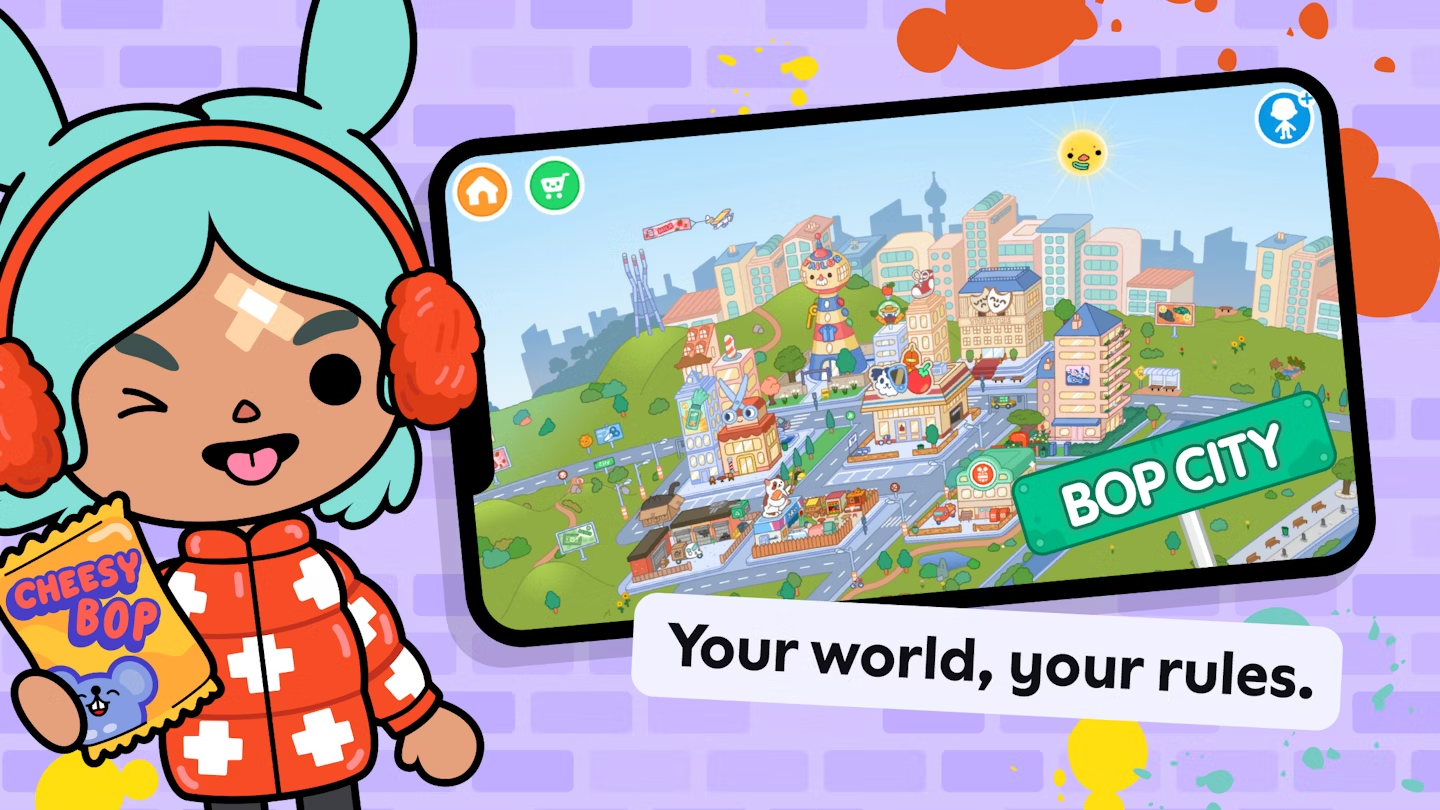
Toca Boca World is an open-ended digital play environment from Toca Boca. Rather than functioning like a conventional level-based game, it combines different locations and characters into a single interactive world.
Children can move characters around, interact with objects, change clothing, prepare food, decorate spaces, and create their own stories.
The basic philosophy is simple:
There is no requirement to win. The child decides what happens next.
That makes it different from many conventional mobile games where progression depends on completing challenges or collecting points.
The experience is closer to a digital dollhouse or interactive storytelling environment than a traditional adventure game.
How Toca Boca World Gameplay Works
Getting started is relatively straightforward. Players select or create characters and then explore the available locations.
Objects throughout the environment can usually be moved, opened, combined, or otherwise interacted with.
For example, a child might:
- Prepare a meal in a virtual kitchen
- Dress a character in different outfits
- Create a family
- Decorate a room
- Visit different locations
- Invent a school-day story
- Organize a party
- Create imaginary jobs and characters
- Move characters between locations
- Use everyday objects in unexpected ways
There isn’t necessarily a prescribed sequence.
That freedom is one of the game’s defining features.
Why Open-Ended Play Matters
Traditional games often reward children for reaching a predetermined objective. Open-ended play works differently.
Instead of:
“Complete this task to progress,”
the experience becomes:
“What would you like to do?”
That change gives children more control over the activity.
A child might spend ten minutes arranging a bedroom without creating a traditional “game objective.” Another child might develop an elaborate story involving several characters and locations.
Both approaches are valid.
Creativity Becomes the Main Mechanic
The objects and environments effectively become storytelling tools.
A restaurant isn’t just a restaurant. It can become a meeting place for fictional characters. A school can become the setting for an adventure. A home can turn into a hotel, hospital, spaceship, or anything else the child imagines.
This is where the game’s strongest feature becomes apparent: the player supplies much of the content through imagination.
Exploring Locations
The world includes different environments designed around familiar aspects of everyday life.
Depending on the available content, children can encounter places such as:
- Homes
- Shops
- Schools
- Restaurants
- Parks
- Medical environments
- Workplaces
- Community spaces
The value of these locations isn’t simply their appearance. They provide context for storytelling.
A child can move a character from one location to another and build a connected narrative rather than playing each area as an isolated level.
Small Details Encourage Experimentation
Interactive objects are particularly important.
Opening a cupboard, moving an item, changing an outfit, or placing food somewhere may seem insignificant to an adult. For a child, these actions can become part of a much larger story.
That encourages experimentation.
Children can ask:
“What happens if I put this here?”
Because there usually isn’t a conventional failure state, experimentation feels low-risk.
Character Creation and Customization
Characters are another major part of the experience.
Children can create different personalities and appearances, allowing them to build families, friends, workers, students, or entirely fictional characters.
Customization can include elements such as:
- Clothing
- Hairstyles
- Accessories
- Appearance
- Character roles
- Different combinations of visual features
This makes the world more personal.
Instead of simply controlling a predetermined protagonist, children can create characters that fit the stories they want to tell.
Toca Boca World and Storytelling
Storytelling may be the most interesting part of the experience from a developmental perspective.
Consider a simple example.
A child creates a family, gives each character a role, prepares breakfast, sends one character to school, takes another to work, and then invents a problem that everyone must solve.
There is no scripted mission requiring this sequence.
The child creates it.
That process can involve:
- Sequencing events
- Assigning roles
- Creating dialogue
- Solving imaginary problems
- Understanding relationships
- Expressing emotions
- Remembering previous events
Parents may even find that children continue these stories away from the screen by drawing characters or acting them out with physical toys.
Can Toca Boca World Be Educational?
It is important not to overstate the educational benefits of an entertainment product. Toca Boca World is primarily a creative play experience, not a replacement for structured education.
However, open-ended play can naturally exercise several useful abilities.
Language and Communication
Children who narrate their stories aloud practice describing situations, characters, actions, and emotions.
For younger children, parents can participate by asking questions such as:
- “Who is that character?”
- “Where are they going?”
- “What happened?”
- “Why is the character upset?”
- “What happens next?”
A simple gaming session can therefore become a conversation.
Problem-Solving
Because children control the environment, they frequently have to figure out how to achieve the scenario they imagined.
If they want to create a restaurant, for example, they may need to decide where characters sit, what food they receive, and who works there.
The problem is imaginary, but the process of solving it is real.
Social and Emotional Exploration
Children can also use pretend play to explore everyday situations.
A story might involve:
- A new child joining a school
- Friends having an argument
- A family preparing for an event
- Someone feeling nervous
- Characters helping one another
These scenarios can give parents opportunities to discuss emotions and social situations without turning play into a formal lesson.
Is Toca Boca World Safe for Kids?
This is where parents should be careful about making broad assumptions.
A child-friendly design does not mean parents should ignore device settings, purchases, privacy controls, or screen-time habits.
The safest approach is to review the game’s current store listing and the settings on the specific device being used.
Parents should pay particular attention to:
In-App Purchases
Toca Boca World has additional content available beyond the basic experience. Parents should understand what is included and how optional purchases work.
If a child uses a shared device, consider requiring parental approval for purchases through the device’s operating-system settings.
Screen-Time Limits
Open-ended games can make it easy for children to continue playing because there is no natural “game over.”
That makes a household screen-time routine especially useful.
Instead of relying on the child to decide when to stop, parents can establish a simple rule such as:
“When the timer ends, save your story and move to another activity.”
Privacy and Device Settings
Parents should also review the permissions and privacy information associated with the current version of the app.
Settings can change over time, so relying on an old review or outdated article isn’t enough.
Toca Boca World Without Constant Competition
One reason families may prefer open-ended games is the absence of conventional competitive pressure.
There is no need to defeat another player to enjoy the experience.
That can create a calmer type of digital play.
Children can take their time, change their minds, restart a story, or simply experiment with objects.
For a child who becomes frustrated by difficult levels in traditional games, this can make the experience considerably more approachable.
A Practical Way for Parents to Join In
Parents don’t necessarily need to control the game to make it more valuable.
Instead, occasionally join the child’s storytelling.
For example:
Parent: “Where is everyone going?”
Child: “They’re going to the restaurant.”
Parent: “Who works there?”
Child: “Grandma.”
Parent: “What is she cooking?”
Suddenly, the child isn’t simply moving digital characters around. They’re explaining a story, making decisions, and communicating.
The important point is not to take over.
Let the child remain the director.
Common Misunderstandings About Toca Boca World
“There must be a correct way to play.”
There isn’t necessarily one intended storyline. The open-ended format is designed around experimentation and imagination.
“More content automatically means better play.”
Not always. A child can create an elaborate story using a relatively small number of objects. Creativity doesn’t depend entirely on having the largest collection of digital items.
“The game replaces traditional toys.”
It doesn’t have to.
The strongest use of digital creative play can be complementary. Children can move from digital storytelling to drawing, role-playing, building with toys, or telling a parent what happened in their story.
Toca Boca World vs. Traditional Mobile Games
| Feature | Toca Boca World | Traditional Mobile Games |
|---|---|---|
| Main objective | Open-ended play | Usually defined goals |
| Competition | Minimal/non-central | Often important |
| Creativity | Very high | Varies |
| Failure states | Limited | Common |
| Storytelling | Player-created | Usually developer-created |
| Progression | Flexible | Often structured |
| Session style | Exploratory | Goal-oriented |
Neither approach is automatically better for every child.
A child who loves challenges and competition may prefer a conventional game. A child who enjoys role-playing and imagination may find an open-ended world more rewarding.
Three Practical Insights Parents Often Miss
1. The Game Can Become More Interesting When You Stop Directing It
Adults sometimes instinctively turn open-ended play into a task.
Instead of asking a child to “complete” something, let them decide what the activity means. The absence of a predetermined objective is actually one of the game’s main strengths.
2. Repetition Isn’t Necessarily a Problem
A child might recreate the same family dinner or school story repeatedly.
Adults may see repetition as boredom. Children can use repetition to change small details, test different outcomes, and become more confident with storytelling.
3. The Best Screen-Time Question Isn’t Always “How Long?”
Duration matters, but what happens during that time matters too.
A focused session where a child creates, narrates, and experiments can be very different from passively consuming content.
Parents should consider both how long a child plays and how the child is engaging with the experience.
How to Make Toca Boca World More Creative
If a child seems to repeat the same activities, parents can introduce gentle prompts without controlling the story.
Try questions such as:
- “What happens if the family moves to a new house?”
- “Can you create a character who has a different job?”
- “What happens when two characters disagree?”
- “Can you make a story with a beginning, middle, and ending?”
- “What would happen if the restaurant suddenly became very busy?”
These prompts can turn familiar locations into new storytelling challenges.
Why Children Keep Returning
The replay value doesn’t depend entirely on unlocking increasingly powerful characters or equipment.
Instead, the same locations can support completely different stories.
A house can be a family home today and a detective headquarters tomorrow.
A shop can become a normal store or part of an imaginary adventure.
That flexibility means the content can change even when the underlying environment remains familiar.
Final Verdict
Toca Boca World succeeds because it understands something simple about children’s play: sometimes the most valuable game is the one that doesn’t tell them exactly what to do.
Its open-ended environments, customizable characters, interactive objects, and storytelling possibilities give children room to experiment. Rather than measuring success through points or victories, the experience puts imagination at the center.
For parents, the best approach is balanced. Check current purchase and privacy settings, establish sensible screen-time boundaries, and occasionally participate in the child’s stories. Used this way, the game can become more than a digital distraction—it can serve as a starting point for creativity, conversation, and imaginative play.
The most important thing to remember is that Toca Boca World doesn’t need to replace traditional play to be valuable. At its best, it can sit alongside drawing, building, reading, role-playing, and real-world exploration, giving children another medium through which to tell their own stories.
FAQ
What is Toca Boca World used for?
Toca Boca World is primarily designed for open-ended digital play and storytelling. Children can explore locations, customize characters, interact with objects, and invent their own scenarios. There is no single storyline that every player has to follow.
Is Toca Boca World suitable for young children?
Its open-ended and non-competitive design makes it appealing to many children, but suitability depends on the child’s age, maturity, and the specific content available. Parents should also review current app-store information, purchase settings, privacy options, and device controls before allowing independent play.
Is Toca Boca World educational?
It is better described as a creative play experience than a formal educational app. However, children can naturally practice storytelling, communication, sequencing, role-playing, and problem-solving while creating scenarios.
Does Toca Boca World have in-app purchases?
Additional digital content can be available through purchases, so parents should check the current version and configure the device’s purchase restrictions if children use the device independently.
How can parents make Toca Boca World more beneficial?
Parents can encourage children to explain their stories, ask open-ended questions, and connect digital scenarios with offline activities such as drawing or role-playing. Setting reasonable screen-time boundaries also helps maintain a healthy balance with other forms of play.
Why is Toca Boca World so popular?
Its biggest attraction is freedom. Children can decide what characters do, where stories take place, and how situations develop, making the experience feel different from traditional games with fixed objectives and predetermined outcomes.