A good motorcycle racing game should make you feel like every second matters. You lean into a corner, squeeze through a gap, activate the turbo at exactly the right moment, and hope you don’t lose control before reaching the finish line. That combination of speed and precision is what makes turbo motorcycle games so addictive.
The genre has changed dramatically since early arcade racers. Today’s motorcycle games range from realistic racing simulations and stunt challenges to traffic-dodging arcade games and competitive online experiences. Some focus on authentic bike handling, while others deliberately exaggerate speed, jumps and turbo boosts for instant excitement.
But not every motorcycle game uses “turbo” in the same way. In some titles, it means a temporary acceleration boost; in others, speed comes from upgrades, drafting, track design or simply mastering momentum.
This updated guide explains what defines the genre, how motorcycle racing games evolved, which gameplay mechanics matter most, what types of games are worth trying, and how to get better without simply relying on the boost button.
What Is a Turbo Motorcycle Game?
A turbo motorcycle game is generally a motorcycle-focused racing or action game where high speed and acceleration are central to the experience.
The turbo mechanic usually gives the player a temporary burst of speed. Depending on the game, it may be called:
- Turbo
- Boost
- Nitro
- NOS
- Speed boost
- Afterburner
The terminology changes, but the basic idea is similar: you temporarily trade a stored resource or strategic opportunity for greater acceleration.
That simple mechanic can completely change a race.
Using turbo on an empty straight road may give you a small advantage. Saving it until the final corner or using it immediately after a successful overtake can be much more valuable.
How Motorcycle Racing Games Have Evolved
Motorcycle games have been around for decades, but their design has changed alongside gaming hardware.
From Arcade Cabinets to Realistic Simulations
Early motorcycle racers were primarily about immediate fun. The controls were simple, races were short, and players could understand the objective within seconds.
As consoles and PCs became more powerful, developers gained the ability to simulate:
- Motorcycle suspension
- Lean angles
- Tire grip
- Braking
- Acceleration
- Weather
- Track surfaces
- Rider movement
- Bike damage
This created a split within the genre.
One side moved toward simulation, where realistic handling and racing technique are central.
The other embraced arcade racing, where exaggerated speed, boosts, stunts and dramatic crashes are part of the fun.
Both approaches remain popular because they satisfy different types of players.
What Makes Turbo Motorcycle Games So Exciting?
1. Extreme Speed
Speed is the obvious attraction.
A motorcycle occupies less road space than a car, allowing games to create situations where the player races through narrow gaps, overtakes opponents at close range or navigates obstacles at tremendous speed.
When turbo is added, that feeling becomes even stronger.
A well-designed boost system creates a temporary change in rhythm:
normal speed → acceleration → maximum speed → strategic recovery
That constant change prevents races from becoming predictable.
2. Motorcycle Handling Is Different From Car Racing
A motorcycle isn’t simply a smaller racing car.
Two-wheel physics create different challenges.
Players must understand:
- Lean angle
- Braking distance
- Corner entry speed
- Acceleration out of corners
- Weight transfer
- Track position
- Traction
At high speeds, braking too late can be just as dangerous as accelerating too slowly.
This is why experienced players often appear much faster even when using the same motorcycle.
They aren’t necessarily pressing the accelerator more aggressively. They’re carrying more speed through the parts of the track that matter.
3. Turbo Is a Strategy, Not Just a Speed Button
One of the biggest mistakes beginners make is using turbo whenever the meter becomes available.
That isn’t always optimal.
Imagine you’re approaching a tight corner. Activating turbo immediately might make you arrive at the corner too fast and force you to brake heavily.
Instead, you could:
- Brake before the corner.
- Take the ideal racing line.
- Accelerate through the exit.
- Activate turbo once the motorcycle is stable.
The same amount of boost can therefore produce a much greater advantage.
A useful rule
Use turbo where the extra speed can actually be converted into distance.
Long straights, corner exits and overtaking opportunities are usually more valuable than technically difficult sections.
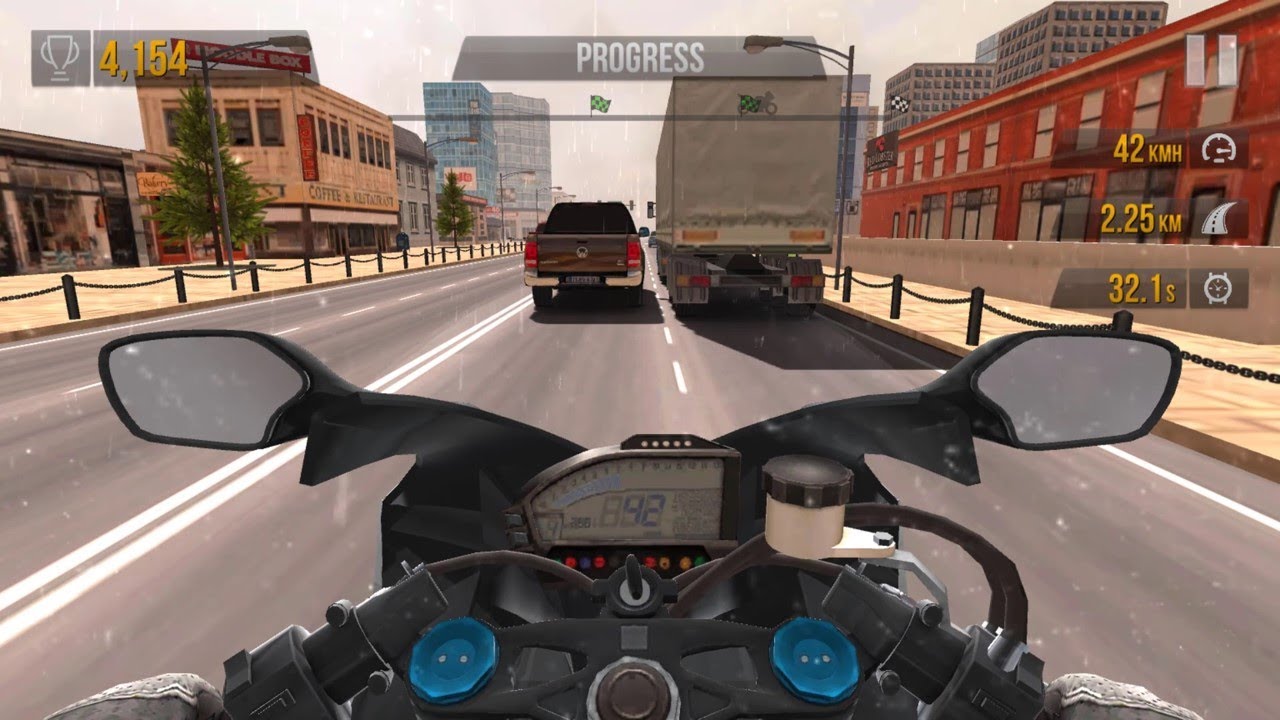
4. Traffic Creates a Different Kind of Challenge
Many arcade-style motorcycle games use traffic as an obstacle.
Instead of racing against competitors on a closed circuit, players may have to navigate:
- Cars
- Trucks
- Buses
- Road barriers
- Construction zones
- Sudden lane changes
- Narrow gaps
This changes the game from traditional racing into a combination of speed, reaction time and risk management.
The fastest route isn’t always the safest route.
A player who constantly takes tiny gaps may occasionally gain huge amounts of time—but one mistake can eliminate the entire advantage.
Different Types of Turbo Motorcycle Games
Not every game marketed around motorcycle speed offers the same experience.
Arcade Motorcycle Racers
These games prioritize accessibility.
You can usually learn the controls quickly and start racing without understanding complex motorcycle physics.
They’re ideal for players who want:
- Quick races
- Simple controls
- Fast acceleration
- Stunts
- Boost mechanics
- Immediate action
Motorcycle Simulation Games
Simulation-focused titles take a very different approach.
Here, braking, cornering and throttle control can be more important than turbo.
Players may need to learn:
- Racing lines
- Braking points
- Corner apexes
- Tire management
- Bike setup
- Track characteristics
These games can have a steep learning curve, but they offer much greater depth for players who enjoy realistic racing.
Stunt and Physics-Based Motorcycle Games
Games in this category focus on jumps, obstacles and balance.
Instead of simply asking:
“How quickly can you finish?”
they may ask:
“Can you finish without crashing?”
Players might need to control the rider’s body position while jumping across ramps, balancing over obstacles or landing at unusual angles.
Open-World Motorcycle Games
Open-world games add exploration to the racing formula.
Instead of selecting a track and immediately starting a race, players can travel through cities, highways or countryside environments.
This format can provide:
- Free riding
- Street races
- Bike customization
- Collectibles
- Side challenges
- Traffic
- Exploration
The motorcycle becomes more than a racing vehicle—it becomes a way of interacting with the game world.
Classic Motorcycle Games That Shaped the Genre
Road Rash
Road Rash remains one of the most recognizable motorcycle games from the 1990s.
Its major innovation was combining motorcycle racing with combat. Players weren’t simply trying to reach the finish line; they could attack rival riders while racing.
That combination gave the game a personality that conventional motorcycle racers lacked.
It also demonstrated an important lesson for the genre: motorcycle games don’t have to reproduce real racing to be entertaining.
MotoGP
The MotoGP franchise represents the simulation-oriented side of motorcycle gaming.
Instead of focusing primarily on exaggerated boosts or arcade action, the series emphasizes authentic racing environments, motorcycles, tracks and handling.
For players interested in learning the fundamentals of motorcycle racing, this type of game can be considerably more rewarding than a pure arcade racer.
Trials
The Trials series takes motorcycle gameplay in another direction.
The emphasis is on physics, balance and obstacle navigation rather than traditional circuit racing.
Players must control acceleration and rider movement carefully to avoid flipping or losing balance.
It’s a useful reminder that motorcycle gaming is much broader than simply going fast.
How to Get Better at Turbo Motorcycle Games
If you’re repeatedly crashing or finishing behind opponents, simply upgrading your motorcycle may not solve the problem.
Try improving these areas first.
1. Learn the Track
Knowing where corners, jumps and obstacles appear gives you an enormous advantage.
After a few races, you should begin remembering:
- Where to brake
- Where to accelerate
- Where turbo is safe
- Where traffic usually becomes difficult
- Which corners can be taken aggressively
Track knowledge reduces reaction time.
2. Don’t Overuse Turbo
Turbo is most useful when the motorcycle is already positioned correctly.
Avoid wasting it:
- Immediately before a sharp corner
- On rough terrain
- When blocked by traffic
- During a section where you must brake anyway
Instead, look for clean acceleration zones.
3. Upgrade Handling Before Pure Speed
This is especially important in games where upgrading systems allow players to improve different statistics.
A faster motorcycle isn’t necessarily better if you cannot control it.
A useful progression can be:
Handling → acceleration → braking → top speed
The exact order depends on the game, but control often produces more practical benefits than adding a few extra points of maximum speed.
4. Learn Controlled Risk
High-level racing isn’t about avoiding every risk.
It’s about knowing which risks are worth taking.
For example:
Low risk: passing a slow opponent on a wide straight.
Medium risk: squeezing through traffic with a clear exit.
High risk: attempting a narrow gap immediately before a corner.
Experienced players don’t necessarily take fewer risks. They take better-calculated risks.
Common Mistakes Beginners Make
Holding the accelerator constantly
Maximum throttle isn’t always the fastest strategy.
Boosting too early
A poorly timed boost can force unnecessary braking.
Ignoring braking
Braking isn’t the enemy of speed. Good braking allows you to maintain more speed through the following section.
Choosing the fastest bike immediately
A difficult-to-control motorcycle can actually produce slower race times.
Watching only the opponent
Look ahead.
You need to anticipate corners, traffic and obstacles before they become immediate problems.
Turbo Motorcycle Games on Mobile
Mobile devices have made motorcycle racing accessible to an enormous audience.
Touch controls can work well for arcade games because the objective is immediate and the controls are relatively simple.
However, realistic motorcycle simulations can benefit significantly from:
- Tilt controls
- Virtual joysticks
- Controller support
- Custom sensitivity settings
If a mobile game feels difficult, check its control settings before assuming the game itself is too hard.
Reducing steering sensitivity can sometimes make high-speed cornering considerably easier.
Why Multiplayer Makes These Games Better
Racing against computer-controlled opponents can be fun, but human opponents introduce unpredictability.
Online multiplayer creates situations where:
- Players defend racing lines
- Opponents save turbo for the final section
- Aggressive overtakes become common
- Mistakes are punished immediately
- Track knowledge becomes extremely valuable
Leaderboards also give players a reason to return.
Once you’ve completed a track, the challenge changes from:
“Can I finish?”
to:
“Can I finish five seconds faster?”
That shift is one reason racing games can remain engaging long after the initial excitement disappears.
The Future of Turbo Motorcycle Games
The genre is likely to continue benefiting from improvements in hardware and game technology.
More Advanced Physics
Future games can simulate tire behavior, suspension and surface changes with increasing detail.
Better Virtual Reality
VR has particular potential for motorcycle games because speed and spatial awareness are central to the experience.
More Dynamic Worlds
Instead of fixed tracks, developers can create environments with changing traffic, weather and road conditions.
Smarter Opponents
Artificial intelligence can also become more adaptive, learning how aggressively the player races and responding accordingly.
The result could be motorcycle games that combine the accessibility of arcade racing with the depth of simulation.
Why Turbo Motorcycle Games Remain Popular
The appeal ultimately comes down to a simple combination:
speed + control + risk + mastery.
The turbo creates bursts of excitement, but it isn’t enough on its own.
The best games reward players who understand when to accelerate, when to brake, how to position the motorcycle and when to take a risk.
That’s why the genre can appeal to very different players.
A casual gamer can enjoy a five-minute traffic race, while a dedicated racing fan can spend hours perfecting a single corner.
FAQ
What is a turbo motorcycle game?
A turbo motorcycle game is generally a motorcycle racing or action game built around high-speed riding, often with a temporary turbo, boost or nitro mechanic. Some are arcade-focused, while others emphasize realistic motorcycle physics and racing technique.
Are turbo motorcycle games realistic?
It depends on the game. Arcade titles often exaggerate acceleration, jumps and crashes for entertainment, while simulation-focused games try to reproduce realistic braking, handling, tire grip and motorcycle behavior.
How should you use turbo in a motorcycle racing game?
Turbo is usually most effective on long straights, after clean corner exits or during safe overtaking opportunities. Using it immediately before a sharp corner can waste the boost because you’ll have to slow down again.
What is more important: speed or handling?
Handling is often more important for beginners. A motorcycle with slightly lower top speed but better control can produce faster overall race times because you can corner, brake and accelerate more consistently.
Can motorcycle racing games be played on mobile?
Yes. Mobile platforms offer a wide variety of motorcycle racing games, ranging from simple arcade racers to more advanced simulations. Depending on the game, touchscreen, tilt and controller-based controls may be available.
What makes a motorcycle racing game addictive?
The combination of immediate speed and long-term mastery is a major factor. Players can quickly understand the objective, but improving lap times, learning tracks, mastering controls and competing against other players provides a much deeper challenge.
Conclusion
Turbo motorcycle games have developed far beyond simple speed-based racing. Modern titles can offer everything from realistic circuit racing and technical motorcycle physics to traffic challenges, stunt courses and open-world exploration.
The turbo mechanic remains one of the genre’s most exciting features, but smart players quickly discover that winning isn’t simply about pressing boost whenever possible. Timing, positioning, braking and track knowledge often matter more than raw speed.
Whether you prefer the chaotic fun of arcade racing, the precision of motorcycle simulation or the balance challenges of physics-based games, there’s a style to suit almost every player.
And that’s ultimately why motorcycle racing remains so compelling: the road is fast, the margin for error is small, and every corner gives you another chance to become a better rider.