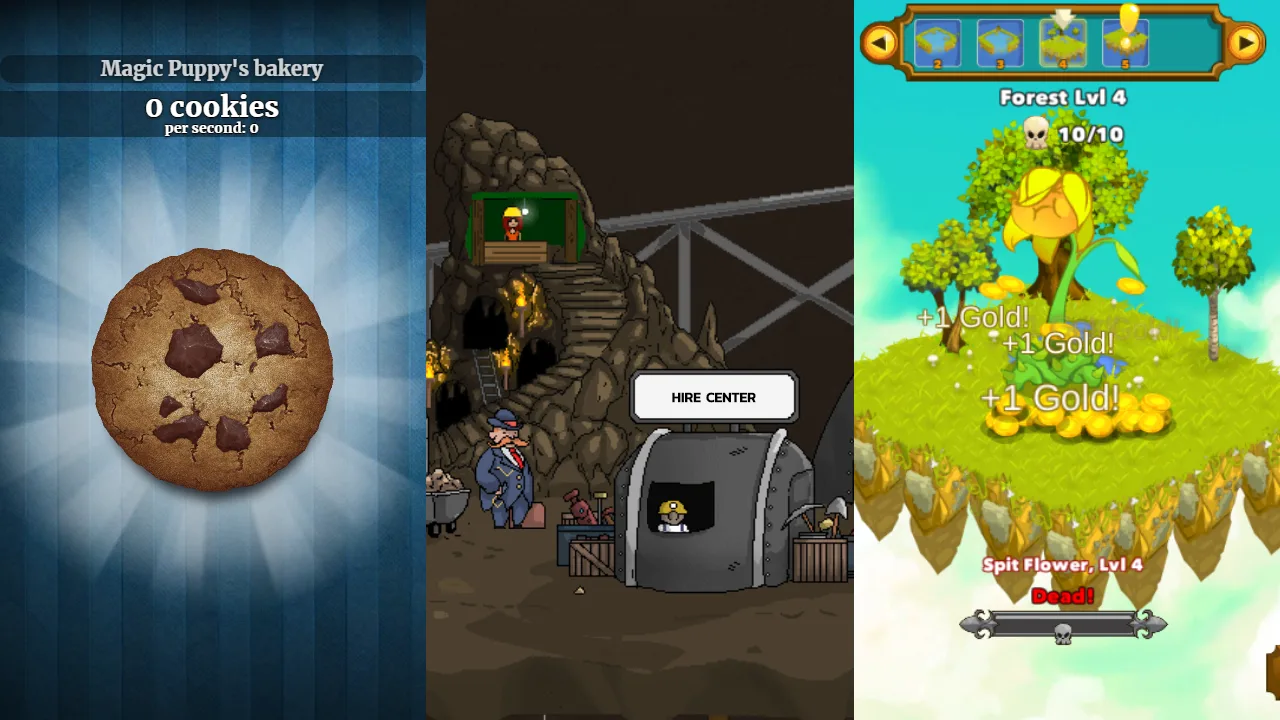
There is something strangely satisfying about watching a number grow. You click once, earn a few coins, buy an upgrade, and suddenly the same action produces much more than before. Eventually, the game starts earning resources for you even when you are not actively playing. That simple loop explains much of the appeal of Idle Clicker Games.
At first glance, these games can look almost too simple to be interesting. There may be little more than a button, a resource counter, and a collection of upgrades. Yet a well-designed idle game can keep players coming back for weeks or even months because every session answers the same tempting question: How much further can I push my progress?
This guide explains how idle clicker games work, why their progression systems are so effective, where the strategy comes from, and how the genre has evolved beyond simple clicking. It also looks at the practical differences between active clicking, automation, prestige systems, and modern hybrid idle games.
What Are Idle Clicker Games?
Idle clicker games are games built around incremental progression.
The basic loop is usually:
- Perform a simple action.
- Earn a resource.
- Spend the resource on an upgrade.
- Increase your earning rate.
- Unlock automation.
- Repeat at a larger scale.
The word idle refers to the game’s ability to continue generating progress without requiring constant interaction.
The word clicker comes from the early design of the genre, where clicking or tapping was the primary way to produce resources.
Modern games are often more sophisticated than that name suggests. Many include automated production, multiple currencies, upgrade trees, characters, quests, events, prestige mechanics, and even story elements.
So while clicking remains part of the genre’s history, it is no longer the whole experience.
How the Idle Game Loop Works
A good idle game is built around a carefully balanced progression loop.
Imagine you begin with a resource generator producing 1 coin per second. You save 10 coins and purchase an upgrade that increases production to 2 coins per second.
The next upgrade may cost 25 coins.
That upgrade raises production again.
Eventually, manually clicking becomes less important because automated generators produce most of your income.
The numbers grow, the costs grow, and the player continually works toward the next meaningful milestone.
This creates a straightforward relationship:
Resources → upgrades → faster production → larger resources → new upgrades
The loop sounds repetitive, but the pacing between those stages determines whether a game feels rewarding or boring.
Why Watching Numbers Increase Feels Rewarding
One reason idle games are effective is that progress is highly visible.
Instead of waiting hours to notice an improvement, players can often see the effect of an upgrade immediately.
For example:
- Before upgrade: 100 coins per minute
- After upgrade: 150 coins per minute
- After another upgrade: 300 coins per minute
The improvement is easy to understand.
There is no need to learn a complicated control system. The player can immediately connect the decision with the result.
That clarity is important.
The strongest idle games make progress understandable without making it completely predictable.
You know an upgrade will help, but you still have to decide which upgrade helps most.
The Real Strategy Behind Simple Gameplay
Calling idle clicker games “simple” can be misleading.
The controls may be simple, but the decisions can become increasingly complex.
Players may have to choose between:
- Increasing immediate production
- Improving long-term multipliers
- Unlocking a new generator
- Saving for an expensive upgrade
- Investing in automation
- Preparing for a prestige reset
- Maximizing offline rewards
A small decision early in a run can sometimes influence progress much later.
Short-Term Gains vs. Long-Term Efficiency
Suppose you have enough currency for two upgrades.
Upgrade A increases production by 20% immediately.
Upgrade B unlocks a new generator that is initially weak but becomes powerful after several additional upgrades.
The first option may be better if you need quick progress.
The second may be better if you are planning a longer run.
This is where an incremental game becomes more strategic than its interface suggests.
Manual Clicking vs. Automation
The transition from manual clicking to automation is one of the defining moments in many idle games.
At the beginning, your direct actions may provide most of your income.
Later, automated systems take over.
That progression changes the player’s role.
Early game:
“What should I click next?”
Mid game:
“Which generator should I upgrade?”
Later game:
“How should I optimize the entire production system?”
This shift is important because it prevents the experience from becoming a simple test of how quickly someone can tap.
The player gradually moves from doing the work to designing the system that does the work.
Prestige Systems: Starting Over to Move Forward
One of the most important innovations in the genre is the prestige system.
At some point, a game may allow you to reset much of your current progress in exchange for a permanent bonus or special currency.
At first, resetting can seem counterproductive.
Why would anyone voluntarily throw away progress?
Because the reset changes the next run.
For example, imagine:
- Run 1 takes 5 hours to reach a particular milestone.
- You prestige and receive a permanent multiplier.
- Run 2 reaches the same milestone in 2 hours.
You have technically started over, but your overall account has become stronger.
Why Prestige Changes the Experience
Prestige creates multiple timescales of progression.
There is:
- Progress within a single session
- Progress during a run
- Permanent progress across resets
That layered structure gives experienced players something more interesting to optimize.
Instead of asking only, “What should I buy?”
They can ask:
“When should I reset to make my next run more efficient?”
That is a much deeper strategic question.
Offline Progress Is More Than a Convenience
Offline progression is another defining feature.
When a player closes an idle game, production may continue in the background. Returning later can result in a collection of accumulated resources.
This creates a very different relationship between the player and the game.
In a traditional action game, leaving usually means nothing happens.
In an idle game, leaving can be part of the progression cycle.
However, the best systems still give players meaningful reasons to return rather than making the game completely automatic.
A useful design balance is:
Active play should feel valuable, while offline play should still feel rewarding.
If active play has no advantage, there is little reason to interact. If offline progress is too weak, the “idle” concept loses much of its appeal.
Why Short Sessions Work So Well
Idle games fit naturally into short periods of free time.
A player can:
- Open the game for a few minutes
- Collect accumulated resources
- Purchase upgrades
- Adjust a strategy
- Close the game
There is no requirement to complete a 30-minute mission before leaving.
That flexibility makes the genre particularly suitable for mobile and browser environments.
The game can fit around the player’s schedule rather than demanding that the player reorganize their schedule around the game.
Idle Clicker Games on Browser Platforms
Browser gaming helped the incremental genre grow because the basic mechanics work extremely well in a lightweight environment.
A player does not necessarily need:
- A powerful gaming computer
- A large installation
- Complex controls
- A long tutorial
A browser can be enough.
This makes idle games easy to experiment with. Someone who has only a few minutes can understand the basic idea quickly.
The browser environment also encouraged developers to experiment with unusual concepts, which helped incremental mechanics spread into many different themes.
From Clickers to Incremental Games
The genre has gradually expanded beyond the classic clicker formula.
Modern incremental games can include:
Idle RPG systems
Characters gain experience and resources automatically while players manage upgrades, equipment, abilities, and progression.
Simulation elements
Players build factories, businesses, farms, civilizations, or production networks that generate increasingly large quantities of resources.
Adventure mechanics
Exploration, quests, enemies, and story elements can be layered over an idle progression system.
Collection systems
Players unlock characters, creatures, cards, equipment, or other items that contribute to long-term progression.
These hybrids demonstrate why the genre has remained flexible.
The central idea is still incremental growth, but the surrounding systems can be almost anything.
The Importance of Upgrade Design
Not all upgrades are equally satisfying.
A good upgrade should answer at least one of three questions:
What does it improve?
How much does it improve it?
What does it unlock next?
If an upgrade costs a large amount but produces an effect that is barely noticeable, the reward feels weak.
On the other hand, a meaningful upgrade can change the player’s entire strategy.
This is why experienced players often pay attention to return on investment, not simply the size of the next number.
An upgrade that costs 1,000 resources and adds 500 production may be more useful than one costing 2,000 resources and adding only 600 production.
The bigger upgrade is not automatically the better upgrade.
Common Mistakes When Playing Idle Games
Buying every upgrade immediately
More upgrades do not always mean faster progress.
Some upgrades provide much better value than others.
Better approach: compare the cost with the actual improvement before spending.
Ignoring multipliers
A percentage multiplier can become extremely valuable as production grows.
An upgrade that looks modest early in the game may become powerful later.
Resetting too early
Prestige systems reward good timing.
Resetting before you have gained a meaningful permanent advantage can slow your overall progress.
Resetting too late
The opposite mistake is equally common.
Holding onto a run for too long can mean missing out on a powerful permanent bonus.
The best reset point depends on the specific game’s economy.
Focusing only on active clicking
Manual clicking may feel productive because it provides immediate feedback.
But once automation becomes efficient, spending all your attention on clicking may be less valuable than optimizing your production system.
How to Get Better at Idle Clicker Games
If you want to approach an incremental game more strategically, try this simple method.
1. Identify the main source of income
Find out what actually generates most of your resources.
Do not assume the button you click most often is your strongest source of production.
2. Measure upgrades by efficiency
Ask how much additional production you receive relative to the cost.
3. Look for breakpoints
Some upgrades unlock entirely new systems.
These can be more important than ordinary percentage increases.
4. Plan around prestige
If the game uses resets, understand what you keep and what you lose before committing.
5. Use offline rewards intelligently
Returning after a long break may provide enough resources for a major upgrade.
Instead of spending immediately, compare the available options first.
Why Idle Games Can Feel Relaxing
Idle games often avoid the pressure found in competitive or reaction-heavy genres.
There may be no opponent waiting to defeat you.
No character needs to be controlled perfectly.
No split-second decision necessarily determines success.
Instead, the player watches a system develop over time.
That can make the experience feel calm.
However, it is important not to confuse “relaxing” with “automatically healthy.” Individual experiences vary, and excessive play can still become unhelpful if it interferes with sleep, work, study, or other responsibilities.
The attraction is better explained by the combination of low mechanical pressure and visible progress.
The Psychology of Progress
Idle games make progression unusually tangible.
Players can see:
- Bigger numbers
- Faster production
- New unlocks
- Additional systems
- Permanent bonuses
- Higher milestones
This provides a clear feedback loop.
The player makes a decision, sees an outcome, and uses that outcome to make the next decision.
That loop can encourage continued engagement because there is almost always another improvement available.
But good design requires pacing.
If everything happens instantly, progress becomes meaningless.
If progress becomes too slow, players may lose interest.
The challenge for developers is finding the point between those extremes.
How Developers Keep Players Engaged
Modern idle games often use several systems to maintain long-term interest.
These can include:
- Daily rewards
- Achievements
- Prestige layers
- Limited-time events
- New areas
- Additional currencies
- Collection systems
- Quests
- Milestones
- Seasonal progression
These features provide new goals when the basic resource loop becomes familiar.
However, adding more systems does not automatically improve a game.
Complexity should support the central progression rather than bury it.
Idle Games and Monetization
Modern idle games also frequently use monetization systems, especially on mobile.
Players may encounter:
- Optional purchases
- Advertising rewards
- Premium currencies
- Time-saving boosts
- Subscription-style benefits
- Limited-time offers
This creates an important distinction between a game being idle and being designed primarily around monetization.
A well-balanced title should make its core progression understandable and enjoyable without constantly pressuring the player to spend money.
Players should also understand that “saving time” through a purchase changes the progression loop: the game is partly selling convenience rather than simply selling content.
The Future of Idle Clicker Games
The genre is unlikely to remain limited to a button and a counter.
Future incremental games can combine idle mechanics with increasingly sophisticated systems such as:
- Deeper simulation
- Procedural progression
- Character development
- Strategy mechanics
- Narrative systems
- Multiplayer elements
- More personalized progression
The basic idea is surprisingly adaptable.
As long as players enjoy seeing a system become more powerful over time, incremental mechanics can be attached to almost any theme.
That may be the genre’s greatest strength.
Why Idle Clicker Games Continue to Work
The lasting appeal of Idle Clicker Games is not really about clicking.
It is about transformation.
You begin with almost nothing.
Then you build a small source of income.
That becomes an automated system.
The system becomes an economy.
The economy unlocks new mechanics.
Eventually, the tiny action that started everything becomes almost irrelevant.
That feeling of watching something grow from a trivial beginning into a complicated machine is what gives the genre its identity.
Conclusion
Idle clicker games demonstrate that engaging gameplay does not always require complex controls, huge worlds, or constant action.
Their strength comes from a simple but carefully balanced progression loop: earn, upgrade, automate, optimize, and repeat.
The best games in the genre give players more than rapidly increasing numbers. They create meaningful choices about efficiency, timing, automation, and long-term progression. Prestige systems add another layer by turning temporary progress into permanent improvement, while modern hybrid titles combine idle mechanics with RPG, simulation, adventure, and management systems.
For players, the key is to recognize what makes the progression satisfying rather than simply chasing the biggest number on the screen. For developers, the challenge is creating a system where every upgrade feels meaningful and where active play and passive progress complement each other.
That balance explains why such simple games can hold attention for surprisingly long periods. Sometimes the most compelling question in a game is not “Can I win?” but simply:
“What happens if I let this grow a little further?”
FAQ
What are Idle Clicker Games?
Idle Clicker Games are progression-focused games where players earn resources through clicking, tapping, automated production, or a combination of these systems. Resources are spent on upgrades that increase future production. Many games continue generating resources while the player is away.
How do idle games make money?
Depending on the platform, idle games can use advertisements, optional purchases, premium currencies, subscriptions, or other monetization systems. Some games are completely free, while others combine free access with optional paid features. The exact model varies considerably between individual titles.
Are idle clicker games actually strategic?
Yes. Although the basic controls are simple, many idle games require decisions about upgrade efficiency, automation, resource allocation, and prestige timing. Advanced incremental games can become surprisingly mathematical because small efficiency differences compound over time.
What is a prestige system in an idle game?
Prestige is a mechanic that lets players reset some or most of their current progress in exchange for a permanent advantage. The reset usually makes future runs faster or more powerful. It creates a second layer of progression beyond the ordinary upgrade cycle.
Why are idle games so popular?
Their accessibility is a major factor. Players can make progress during very short sessions and often return later to collect accumulated resources. The visible growth of numbers, upgrades, and automated systems also provides a clear sense of progression without requiring demanding controls.
Do idle games require constant clicking?
Not necessarily. Clicking is central to many classic titles, but modern idle games usually introduce automation that gradually reduces the importance of manual input. In many games, the player’s role eventually shifts from clicking resources to managing and optimizing the systems that generate them.