In the ever-evolving world of online gaming, few experiences capture collective excitement quite like the Fortnite Live Event. It’s more than just a moment in gameplay — it’s a cultural phenomenon that unites millions of players around the globe for one epic, shared experience. Each event feels like a cinematic journey, where storytelling, technology, and community blend seamlessly into something unforgettable.
Over the years, Fortnite has redefined what live, interactive entertainment can be. From breaking the boundaries of virtual concerts to merging storylines with real-time gameplay, every Fortnite event is a reminder that gaming can be much more than pressing buttons — it can be an experience of pure immersion.
The Magic of the Fortnite Live Event
The Fortnite Live Event has become the pinnacle of what the game represents: creativity, connection, and constant reinvention. Players don’t just log in to play — they gather to witness something that feels monumental, something that only happens once.
These events are designed to surprise. Whether it’s the island being swallowed by a black hole, Travis Scott towering over players in a surreal concert, or a massive battle between mechs and monsters, each experience transforms Fortnite’s world in real-time.
The genius lies in how Epic Games builds anticipation. Leaks, cryptic teasers, mysterious in-game changes — all contribute to an electric sense of curiosity. Then, when the countdown clock hits zero, millions of players witness the same thing simultaneously. It’s like watching a blockbuster premiere, except you’re inside it.
The First Steps Toward Something Bigger
When Fortnite first launched in 2017, few could have predicted it would evolve into one of the world’s largest entertainment platforms. Initially designed as a co-op survival game, Fortnite found its footing with the introduction of its Battle Royale mode. But Epic Games didn’t stop there. They understood that community engagement was key.
The early live events started small — a rocket launch here, a cube explosion there. Yet even those simple beginnings laid the foundation for something revolutionary. Players started to realize they weren’t just participating in a static world; the game itself was alive, constantly changing.
This dynamic approach transformed Fortnite from a simple battle arena into a living narrative universe. Every event left players wondering, “What will happen next?”
Building the Anticipation
The build-up to any Fortnite Live Event is half the thrill. As each season nears its end, the map starts to shift subtly. Strange symbols appear, structures emerge overnight, and characters begin to act differently. Social media buzzes with theories, YouTubers dissect every clue, and players across the world collaborate to uncover hidden meanings.
By the time the event arrives, the excitement is unmatched. Fortnite’s servers swell with millions logging in simultaneously, all waiting for the countdown to hit zero. The sense of community in those final moments is electric — every player knows they’re about to witness something that will change the game forever.
Unforgettable Moments from Fortnite’s History
Few games have managed to deliver so many jaw-dropping live moments. Fortnite’s legacy is built upon these experiences — moments that players remember vividly even years later.
The Rocket Launch (2018)
The very first major live event, known simply as “The Rocket Launch,” set the tone for everything to come. Players stopped fighting, built platforms into the sky, and watched as a rocket shot across the horizon. It was a communal moment unlike anything gaming had seen before.
For the first time, millions of players realized that Fortnite wasn’t just a game — it was a stage for storytelling on a global scale.
The Black Hole Event (2019)
Perhaps the most legendary moment in Fortnite’s history came with the Chapter 2 transition. After a massive in-game explosion, the entire island was sucked into a swirling black hole. Then… nothing. For over 30 hours, players stared at a mysterious void on their screens.
It was bold. It was risky. But it worked. The blackout generated massive buzz, with Fortnite trending across the world. It showed that Epic Games understood suspense and spectacle better than most Hollywood directors.
Travis Scott’s Astronomical Concert (2020)
When concerts went virtual during the pandemic, Fortnite delivered something revolutionary: a live, interactive concert inside the game. Travis Scott’s “Astronomical” event wasn’t just music — it was an audiovisual journey through space, color, and imagination.
Players were flung into alternate dimensions, underwater dreamscapes, and floating stages as a giant holographic Travis performed hits like Sicko Mode. The scale and creativity of this event cemented Fortnite’s status as a cultural powerhouse.
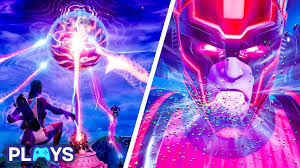
The Galactus Battle (2020)
Fortnite’s collaboration with Marvel reached its climax in the Galactus event. Millions of players boarded Battle Buses to take on the colossal villain in a cinematic showdown. It wasn’t just a cutscene — players actively participated in the battle.
The seamless mix of gameplay, narrative, and spectacle left players breathless. It was proof that Fortnite could turn any collaboration into an epic experience.
The Art and Technology Behind the Events
What makes each Fortnite Live Event so extraordinary isn’t just the visuals — it’s the technological brilliance behind it. Epic Games’ Unreal Engine allows real-time rendering on a scale that most studios can only dream of.
Each event is meticulously choreographed. Developers spend months fine-tuning animations, particle effects, and synchronized events so that millions of players can experience the same moment with no delay. The server coordination, scripting, and precision timing are feats of digital engineering.
But beyond the code lies artistry. Every event tells a story through motion, sound, and scale. Whether it’s a quiet cosmic drift or an explosive finale, the emotional beats are as carefully crafted as any film.
The Role of Storytelling
The beauty of Fortnite’s storytelling is how it merges community and narrative. Each season tells a new chapter, with clues scattered across the island, NPCs hinting at coming chaos, and events that push the story forward.
Players don’t just watch the story unfold; they live it. When the world ends, they’re there. When it’s reborn, they’re the first to explore it. This level of participation is what makes Fortnite so special — it blurs the line between viewer and player.
The live events act as the culmination of these stories, bringing months of speculation to a grand, satisfying conclusion. Then, just as quickly, a new mystery begins.
Community Reactions and Cultural Impact
Every major Fortnite event becomes an internet-wide celebration. Social media floods with screenshots, memes, and live reactions. Twitch and YouTube see record-breaking viewership numbers. Millions of players come together not just to play, but to share the moment.
Even those who don’t play Fortnite often tune in out of curiosity. It’s become more than a game — it’s a live cultural event. The boundaries between gaming, music, film, and art continue to blur.
Fortnite’s collaborations with artists, filmmakers, and global brands have redefined cross-media storytelling. It’s no longer strange to see a Marvel superhero fighting next to an anime character while watching a virtual concert — in Fortnite, it’s all part of the experience.
Why the Fortnite Live Event Is Unlike Anything Else
Other games have tried to replicate Fortnite’s magic, but few can match its scale or creativity. What sets it apart is the emotional connection players feel. Each event feels personal because you’re there, in it, watching the world change around you.
That sense of presence and participation transforms the experience from a simple game update into a shared memory. It’s something people talk about years later — “I remember when the island flipped,” or “I was there when the rocket launched.”
In many ways, Fortnite’s live events have changed how the industry views storytelling. They’ve proven that games can host moments as culturally relevant as movie premieres or global sporting events.
The Future of Fortnite’s Live Spectacles
So, what’s next for Fortnite? If the past is any indication, the future will only get bigger, bolder, and more breathtaking.
As technology advances, we may see even more immersive experiences: deeper interactivity, real-time audience participation, and larger crossovers between the physical and digital worlds. The metaverse conversation often starts with Fortnite for a reason — it has already demonstrated what shared virtual worlds can look like.
The beauty of it all is unpredictability. No one truly knows what the next Fortnite Live Event will bring. And that’s what keeps players coming back.
Lessons from the Phenomenon
The Fortnite phenomenon teaches us something valuable about modern entertainment: audiences crave participation. They want to be part of the story, not just observers.
Epic Games tapped into that desire perfectly. By merging technology, art, and community, they created a blueprint for the future of digital experiences. Other companies may follow, but Fortnite’s combination of accessibility and spectacle remains unmatched.
Moreover, the events remind us that gaming is now one of the most powerful storytelling mediums in existence. It’s not limited by screens — it’s interactive, emotional, and alive.
Conclusion
At its core, the Fortnite Live Event is about connection — players, stories, and emotions woven together in real-time. It’s about millions sharing a single moment of wonder, no matter where they are in the world.
From rocket launches to galactic showdowns, Fortnite continues to raise the bar for interactive entertainment. Each event feels like a celebration of creativity and community — a reminder that games can inspire awe, laughter, and unity.
As we look to the future, one thing is certain: Fortnite’s live events will continue to blur the lines between game and reality, player and creator, fantasy and life.