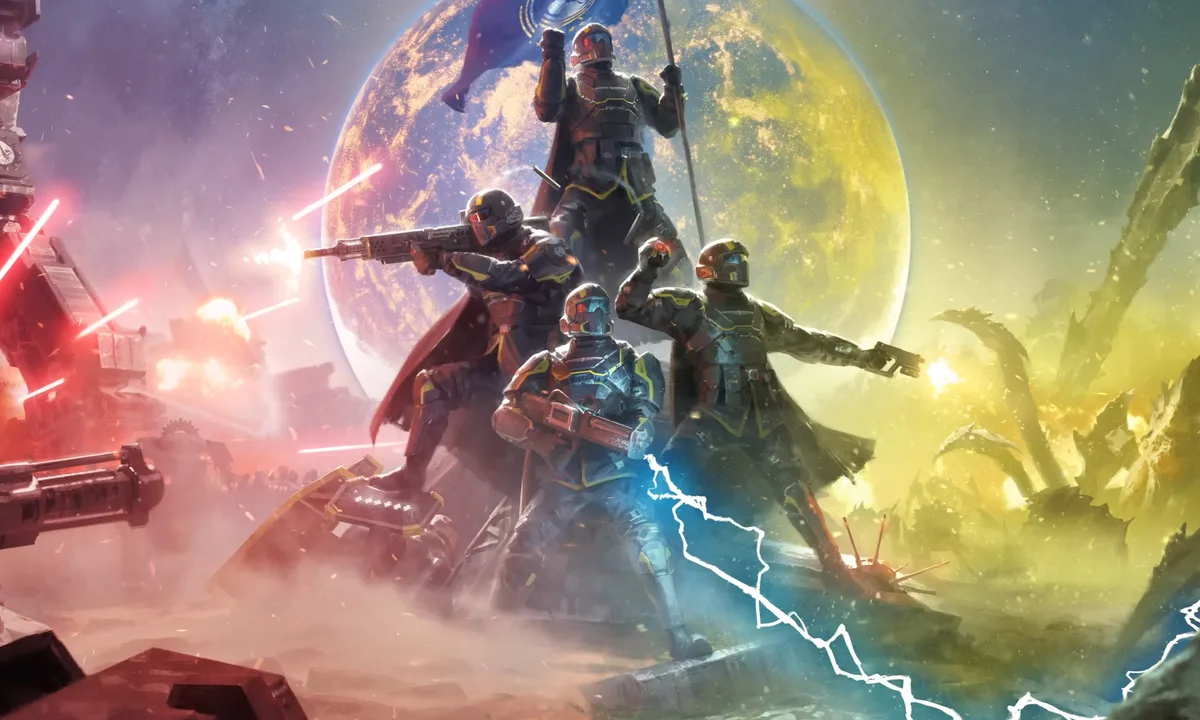
The Helldivers 2 Galactic War has entered one of its strangest chapters yet. In August 2026, Arrowhead pushed the war into a new frontier with the Devoid of Liberty update, taking players toward the mysterious Illuminate Void. The update introduced new mission objectives, mutated enemies, SEAF support, new progression ranks, and a radically different environment from the familiar planetary battlefields.
The change is more than another collection of missions. The Void alters how players approach objectives, movement, extraction, and squad coordination. Instead of simply fighting through another conventional planet, Helldivers must investigate corrupted worlds, document what they find, destroy Illuminate structures, and locate the source of the corruption.
The latest developments make this an especially interesting time to return to the game. Helldivers 2 has also entered the PlayStation Plus Game Catalog for Extra and Premium members, potentially bringing a new wave of players into the Galactic War.
Here is what is happening in Helldivers 2 right now and why the Void has changed the battlefield.
The Biggest Helldivers 2 News: The Void Is Open
The most significant recent development is the opening of the Illuminate Void.
According to Arrowhead, the Void became accessible after Super Earth used research gathered during the Census Thunder campaign to stabilize a wormhole on Rirga Bay. That Gateway now provides access to a strange region where planets have been transformed by the Void.
The visual and gameplay identity of these worlds is deliberately different.
The Void has:
- Mutated environments
- Illuminate ruins and structures
- Strange flora
- New enemy variants
- New objectives
- Different extraction possibilities
- A darker, more mysterious atmosphere
Players are being pushed toward the Source Planet, formerly known as Seasse, where the corruption is at its most extreme.
This makes the current Galactic War feel less like another ordinary campaign and more like an expedition into an unknown region.
What Is Devoid of Liberty?
Devoid of Liberty is the major August 2026 content update that introduced the new Void-focused experience.
The update launched on August 12 and added a new frontier for the Helldivers to investigate. It also arrived alongside Helldivers 2’s addition to the PlayStation Plus Game Catalog.
The update focuses heavily on the Illuminate threat and the consequences of Void corruption.
Rather than simply adding another planet with familiar objectives, Arrowhead has used the Void to experiment with how missions themselves work.
That distinction is important.
New Void Missions Change the Usual Formula
One of the most interesting changes is the way primary objectives are structured inside the Void.
Arrowhead describes Void operations as less linear than previous dives, with several randomized primary objectives available for operations. This means squads need to make decisions during the mission instead of relying as heavily on a predictable sequence.
Objectives can include:
- Documenting corruption
- Destroying Illuminate structures
- Conducting reconnaissance
- Investigating the environment
- Collecting materials for research
- Dealing with Void mutations
This has an important gameplay consequence: preparation becomes less about memorizing one mission pattern and more about carrying a flexible loadout.
A squad that can handle several types of problems is better positioned to react when the operation takes an unexpected turn.
New Illuminate Enemies: The Wretch and Crusher
The Void has also introduced new threats.
The Wretch
The Wretch is a fast and aggressive enemy designed to pressure players at close range.
Arrowhead describes it as nimble and capable of dodging and leaping toward players. That means accuracy and reaction speed become particularly important.
The Wretch creates a different kind of danger from a slow, heavily armored opponent.
Instead of giving you plenty of time to line up a shot, it can rapidly close the distance.
A practical response is to maintain awareness of your surroundings and avoid becoming so focused on larger targets that smaller threats reach the squad unnoticed.
The Crusher
The Crusher presents the opposite problem.
It is capable of absorbing substantial punishment and can regenerate while taking damage. Arrowhead specifically emphasizes the need to damage it consistently rather than allowing it to recover.
That creates a useful tactical distinction:
Wretch = speed and pressure
Crusher = durability and sustained damage
A squad facing both needs to manage immediate threats while maintaining enough firepower to deal with tougher enemies.
SEAF Support Finally Joins the Battlefield
One of the most interesting additions in the current update is the arrival of SEAF support.
SEAF platoons can now appear as a planet modifier and participate directly in missions. They bring additional battlefield support, including different soldiers with different equipment and roles.
The current SEAF lineup includes roles such as:
- Squad Leader
- Medic
- Rifleman
- Specialist
The Medic can provide healing support, while the Specialist can bring heavier weapons such as a machine gun and anti-tank equipment.
This is more than a cosmetic addition.
Additional AI-controlled support can change how a squad approaches an engagement, especially when the battlefield becomes crowded.
It also reinforces one of Helldivers 2’s central themes: you are part of a larger military force rather than an unstoppable solo superhero.
New Extraction Options in the Void
Extraction has always been one of Helldivers 2’s most stressful moments.
The current Void missions add another strategic option.
Players can unlock secondary extraction zones on Void planets, potentially giving squads an alternative way to evacuate.
This matters because Void missions can require squads to travel through unfamiliar environments while completing multiple objectives.
An additional extraction location can change how you plan the final part of the operation.
Instead of thinking only about:
“Where is the extraction point?”
you can start thinking:
“Which extraction option gives our squad the best chance of getting out alive?”
That is a subtle but meaningful change to mission strategy.
The Galactic War Still Depends on the Community
Despite the new Void mechanics, the central idea behind Helldivers 2 remains the same: the community is fighting a shared war.
Players collectively influence the Galactic Campaign by completing operations and responding to threats.
This creates a different feeling from a conventional single-player campaign.
You are not simply following a predetermined storyline.
The wider player population determines where attention goes, which fronts receive reinforcements, and how the war develops.
That is why following Helldivers 2 news can actually improve your understanding of the game.
A planet that looks unimportant during one session may become strategically significant after a new Major Order or campaign development.
Why the Illuminate Matter So Much Right Now
The Illuminate have become the central focus of the current Void storyline.
The new frontier is essentially an escalation of that conflict, with the Void itself transforming the environments and enemies found within it.
The deeper players go, the more extreme the corruption becomes.
That creates an interesting narrative structure:
Galaxy → Void → Corrupted planets → Source Planet
Each step increases the mystery and the danger.
The Source Planet therefore feels like more than another destination on the Galactic Map. It represents the point where the current investigation is supposed to lead.
Helldivers 2’s New Mission Design Rewards Adaptability
The randomized objectives inside the Void may be one of the most important gameplay changes in the update.
Previously, experienced players could become highly efficient at recognizing familiar mission patterns.
Randomized objectives make that knowledge less absolute.
A squad might need to adjust its plan depending on what the operation generates.
This encourages:
- Flexible loadouts
- Better communication
- More map awareness
- Faster decision-making
- Improved resource management
The result is a battlefield that can feel less predictable even when you are playing with experienced teammates.
How to Prepare for Void Missions
If you are returning to Helldivers 2 after a break, the Void is a good reason to rethink your loadout.
Prioritize flexibility
Avoid building a loadout that is excellent against only one type of threat.
The current environment can throw fast enemies, durable enemies, structures, and mission-specific objectives at you.
Bring reliable crowd control
Fast enemies such as the Wretch can become dangerous when they reach a squad that is already occupied with a larger threat.
Maintain sustained damage
The Crusher’s regeneration means squads need enough consistent damage to prevent the enemy from recovering.
Communicate during objectives
Randomized objectives make communication more valuable.
Before splitting up, make sure everyone understands the plan.
Think about extraction early
Do not wait until the final objective is complete to consider how the squad will escape.
The availability of secondary extraction zones can influence your route and final positioning.
Recent Technical Fixes
The current Helldivers 2 news cycle is not only about new content.
Arrowhead has also released follow-up fixes.
The August 17, 2026 patch addressed several issues, including crashes that could occur in fullscreen when opening terminals and crashes associated with superwide windows. It also fixed an issue where the interface could fail to display all available stratagems in certain situations.
This is important because major content updates can introduce technical problems alongside new features.
The follow-up patch shows that the current development cycle is not finished simply because Devoid of Liberty has launched.
Helldivers 2 Is Now in the PlayStation Plus Game Catalog
Another major development for the player base is the game’s arrival in the PlayStation Plus Game Catalog.
Helldivers 2 became available to PlayStation Plus Extra and Premium members on August 12, 2026, according to PlayStation’s announcement.
That could have a significant effect on the community.
More accessible membership-based availability can bring additional players into the game, potentially increasing activity across different fronts.
For existing players, that can mean more teammates, more activity on the Galactic Map, and a larger pool of people participating in major campaigns.
What Makes Helldivers 2 Still Interesting?
The game’s biggest strength is not simply the number of weapons or enemies.
It is the interaction between systems.
A mission can involve:
- A changing battlefield
- Multiple enemy types
- Friendly AI support
- Limited resources
- Randomized objectives
- Environmental hazards
- A tense extraction
- Four-player coordination
No individual mechanic needs to carry the entire experience.
The fun comes from what happens when they collide.
A routine mission can suddenly become memorable because a squad member makes a risky decision, an unexpected enemy appears, or extraction becomes much harder than planned.
The Human Side of Helldivers 2 News
The community remains a major part of the game’s identity.
Players do not simply discuss weapons and patch notes. They share stories.
A failed extraction can become a joke.
A desperate defense can become a community memory.
A strange bug can become a running meme.
A successful Major Order can create a feeling that thousands of unrelated players accomplished something together.
That shared experience is difficult to reproduce in a conventional multiplayer shooter.
Where Could the Galactic War Go Next?
There is plenty of room for speculation, but it is important to separate confirmed information from predictions.
The current confirmed direction is clear: the Helldivers have entered the Void and are investigating its corruption while confronting mutated Illuminate threats.
What comes after that remains part of the game’s evolving live narrative.
Potential future developments could involve:
- New Void environments
- Additional Illuminate threats
- Further changes to mission design
- More Galactic War campaigns
- Additional equipment
- New Warbonds
- Further progression changes
Those possibilities should be treated as speculation until officially announced.
Why Staying Updated Matters
Following Helldivers 2 news is more useful now than simply checking which weapons were buffed or nerfed.
The game’s live structure means updates can change the context of your next mission.
A new enemy can alter your loadout.
A new objective can change how you approach the map.
A new extraction mechanic can change your route.
A new Galactic War campaign can change where the community deploys.
That means the best players are not necessarily the ones who memorize one perfect strategy.
They are the ones who can adapt quickly.
FAQ
What is the latest major Helldivers 2 update?
The major current update is Devoid of Liberty, released in August 2026. It introduces the Illuminate Void, new mutated enemies including the Wretch and Crusher, SEAF support, new objectives, secondary extraction options, and additional progression.
What is the Illuminate Void in Helldivers 2?
The Void is a new frontier connected to the Illuminate conflict. Its planets have been transformed by strange corruption, with altered environments, Illuminate structures, new enemies, and different mission objectives. Players are ultimately directed toward the Void’s Source Planet.
What are the new enemies in Helldivers 2’s Void update?
The Devoid of Liberty update introduced the Wretch and Crusher as new mutated threats. The Wretch is fast and mobile, while the Crusher is heavily durable and capable of regeneration, requiring sustained damage.
What is SEAF support in Helldivers 2?
SEAF support allows Super Earth Armed Forces personnel to appear alongside Helldivers on certain missions. Different SEAF soldiers provide different capabilities, including medical assistance and heavier weapon support.
Did Helldivers 2 get new mission objectives?
Yes. Void operations introduce new objectives such as documenting corruption, reconnaissance, destroying Illuminate structures, and gathering research materials. Void missions can also use randomized primary objectives, making operations less predictable.
Is Helldivers 2 on PlayStation Plus?
Yes. Helldivers 2 joined the PlayStation Plus Game Catalog on August 12, 2026, for Extra and Premium members, according to PlayStation. Availability can depend on the relevant regional catalog and subscription terms.
Conclusion
The latest Helldivers 2 news points to a game entering another important phase.
The opening of the Illuminate Void has introduced more than new enemies and locations. It has changed the structure of missions, added randomized objectives, introduced SEAF battlefield support, created new extraction possibilities, and pushed players toward a mysterious Source Planet.
The Wretch and Crusher also demand different responses, making adaptable squad composition more valuable. Meanwhile, follow-up patches are addressing technical issues that appeared around the major update.
Perhaps the most interesting development is that Helldivers 2 continues to make the community part of the story. Players are not simply watching a campaign unfold. They are participating in it.
For returning Helldivers, now is a particularly good time to revisit the Galactic War. The battlefield has changed, the Illuminate threat has expanded, and the Void offers a very different kind of operation.
The galaxy is still at war—and this time, the fight leads somewhere far stranger.