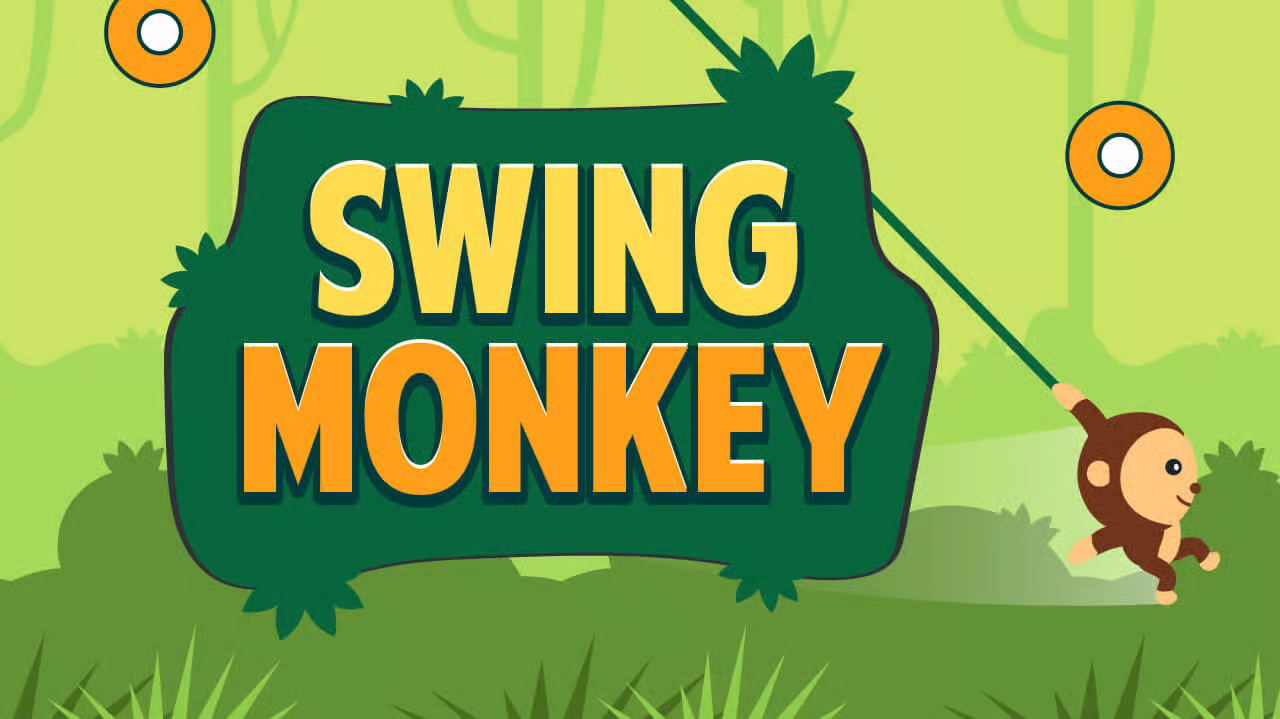
Swing Monkey is a simple physics-based browser game built around one entertaining idea: swing through a colorful environment by attaching a monkey to different points and releasing at the right moment. The controls are easy to understand, but reaching the end of a level requires timing, momentum, and careful judgment.
The game is appealing because every movement depends on physics. A poorly timed release can send the monkey in the wrong direction, while a well-timed swing can create a smooth arc that carries it directly toward the next point. This makes even short levels feel interactive and unpredictable.
Part of the game’s popularity comes from its accessibility. Players can understand the basic objective almost immediately, making it suitable for casual gaming sessions. At the same time, the need to judge distance, speed, and trajectory gives experienced players a reason to keep practicing.
Whether someone discovers it during a quick break or spends longer trying to improve their performance, Swing Monkey demonstrates how a small set of mechanics can create surprisingly engaging gameplay.
What Is Swing Monkey?
Swing Monkey is a browser-based physics game in which players control a cartoon monkey that moves through levels by swinging between attachment points.
Rather than relying on traditional running and jumping controls, the game focuses on:
- Timing
- Momentum
- Swing direction
- Release points
- Distance between platforms or attachment points
- Reaction to changing level layouts
The central objective is generally straightforward: keep the monkey moving forward and successfully navigate the course.
The simplicity of the concept makes the game easy to pick up, while the physics provide enough variation to keep individual attempts interesting.
How Swing Monkey Gameplay Works
The basic gameplay revolves around attaching the monkey to a suitable point, building momentum, and releasing at the appropriate moment.
The important decision is not simply when to swing, but when to let go.
If the monkey is released too early, it may not travel far enough. If released too late, its trajectory may carry it away from the next target.
This creates a repeating gameplay cycle:
Attach → swing → build momentum → release → reach the next point → repeat.
As levels become more demanding, players need to make these decisions faster and with greater accuracy.
Why the Physics Make Swing Monkey Fun
Physics are the foundation of the game’s challenge.
The monkey’s movement depends on the direction and speed generated during each swing. Instead of simply pressing a button to move a fixed distance, players influence the trajectory through timing.
That makes movement feel dynamic.
Two attempts at the same section can produce different results because a slightly different release point changes the monkey’s path. This creates an important sense of experimentation.
Players naturally begin asking:
- Should I release earlier?
- Can I carry more momentum into the next swing?
- Am I approaching the next point from the right angle?
- Should I wait for a better position before releasing?
These questions add depth without making the game complicated.
The Importance of Timing
Timing is arguably the most important skill in Swing Monkey.
A successful swing requires players to recognize the right moment to release. With practice, this becomes less of a conscious calculation and more of an instinctive response.
Early Release
Releasing too early can reduce distance and leave the monkey short of the next target.
Late Release
Waiting too long can produce an unfavorable trajectory and make the next connection difficult.
Well-Timed Release
A carefully timed release allows the monkey to use its existing momentum efficiently and move naturally toward the next section.
Learning this timing is what turns the game from a basic browser distraction into a skill-based challenge.
Momentum Makes Every Swing Matter
Momentum is closely connected to timing.
A player who understands how momentum carries the monkey can plan several moves ahead rather than treating every swing as an isolated action.
For example, the ideal release point for one swing may depend on where the monkey needs to be positioned for the next one.
This creates a simple form of forward planning.
Instead of thinking only about:
“How do I reach the next point?”
experienced players begin thinking:
“Where should I land so that my next swing is easier?”
That change in perspective can significantly improve consistency.
Levels and Increasing Difficulty
Progression is an important part of the game’s appeal.
Early sections introduce the basic swinging mechanic in a relatively forgiving environment. As players progress, the layouts can require more precise timing and faster decisions.
Difficulty can come from factors such as:
- Greater distances between targets
- More demanding movement patterns
- Less room for error
- Faster sequences
- More complicated routes
- Increased need for accurate releases
This gradual increase in difficulty creates a natural learning curve.
Players do not have to master everything immediately. Instead, they develop their skills while progressing through increasingly challenging situations.
Why Swing Monkey Is Easy to Learn
One of the game’s strongest qualities is its low barrier to entry.
Players do not need extensive instructions before starting. The central mechanic can be understood quickly, and the game’s visual design helps communicate what to do.
This makes it suitable for casual players who want something immediately playable.
At the same time, accessibility does not mean the game has no skill ceiling. Players who want better results still need to develop timing, spatial awareness, and consistency.
Common Mistakes Beginners Make
New players often make predictable mistakes while learning the physics.
Releasing Too Quickly
An early release may leave the monkey without enough momentum to reach the next target.
Waiting Too Long
Holding the swing for too long can send the monkey along an unfavorable trajectory.
Ignoring the Next Move
Focusing only on the current attachment point can make the following swing harder.
Panicking After a Mistake
A poor swing does not always mean the entire attempt is lost. Staying focused can sometimes allow players to recover.
Repeating the Same Timing
If a particular release consistently fails, changing the timing slightly is usually more productive than repeating the identical move.
Tips for Improving at Swing Monkey
Improving does not require complicated strategies. Most progress comes from understanding the movement system.
1. Watch the Trajectory
Pay attention to how the monkey moves through the air after each release.
2. Experiment With Release Timing
Try releasing slightly earlier or later and compare the results.
3. Look Ahead
Identify the next target before completing the current swing whenever possible.
4. Use Momentum Efficiently
Avoid making unnecessary movements that disrupt a useful trajectory.
5. Learn From Failed Attempts
A failed swing provides information about distance, timing, and positioning.
6. Prioritize Consistency
A reliable technique is more valuable than occasionally making an impressive but unpredictable move.
Swing Monkey and the Appeal of Browser Games
Swing Monkey fits into a broader category of lightweight browser games that can be started quickly and understood without a lengthy tutorial.
These games are particularly attractive because they do not demand a large time commitment.
A player can complete a short session, close the browser, and return later without having to remember a complicated storyline or progression system.
This makes browser games useful for people looking for quick entertainment rather than a long gaming commitment.
Why Players Search for Swing Monkey Online
Searches for Swing Monkey online and related terms are largely driven by players looking for convenient access to the game.
Browser-based games are attractive because they can generally be played directly through a compatible web browser rather than requiring a traditional console or large software installation.
However, players should distinguish between legitimate game-hosting pages and questionable websites. Some unofficial pages may contain excessive advertising, misleading download buttons, or other unwanted content.
Using a reputable source and following the rules of the network or device being used is the safest approach.
Visual Design and Playful Presentation
Swing Monkey does not need highly detailed graphics to communicate its gameplay.
Its cartoon-like presentation supports the lighthearted nature of the experience. The monkey’s expressive movement and colorful environments make the physics easier to follow while keeping the atmosphere playful.
Good visual feedback is especially important in a physics game. Players need to understand where the monkey is moving, where attachment points are located, and how their actions affect the trajectory.
The combination of simple visuals and clear movement keeps the gameplay readable.
Why Short Sessions Work So Well
Swing Monkey is particularly suited to short play sessions.
A player can start a level, attempt a sequence, fail, and immediately try again. There is little preparation involved.
This structure supports the classic casual-game loop:
Play → fail → learn → retry → improve.
The short cycle is one of the reasons these games can become surprisingly difficult to put down. Players often feel that another attempt might be enough to overcome the section that stopped them previously.
The Psychology of “One More Attempt”
The game creates a natural improvement loop.
When a player fails, the reason is usually understandable. Perhaps the release was too early, the angle was wrong, or the next target was approached incorrectly.
Because the mistake appears fixable, another attempt feels worthwhile.
This is different from games where failure can result in losing hours of progress. A short failed attempt has a low emotional cost, encouraging immediate experimentation.
Skill, Curiosity, and Experimentation
A good physics game encourages players to experiment.
Instead of providing one rigid solution to every situation, movement mechanics allow players to discover what works.
Players may naturally test different:
- Release points
- Swing durations
- Angles
- Approaches to targets
- Recovery techniques
This experimentation is part of the learning process.
The player gradually develops an internal understanding of the game’s physics without needing to calculate every movement mathematically.
Is Swing Monkey Good for Casual Players?
Yes. The game’s simple concept and straightforward controls make it particularly accessible to casual players.
Someone unfamiliar with physics-based games can understand the basic mechanic quickly, while players who enjoy skill-based challenges can spend more time improving their timing.
Its flexible difficulty experience is one of its strongest characteristics.
A casual player can simply enjoy the movement, while a more competitive player can focus on completing difficult sections consistently.
What Makes Swing Monkey Different From Traditional Platform Games?
Traditional platform games often depend heavily on jumping, running, and direct character movement.
Swing Monkey changes that formula by making momentum and attachment mechanics central to progression.
The player is not simply deciding where the monkey should walk or jump. They are influencing how it travels through space.
That difference makes the game feel closer to solving a series of movement puzzles.
Every successful swing combines prediction and execution.
FAQ
What is Swing Monkey?
Swing Monkey is a physics-based browser game where players guide a cartoon monkey through levels by swinging between attachment points and releasing at the right time.
How do you play Swing Monkey?
The basic strategy is to attach to a point, build momentum, and release at an appropriate moment so the monkey reaches the next target.
Is Swing Monkey difficult?
The basic mechanic is easy to understand, but later sections can require increasingly precise timing and movement control.
What is the most important skill in Swing Monkey?
Timing is one of the most important skills. Understanding when to release the monkey can significantly affect its trajectory.
How can I get better at Swing Monkey?
Practice different release timings, watch the monkey’s trajectory, look ahead to upcoming targets, and learn from failed attempts rather than simply repeating the same movement.
Why is Swing Monkey popular?
Its appeal comes from a combination of simple controls, playful presentation, physics-based movement, short sessions, and a gradual skill curve.
Final Verdict
Swing Monkey shows how a straightforward idea can create engaging gameplay when movement mechanics are designed well.
The game does not depend on complicated controls or an elaborate story. Instead, it builds its experience around a small number of ideas: timing, momentum, trajectory, and progression.
That simplicity is its greatest strength.
New players can begin swinging almost immediately, while experienced players can refine their timing and develop a better understanding of the game’s physics. Every failed attempt provides useful information, and every successful sequence creates a satisfying sense of control.
The playful monkey, colorful presentation, and physics-driven movement give the experience an approachable personality, while the increasing challenge provides enough motivation to keep practicing.
Ultimately, the appeal of Swing Monkey comes from the satisfying feeling of turning uncertain movement into controlled motion. What begins as a simple browser game can quickly become a test of timing, patience, and precision—exactly the qualities that make casual skill games so enjoyable.