
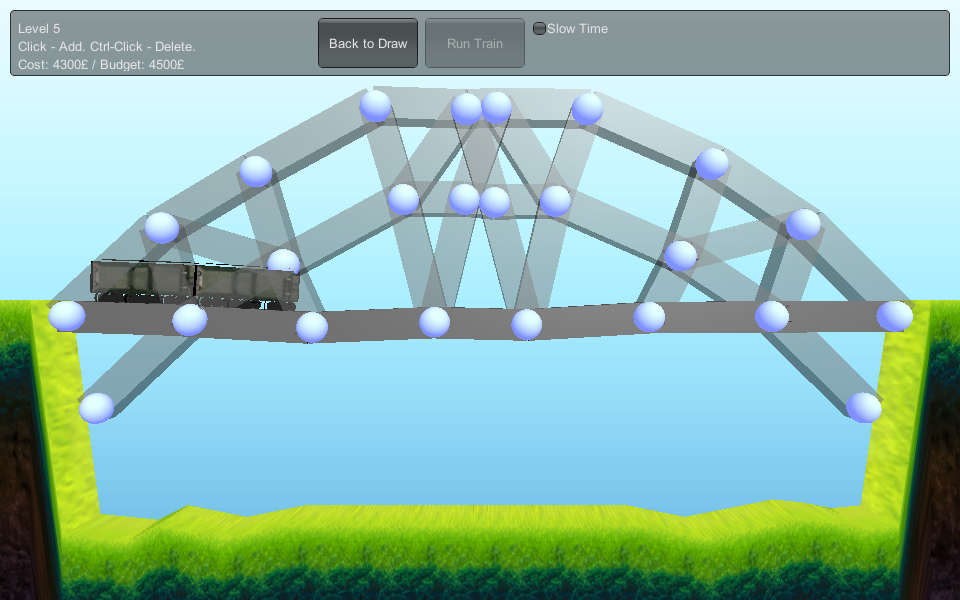
Bridge Builder games turn a surprisingly simple idea into a challenging puzzle: build a bridge that can safely carry vehicles across a gap without collapsing. What starts as placing a few beams quickly becomes a test of structural thinking, resource management, physics, and creativity.
The appeal is easy to understand. You design something, press the test button, and immediately discover whether your idea works. A successful bridge produces a satisfying moment of achievement, while a collapse shows exactly where your design needs improvement.
Unlike traditional puzzle games where the solution is often a fixed sequence of moves, bridge-building games usually allow several possible solutions. You can experiment with triangles, support beams, suspension-style structures, different materials, and unusual designs.
That combination makes the Bridge Builder Game appealing to casual players, students, puzzle fans, and anyone interested in engineering. You do not need to understand advanced structural engineering to start. The game gradually teaches you to think about weight, support, balance, tension, compression, and efficiency simply by letting you build and test.
What Is a Bridge Builder Game?
A Bridge Builder Game is a physics-based construction puzzle in which the player designs a bridge capable of transporting vehicles or other objects across a gap.
A typical level gives you:
- Two or more areas that need to be connected
- A limited construction budget
- Specific building materials
- Anchor points or terrain
- One or more vehicles that must cross
- Physical forces that affect the finished structure
The objective is not simply to connect both sides. Your bridge must usually remain structurally stable while carrying a moving load.
That distinction is what makes these games interesting.
A structure can look perfectly reasonable when it is empty but fail as soon as a vehicle drives onto it. The wheels introduce changing loads, and weak sections may bend, buckle, or break.
How Bridge Builder Games Work
Although individual games use different interfaces and mechanics, the basic gameplay loop is remarkably consistent.
1. Study the level
Before placing anything, examine the gap.
Look for:
- The distance between anchor points
- Available attachment locations
- The terrain underneath
- The expected vehicle path
- Maximum building height
- Material limitations
- Your available budget
Spending a few seconds studying the environment can save several failed attempts.
2. Build the road
The first objective is usually creating a path that vehicles can travel across.
A common mistake is to focus entirely on making the road visually smooth while ignoring the structure underneath it.
The road needs support.
3. Add structural reinforcement
This is where the puzzle becomes more technical.
Players often use triangular trusses because triangles help distribute forces through connected members rather than allowing a long beam to carry everything by itself.
You may also need:
- Vertical supports
- Diagonal braces
- Suspension elements
- Additional anchor points
- Stronger materials in high-stress sections
4. Test the bridge
Once construction is complete, start the simulation.
Watch carefully rather than simply waiting for success or failure.
Pay attention to:
- Where the bridge bends
- Which members stretch
- Which supports compress
- Where joints move excessively
- When the first visible deformation occurs
The first failure point often provides the most useful information for your next attempt.
5. Modify and test again
Bridge Builder games are built around iteration.
A failed bridge is not necessarily a bad attempt. It is feedback.
Instead of rebuilding everything immediately, identify the weakest area and make the smallest useful change. This approach often produces better results than randomly adding more supports.
Why Bridge Builder Games Are So Addictive
The strongest part of the genre is its build-test-improve cycle.
You have an idea.
You build it.
You test it.
It fails.
You understand why.
You change the design.
Then it works.
That feedback loop is powerful because the player can see a direct relationship between decisions and results.
Creativity and logic work together
Some puzzle games reward memorization. Bridge-building games are different because they allow experimentation.
There may be multiple ways to solve the same level.
One player might build a compact truss. Another might use a more elaborate suspension design. A third might discover a surprisingly efficient solution that uses fewer materials.
This freedom gives the genre a creative quality that many traditional logic puzzles lack.
The Physics Behind Bridge Building
You do not need an engineering degree to play, but understanding a few basic concepts can dramatically improve your designs.
Tension
Tension occurs when a structural member is being pulled apart.
Cables and certain bridge components are particularly useful for handling tensile forces.
If a game visually indicates tension, you may see a member stretching or carrying significant load as the vehicle moves across the bridge.
Compression
Compression occurs when a component is being pushed together.
Support columns and structural members can experience substantial compression.
A long, thin component under compression may become unstable or buckle, depending on how the game’s physics system models the material.
Load distribution
The vehicle does not simply add one fixed amount of weight to the bridge.
Its position changes continuously.
As the vehicle moves from one section to another, the forces throughout the structure can change.
This explains why a bridge can survive when the vehicle is near one end but fail when it reaches the middle.
Torque and bending
Long unsupported sections tend to bend under load.
If you notice a bridge sagging dramatically in the center, the problem may not be the total amount of material. The issue may be that the span is too long without adequate structural support.
Adding a well-placed triangular brace can sometimes be more effective than adding several random beams.
Why Triangles Are So Important
One of the most useful lessons in bridge-building games is the importance of triangular structures.
A rectangle can deform relatively easily when forces are applied to its corners. A triangle is much more resistant to changing shape because its three sides constrain one another.
That is why triangular trusses appear so frequently in successful bridge designs.
Instead of creating a large unsupported rectangle, players can divide the structure into smaller triangular sections.
A simplified pattern might look like:
/\ /\ /\
The exact arrangement depends on the game, but the principle is the same: create connected structural paths that transfer forces toward strong anchor points.
How to Build a Better Bridge
If you are struggling with difficult levels, try this practical process.
Start with the shortest sensible structure
Do not immediately cover the entire level with beams.
Begin with the basic route the vehicle needs to follow.
Then identify where additional support is required.
Reinforce the center
The middle of a long span is often vulnerable to bending.
If the bridge sags when the vehicle reaches the center, consider:
- Adding a triangular support
- Reducing the unsupported span
- Using a stronger material
- Creating a better load path toward the anchors
Build from strong anchor points
A beautifully designed structure is useless if its forces ultimately have nowhere reliable to go.
Whenever possible, connect major structural elements to stable anchor points provided by the level.
Use materials strategically
If the game gives you multiple materials, do not automatically use the strongest material everywhere.
A more effective strategy is often:
- Use inexpensive material where loads are relatively low.
- Reserve stronger material for critical members.
- Reinforce sections that experience the greatest stress.
- Test the design before spending additional resources.
This makes the budget part of the puzzle rather than simply a limitation.
Common Bridge Builder Mistakes
Adding too many beams
More material does not automatically mean more strength.
An overcrowded structure can be inefficient and may even create undesirable force paths.
The goal is controlled reinforcement, not maximum construction.
Ignoring joints
Players often focus on individual beams but forget that connections are equally important.
If several structural members meet at a poorly positioned joint, the entire area can become unstable.
Building without testing
Trying to predict everything before running the simulation wastes time.
These games are designed for experimentation.
Build a reasonable first version, test it, and learn from the result.
Copying real bridges too literally
Real-world bridge designs are influenced by construction methods, safety regulations, environmental conditions, material properties, and engineering requirements.
A game simplifies these factors.
A design that looks unrealistic in real life may work perfectly in a particular game because of its simplified physics system.
The best strategy is therefore to understand the game’s mechanics rather than blindly copying real structures.
Bridge Builder Game Tips for Difficult Levels
When a level becomes frustrating, slow down and diagnose the problem.
Tip 1: Watch the first failure
The location where the first beam breaks is often more important than the location where the bridge finally collapses.
The first failure can reveal the original weakness.
Tip 2: Change one thing at a time
If you add ten new supports and the bridge suddenly works, you may not know which change solved the problem.
Instead, make controlled adjustments.
This turns the game into an experiment.
Tip 3: Consider the vehicle’s movement
A moving vehicle creates a changing load.
Do not evaluate the bridge only when the vehicle is stationary at the starting point.
Watch the entire crossing.
Tip 4: Optimize after you succeed
Getting across the gap is only the first achievement.
If the game rewards low construction costs, return to successful levels and see whether you can remove unnecessary materials without sacrificing stability.
Tip 5: Keep a mental record of successful patterns
Over time, you will begin recognizing useful structural patterns.
You may learn when a simple beam is enough, when a truss is necessary, and when a suspension-style design is worth considering.
Is Bridge Builder Educational?
Yes, bridge-building games can provide a useful introduction to several concepts associated with engineering and physics.
Players naturally encounter ideas involving:
- Geometry
- Structural stability
- Force
- Balance
- Load distribution
- Tension
- Compression
- Budget management
- Iterative design
- Spatial reasoning
The important educational benefit is that these concepts are experienced rather than simply memorized.
A player might not know the formal definition of compression before playing. But after watching one beam buckle under pressure several times, they begin developing an intuitive understanding of how forces affect structures.
That makes the genre particularly interesting for educational environments and STEM-oriented learning.
Bridge Builder Games and Problem-Solving Skills
The game’s greatest lesson may not actually be about bridges.
It teaches players to approach difficult problems systematically.
A useful problem-solving cycle is:
Observe → Design → Test → Diagnose → Improve
This method applies far beyond gaming.
If a design fails, the player learns to ask:
- What exactly failed?
- Why did it fail?
- Was the structure too weak?
- Was the load distributed badly?
- Did I spend resources in the wrong place?
- What is the smallest change that could fix it?
That mindset encourages experimentation instead of frustration.
Why Failure Is Part of the Fun
Bridge Builder games make failure unusually satisfying.
Watching a bridge collapse can initially feel like losing. But the collapse itself contains information.
Perhaps the center bent too far.
Maybe one support failed first.
Perhaps the entire structure shifted because a connection was badly positioned.
Once you start viewing failure as data, the game becomes less about guessing and more about engineering-style experimentation.
This is one of the genre’s most valuable design features.
Bridge Builder vs. Traditional Puzzle Games
Bridge-building games sit somewhere between several genres.
| Feature | Bridge Builder Games | Traditional Logic Puzzles |
|---|---|---|
| Creativity | High | Usually moderate |
| Physics | Important | Often limited |
| Multiple solutions | Common | Sometimes limited |
| Experimentation | Very high | Moderate |
| Resource management | Often included | Less common |
| Visual feedback | Immediate | Varies |
| Failure analysis | Important | Less prominent |
The combination of construction and simulation gives bridge-building games a distinctive identity.
You are not simply finding the correct answer. You are creating a solution and then watching the simulation determine whether your design survives.
Why These Games Appeal to Different Ages
Children can approach bridge builders as digital construction toys.
Teenagers may enjoy the challenge and competition of finding efficient solutions.
Adults often appreciate the combination of creativity and logic, especially when a short gaming session can provide a satisfying problem to solve.
The genre does not require players to know advanced mathematics before starting. The complexity emerges naturally as the levels become more demanding.
The Modern Appeal of Bridge Building Games
The basic concept has remained relevant because it does not depend on a particular graphics style or technology.
Better physics simulations can make collapses more convincing. More materials can increase strategic possibilities. Three-dimensional environments can make levels more visually interesting.
But the fundamental appeal remains unchanged:
Can you build something strong enough to work?
That question is simple, but it creates almost endless possibilities.
How to Think Like a Bridge Builder
If you want to become better at these games, try thinking less like someone placing objects and more like someone solving a structural problem.
Before building, ask:
- Where is the load going?
- Which points can support that load?
- Which sections are likely to bend?
- Where should the structure be reinforced?
- Can I solve the problem with fewer materials?
- What happens when the vehicle reaches the weakest section?
These questions encourage deliberate construction rather than trial-and-error guessing.
Final Thoughts
The Bridge Builder Game succeeds because it turns engineering principles into an accessible and entertaining puzzle.
You begin with a gap and a limited set of resources. From there, you must design a structure, predict how it will behave, test it under pressure, and improve it when something goes wrong.
The most rewarding part is not simply seeing a vehicle reach the other side. It is understanding why the bridge succeeded.
That is what separates bridge-building games from simple construction puzzles. They combine creativity with physics, resource management with experimentation, and failure with learning.
Whether you enjoy engineering, puzzle games, simulations, or simply building unusual things, the genre offers a compelling challenge. Start with a simple structure, watch how the forces move through it, learn from every collapse, and gradually develop your own building style.
In a good Bridge Builder Game, there is rarely just one way across. The real challenge is discovering your way to build a bridge that stands.