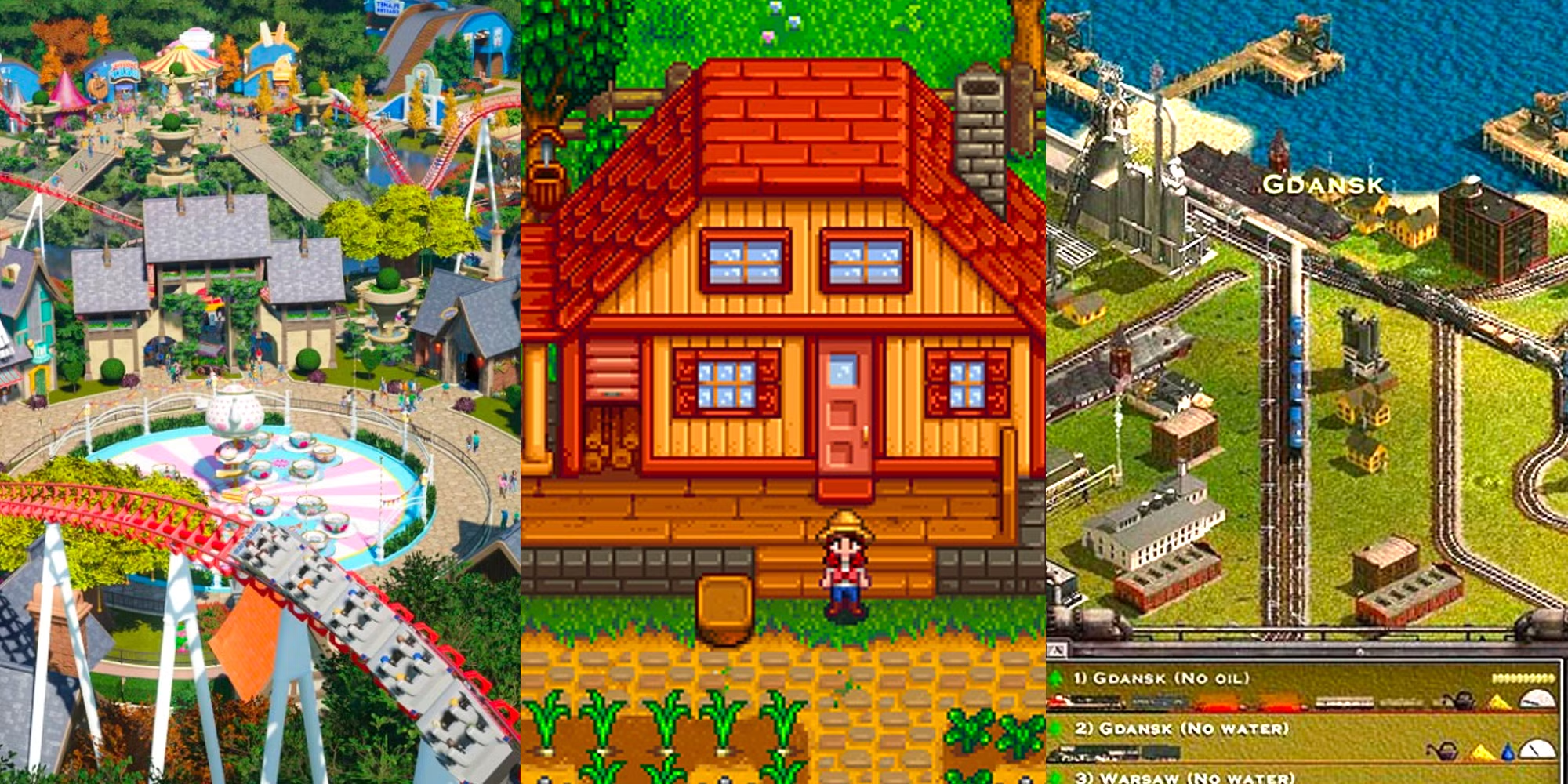
Few gaming genres offer the same feeling of ownership as tycoon games. You start with limited resources, make a few decisions, and gradually transform a small operation into something much larger. Whether you are managing a theme park, developing a city, running a restaurant, operating a transport company, or building an entire virtual economy, the basic attraction is the same: your decisions shape the world around you.
Unlike action-focused games that often depend on reflexes, tycoon and management games reward patience, planning, experimentation, and long-term thinking. A successful playthrough can feel less like completing a traditional game and more like creating a living project.
That flexibility explains why the genre has remained relevant for decades. Classic management titles continue to attract nostalgic players, while modern simulations introduce deeper economies, sophisticated artificial intelligence, customization, automation, and multiplayer features.
This guide explores what makes tycoon games so compelling, how the genre evolved, the mechanics that define it, the skills players can develop, and why building virtual businesses and worlds remains such a satisfying gaming experience.
What Are Tycoon Games?
Tycoon games are management and simulation experiences in which players typically take responsibility for developing and operating a business, organization, city, or other complex system.
The exact objective varies between games, but common goals include:
- Growing revenue
- Managing expenses
- Expanding operations
- Satisfying customers or citizens
- Allocating resources
- Hiring and managing workers
- Improving infrastructure
- Competing with other businesses
- Unlocking new technologies or facilities
- Maintaining long-term stability
The word “tycoon” traditionally suggests becoming a successful business owner or industrial leader, but modern games have expanded the concept far beyond traditional business simulations.
A player can become the owner of a theme park, railroad, zoo, hotel, hospital, farm, airport, football club, or even an entire city.
Why Tycoon Games Are So Appealing
The biggest attraction is the feeling of agency.
Instead of simply following a predetermined path, players make decisions and observe the consequences.
Build a new shop and customer traffic may increase.
Raise prices and demand may fall.
Expand too quickly and finances may become unstable.
Improve services and customer satisfaction may rise.
This relationship between decision and consequence creates a powerful feedback loop.
Players are constantly asking themselves:
What should I change next?
That question can keep a management simulation interesting for dozens or even hundreds of hours.
The Evolution of Tycoon and Management Games
The genre has developed considerably since its earliest days.
Early management games focused heavily on numbers, economic systems, and simple decision-making. Their interfaces were often basic, but the underlying mechanics could be surprisingly deep.
As hardware improved, developers were able to visualize those systems.
Instead of looking at statistics alone, players could watch:
- Customers move through businesses
- Trains travel between stations
- Cities expand
- Employees perform jobs
- Visitors react to attractions
- Supply chains develop
- Buildings change the surrounding environment
This visual feedback transformed management from something abstract into something players could see and interact with.
Modern games have taken the concept even further by introducing detailed environments, dynamic simulations, advanced AI, procedural systems, extensive customization, and multiplayer cooperation.
Strategy Meets Creativity
Tycoon games occupy an unusual position between strategy and creative sandbox gaming.
A traditional strategy game may focus heavily on winning against an opponent. A pure building sandbox may emphasize creativity without requiring economic optimization.
Tycoon games often combine both.
You can design something beautiful while still needing to make it financially viable.
For example, a theme-park simulation may allow you to create an elaborate park layout, but poor pricing, overcrowding, or inefficient facilities can still cause the business to struggle.
This combination creates two different questions:
Does it work?
and
Does it look the way I want?
The best management games allow players to care about both.
The Psychology Behind Management Games
The genre connects with several psychological motivations that help explain its longevity.
The Satisfaction of Progress
Starting with very little and gradually creating something impressive is inherently rewarding.
A small shop becomes a successful business.
A tiny settlement becomes a major city.
A modest park becomes a huge entertainment destination.
Visible progress gives players a constant sense of accomplishment.
Mastery
Management games often contain systems that are easy to understand but difficult to optimize.
Players learn through experience.
They discover which investments provide the greatest return, how to organize resources, and when expansion becomes risky.
The feeling of becoming better at managing a complex system can be highly satisfying.
Creativity
Building games give players a digital space to express themselves.
Two people can start with identical resources and create completely different results.
One might prioritize efficiency, while another creates elaborate environments simply because they look impressive.
Control and Agency
Virtual management offers a controlled environment where decisions produce understandable consequences.
That sense of agency is one of the genre’s defining characteristics.
The Importance of Resource Management
Money is only one resource in many modern tycoon games.
Players may also need to manage:
- Employees
- Raw materials
- Energy
- Space
- Time
- Customer satisfaction
- Transportation capacity
- Storage
- Technology
- Reputation
These systems often interact.
For example, hiring additional employees can improve service but increase operating costs. Expanding a factory can increase production while creating additional logistical demands.
The player must therefore consider both immediate benefits and long-term consequences.
Why Small Decisions Matter
Good management games make small decisions meaningful.
Changing the location of a building might alter customer movement.
Moving a road could improve traffic flow.
Adjusting ticket prices could change demand.
Adding a new product could attract customers but also require additional inventory.
These interconnected systems create the feeling that the simulated world is actually responding to player decisions.
The Role of Failure
Failure is one of the most useful aspects of the genre.
A poorly managed business may collapse. A city can suffer from traffic problems. A transportation network can become inefficient. A theme park can lose money.
Yet failure is usually part of the learning process.
Players can restart and apply what they learned.
This makes tycoon games excellent environments for experimentation because mistakes are relatively inexpensive compared with real-world decisions.
Emergent Storytelling
Many management games do not need traditional narratives because players naturally create their own stories.
A player might remember:
- The tiny restaurant that unexpectedly became profitable
- The train route that transformed an entire region
- The amusement ride that became a park favorite
- The city neighborhood that required an unexpected redesign
- The business that nearly collapsed before recovering
These moments become personal stories created through gameplay.
The game provides the systems; the player creates the narrative.
Different Types of Tycoon Games
The genre is broad enough to include many different subcategories.
Business Tycoon Games
These focus on starting and expanding companies.
Players may manage pricing, employees, products, marketing, competition, and finances.
Theme Park Management
Theme park games combine business strategy with creative construction.
Players must balance attractions, visitor satisfaction, staff requirements, operating costs, and park design.
City-Building Games
City-focused simulations emphasize infrastructure and urban development.
Roads, housing, utilities, public services, transportation, and population growth can all become interconnected systems.
Transportation Management
Transportation simulations focus on moving passengers or goods efficiently.
Railways, buses, trucks, ships, and aircraft may become part of a large network.
Farming and Production Simulators
These games emphasize resource cycles, production chains, land management, and gradual expansion.
Hotel and Restaurant Management
These titles often focus on customer experience, staff efficiency, menus, pricing, facilities, and reputation.
Sandbox vs. Challenge-Based Management
Not every player wants the same experience.
Some prefer sandbox modes, where resources and restrictions are relaxed. These modes prioritize creativity and experimentation.
Others prefer structured scenarios where specific objectives must be completed.
For example, a challenge might require the player to:
- Reach a certain profit level
- Attract a specific number of customers
- Maintain a satisfaction rating
- Expand into new markets
- Survive a difficult economic period
Sandbox modes provide freedom, while challenge modes provide direction.
Both approaches have a place in the genre.
How Realism Has Changed Tycoon Games
Modern management simulations can model remarkably complicated systems.
Customer behavior may depend on price, convenience, reputation, and available services.
Employees may have different skills, needs, and productivity levels.
Supply chains can involve several stages, from raw materials to manufacturing and distribution.
Weather can influence transportation, agriculture, tourism, and infrastructure.
These systems increase immersion because players are not simply manipulating isolated statistics. They are managing interconnected environments.
The Learning Potential of Tycoon Games
Management games can encourage several useful cognitive skills.
Budgeting
Players learn that limited resources require prioritization.
Strategic Planning
Large goals must often be divided into smaller steps.
Problem Solving
When something goes wrong, players must identify the cause and find a solution.
Systems Thinking
Players begin to understand how one decision can affect several connected systems.
Risk Assessment
Expansion can generate greater rewards but also greater costs.
Optimization
Players naturally search for more efficient ways to accomplish objectives.
These skills should not be treated as a substitute for formal education, but the genre can provide an engaging environment for practicing them.
Why Freedom Keeps Players Coming Back
Replayability is another major strength.
A management game can often be approached in completely different ways.
One player might create the most profitable operation possible.
Another might focus on aesthetics.
Someone else might deliberately create an unusual or chaotic environment simply to see what happens.
This freedom makes repeated playthroughs feel different.
The Rise of Community Creativity
Community-created content has extended the lifespan of many management games.
Depending on the title, players may create:
- Maps
- Buildings
- Vehicles
- Scenarios
- Decorations
- Gameplay modifications
- New challenges
- Visual improvements
Modding communities can effectively transform a finished game into a platform for continuous experimentation.
Players also share screenshots, layouts, strategies, guides, and optimization techniques, creating communities centered around creativity and problem-solving.
Mobile Gaming and the Expansion of the Genre
Mobile platforms have introduced management mechanics to a much broader audience.
Touchscreens make certain building and management interactions intuitive, while shorter sessions suit players who want to make a few decisions at a time.
However, mobile management games vary significantly. Some emphasize deep simulation, while others use simplified mechanics and progression systems designed around shorter play sessions.
This diversity has helped make the genre accessible to people who may never have considered themselves strategy gamers.
Modern Tycoon Games Are Becoming Hybrid Experiences
The modern genre is no longer limited to traditional business simulation.
Developers increasingly combine management mechanics with:
- Survival
- Crafting
- Role-playing
- Exploration
- Automation
- Construction
- Farming
- Multiplayer
- Story-driven progression
This hybrid approach gives developers more ways to introduce management mechanics without making the entire experience feel like a spreadsheet.
The result is a genre that can appeal to players who enjoy very different styles of gaming.
Tips for Getting Better at Tycoon Games
If you are new to management simulations, several principles can make the learning process easier.
Start Small
Do not expand simply because you can. Make sure the existing operation is stable before adding major expenses.
Track Your Cash Flow
Profit matters, but cash flow matters too. A business can appear successful while still struggling to pay immediate expenses.
Identify Bottlenecks
When growth slows, find the system causing the problem.
It could be:
- Transportation
- Production
- Staffing
- Customer access
- Storage
- Infrastructure
Fixing the bottleneck can be more effective than expanding everything.
Plan Before Expanding
Expansion should solve a specific problem or create a clear opportunity.
Avoid building simply because empty space is available.
Experiment
Try different layouts, pricing models, production systems, and strategies.
A failed experiment can teach you more than a predictable success.
Why Nostalgia Matters
Classic management games have a special place in gaming culture because they often introduced players to simulation for the first time.
Older players may remember spending hours designing parks, building cities, managing transportation networks, or experimenting with business systems.
Modern games can recreate that feeling while introducing better graphics and more advanced mechanics.
Nostalgia therefore acts as a bridge between generations. Classic ideas remain recognizable even as the technology surrounding them changes.
The Future of Tycoon Games
The future of management simulations is likely to involve increasingly sophisticated simulations.
Artificial intelligence could make virtual citizens, customers, employees, and competitors more dynamic.
Procedural generation can create larger and more varied environments.
Multiplayer systems can allow several players to manage the same world together.
Improved graphics can make simulated environments more believable, while automation tools can help players manage increasingly complex systems.
At the same time, simplicity will remain important. A simulation can become so complicated that it stops being enjoyable.
The best future management games will likely balance depth with accessibility.
FAQ
What are tycoon games?
Tycoon games are management and simulation games where players build, operate, and expand businesses, cities, organizations, or other systems.
Why are tycoon games so popular?
They combine creativity, strategy, progression, experimentation, and a strong sense of ownership. Players can see their decisions directly affect the world.
Are tycoon games difficult?
Some are very accessible, while others contain extremely detailed economic and management systems. Difficulty usually depends on how much control the game gives the player.
Can tycoon games improve real-world skills?
They can encourage skills such as budgeting, planning, problem-solving, resource allocation, and systems thinking, although they should be viewed as entertainment rather than formal training.
What makes a good tycoon game?
A strong management game usually has understandable mechanics, meaningful decisions, balanced progression, useful feedback, and enough freedom for players to develop their own strategies.
Are tycoon games still popular?
Yes. The genre continues to evolve across PC, console, and mobile platforms, with modern games combining traditional management mechanics with sandbox, survival, crafting, simulation, and multiplayer elements.
Final Thoughts
The enduring appeal of tycoon games comes from something remarkably simple: people enjoy creating things and watching them grow.
These games turn decisions into visible results. A few buildings become a neighborhood. A small company becomes an enterprise. A handful of vehicles becomes a transportation network. A basic park becomes a sprawling attraction.
The experience is satisfying because the final creation feels personal. It exists because of the choices the player made.
That combination of strategy, creativity, experimentation, progression, and control explains why management games have survived changing technologies and gaming trends.
Whether you prefer optimizing a virtual economy, designing beautiful environments, managing complicated logistics, or simply watching a tiny operation grow into an impressive empire, there is something uniquely rewarding about being the person behind the decisions.
As long as players enjoy building, improving, experimenting, and seeing their ideas become virtual reality, the tycoon genre will continue to have a place in gaming.