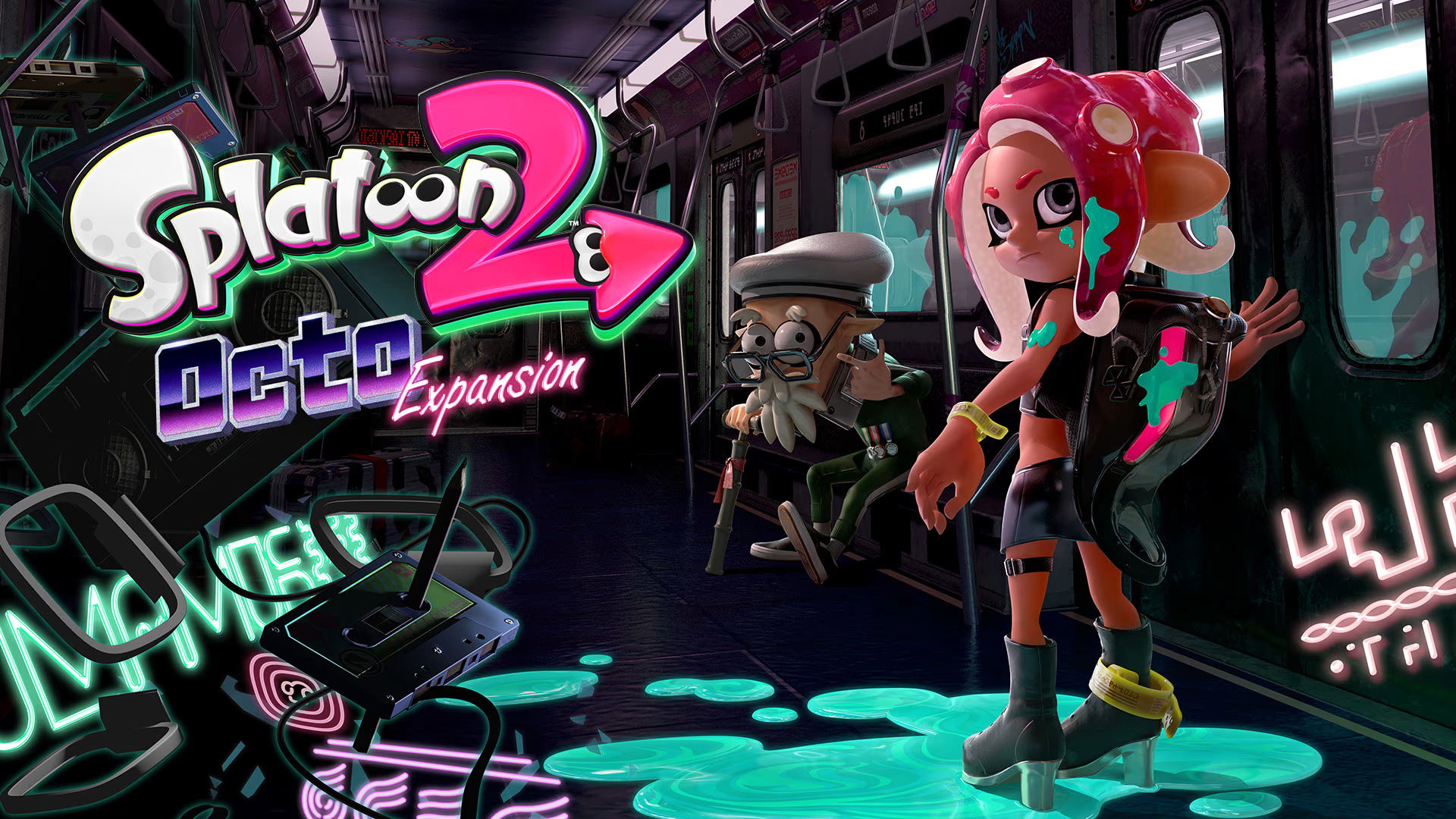
Few multiplayer games make the battlefield feel as playful and strategic as Splatoon 2. Released for Nintendo Switch in 2017, the sequel took the original Splatoon formula and expanded it with more weapons, stages, modes, gear, and ways to play. Instead of asking players to simply eliminate the opposing team, it made control of the environment the heart of every match.
That simple change has important consequences. Ink is not just ammunition or decoration. It determines where you can move quickly, where you can hide, which routes are safe, and how much territory your team controls. A player can contribute by painting, supporting teammates, disrupting opponents, or controlling an important area without necessarily having the highest number of eliminations.
This is why Splatoon 2 remains interesting beyond its colorful presentation. Beneath the bright characters and energetic soundtrack is a competitive game built around positioning, timing, resource management, teamwork, and rapid adaptation. Whether you are returning to the Nintendo Switch title or trying to understand why it became such an important part of Nintendo’s multiplayer lineup, its design offers plenty to examine.
What Makes Splatoon 2 Different?
The most important idea in Splatoon 2 is the relationship between ink and movement.
Players can fight in two forms:
- Humanoid form, used for shooting, attacking, and interacting with the battlefield
- Squid form, used to swim through friendly ink quickly and replenish ink
This creates a constant cycle.
You cover the environment with your team’s ink, transform into squid form, move through that ink, refill your tank, and return to humanoid form when you need to attack or paint.
The battlefield therefore becomes part of your movement system.
In a conventional shooter, the map usually remains visually stable. In Splatoon 2, players continually modify it.
That makes every match dynamic.
Turf War: Simple Rules, Serious Strategy
Turf War is the easiest mode for a new player to understand.
Two teams compete to cover as much of the stage as possible with their color of ink. At the end of the match, the team controlling more territory wins.
The rules are simple, but good Turf War strategy is not.
A common beginner mistake is to focus exclusively on chasing opponents.
That can be counterproductive.
An opponent with a high elimination count may still lose if their team fails to control enough territory. Conversely, a player who spends much of the match painting strategically can make an enormous contribution without dominating the scoreboard.
The Final Seconds Matter
Turf War has an especially interesting ending because the match can change dramatically near the finish.
A team that appears comfortable can lose territory during a coordinated final push.
This creates a useful strategic lesson:
Do not assume the match is over until it actually ends.
Players need to balance attacking the opposition with protecting their own territory, especially during the final moments.
Ranked Battles Add Objective-Based Strategy
Players looking for a more competitive experience can move beyond Turf War into ranked modes.
Splatoon 2’s ranked lineup includes:
- Splat Zones
- Tower Control
- Rainmaker
- Clam Blitz
Each mode changes the meaning of map control.
Splat Zones
Teams fight to control designated areas.
The objective encourages players to think about territory, positioning, and coordinated pushes. Simply getting eliminations is not enough if your team cannot maintain control.
Tower Control
Teams fight over a moving tower and attempt to push it toward the opposing side.
This creates situations where players have to decide whether to escort the objective, defend it, or attack opponents threatening the push.
Rainmaker
The Rainmaker introduces a powerful objective that teams must carry toward the opposing goal.
Because the carrier becomes strategically important, protecting the objective and controlling routes become critical.
Clam Blitz
Clam Blitz adds another layer by requiring teams to collect clams and use them to score against the opposing basket.
The mode demands more coordination and awareness because players must think about both resource collection and scoring opportunities.
The important point is that each ranked mode rewards a different interpretation of teamwork.
Weapons Are Designed Around Playstyles
One of Splatoon 2’s greatest strengths is its weapon variety.
The game includes multiple weapon categories, each with different strengths, weaknesses, ranges, and roles.
Examples include:
- Shooters
- Rollers
- Chargers
- Sloshers
- Splatlings
- Dualies
- Brellas
- Brushes
The differences are not purely cosmetic.
A charger player may specialize in long-range pressure and controlling sightlines. A roller can excel at close-range combat and efficient painting. A splatling can provide sustained ranged pressure, while dualies offer mobility-oriented combat options.
This means choosing a weapon is partly a decision about how you want to contribute to your team.
Why Weapon Choice Matters So Much
New players sometimes select weapons based only on damage or appearance.
That can lead to disappointing results.
A weapon that looks powerful may not fit your preferred movement or decision-making style.
Instead, ask:
- Do I prefer close or long range?
- Do I like aggressive play?
- Am I comfortable supporting teammates?
- Do I enjoy controlling territory?
- How much mobility do I need?
- How quickly does the weapon consume ink?
- What happens when an opponent gets close?
These questions are more useful than simply asking which weapon is “best.”
Sub Weapons and Special Weapons
A weapon’s primary attack is only one part of its identity.
Sub weapons provide additional tactical options, while special weapons can dramatically influence a battle when used effectively.
This creates another resource-management problem.
Players have to consider when to use an ability rather than automatically activating it whenever it becomes available.
A special weapon used at the right moment can help:
- Start a push
- Defend an objective
- Force opponents away
- Recover territory
- Protect teammates
- Break a defensive setup
Timing is often more important than simply using the ability quickly.
Gear and Ability Customization
Splatoon 2 also allows players to customize their characters with gear.
Different clothing pieces can provide ability effects that influence gameplay.
Depending on the build, players may prioritize characteristics related to:
- Movement
- Ink efficiency
- Recovery
- Special usage
- Defensive utility
- Respawn-related advantages
This creates a lightweight build-customization system.
The best setup depends heavily on the weapon and role you are using.
For example, a player who relies on frequent movement may value different abilities from someone who spends more time controlling long sightlines.
Understanding Ink Management
Ink management is one of the game’s most important skills and one of the easiest for beginners to overlook.
Every attack consumes ink.
When the tank becomes empty, you cannot simply continue firing.
That means aggressive players need to know when to stop attacking and switch into squid form to recover.
A Simple Rule for New Players
Avoid entering a fight with an almost empty ink tank unless you have a clear reason.
Running out of ink at the wrong moment can leave you unable to:
- Attack
- Escape
- Paint a route
- Use certain abilities
- Reposition effectively
Experienced players learn to think about ink as a resource rather than an unlimited supply.
Movement Is More Important Than It Looks
Splatoon 2’s movement system is one of the reasons it feels different from conventional shooters.
Swimming through friendly ink allows players to move quickly and disappear from view.
This enables several tactics.
You can:
- Flank an opponent
- Escape after taking damage
- Move between objectives
- Reposition quickly
- Approach a fight from an unexpected direction
However, swimming through enemy ink can slow or restrict movement, making territorial control strategically important.
The result is a fascinating relationship between offense and environment.
Painting creates mobility, and mobility creates opportunities.
Map Awareness Wins Matches
Knowing the map is not just about memorizing its shape.
Players need to understand:
- Common engagement areas
- Safe routes
- Flanking paths
- High-ground positions
- Choke points
- Objective locations
- Areas that are difficult to escape from
A player who understands these patterns can often make better decisions before an opponent even appears.
This is particularly important in ranked modes, where controlling a strategically important location can matter more than chasing an isolated opponent.
Salmon Run: Cooperative Splatoon 2
Salmon Run provides a completely different experience from competitive multiplayer.
Instead of fighting another player-controlled team, players cooperate to defeat waves of enemies and collect Golden Eggs.
The mode introduces its own rhythm.
Teams need to:
- Defeat incoming enemies.
- Deal with special threats.
- Collect Golden Eggs.
- Deposit enough eggs into the basket.
- Survive each wave.
- Adapt as difficulty increases.
Communication and positioning become especially important because one player’s mistake can create problems for the entire team.
Why Salmon Run Feels Different
In competitive modes, players can often focus heavily on opponents.
In Salmon Run, the environment itself becomes the threat.
Enemies can appear from multiple directions, while special enemies create specific tactical problems.
This encourages players to watch the battlefield continuously rather than focusing on one target.
It also rewards cooperation.
A player who ignores teammates and plays entirely for personal statistics can make the entire team less effective.
Single-Player Content
Splatoon 2 is not exclusively an online multiplayer game.
The single-player campaign provides a structured environment for learning movement, weapons, enemies, and mechanics.
This is useful for beginners because it allows them to practice without the immediate pressure of competitive matches.
The Octo Expansion also added a substantial single-player experience designed around challenging scenarios and increasingly demanding objectives.
For players who enjoy learning through structured challenges, this content offers a very different side of the game.
The Importance of Team Roles
Splatoon 2 does not use rigid character classes in the same way as some team-based games, but players can still develop recognizable roles.
A team might effectively include:
- A frontline fighter
- A ranged pressure player
- A territory-focused player
- A support-oriented player
These roles can overlap.
The important lesson is that four players doing exactly the same thing is not always better than a team with complementary strengths.
Stop Chasing Every Opponent
One of the most useful lessons for beginners is learning when not to pursue an enemy.
Suppose an opponent retreats from an objective.
You can chase them.
But doing so may pull you away from the area your team actually needs to control.
Before pursuing someone, ask:
“What does my team gain if I follow them?”
If the answer is unclear, maintaining your position may be the better decision.
Common Beginner Mistakes
Focusing only on eliminations
Splatoon 2 is not a conventional elimination-focused shooter.
Better: think about territory and objectives first.
Ignoring your own team’s ink
Moving through friendly ink is a major advantage.
Better: maintain useful movement routes rather than leaving large areas covered by enemy ink.
Using specials immediately
A special weapon can be much more valuable during an organized push or defensive moment.
Better: wait for a situation where its effect can influence the objective.
Fighting while low on ink
Running out of ammunition during a close fight is dangerous.
Better: learn to retreat and refill before committing to another engagement.
Ignoring the minimap
The map can reveal important information about territory and potential threats.
Better: develop the habit of checking it regularly.
How to Improve at Splatoon 2
You do not need to master every weapon to become a better player.
Start with one weapon that feels comfortable.
Then focus on three areas.
1. Improve positioning
Ask why you died.
Were you exposed?
Were you too far forward?
Did you enter an area without an escape route?
2. Improve map awareness
Learn where opponents are likely to approach from.
3. Improve objective awareness
Before engaging an opponent, identify what your team is actually trying to accomplish.
This prevents unnecessary fights.
A Better Way to Practice
Instead of playing match after match without reflection, give each session a specific goal.
For example:
Session goal: Improve survival.
During the next several matches, concentrate on avoiding unnecessary deaths.
Or:
Session goal: Improve objective awareness.
Before every major engagement, identify where the objective is and whether your position helps your team.
Focused practice makes mistakes easier to recognize.
The Art Direction Is Part of the Gameplay Experience
Splatoon 2’s colorful aesthetic is not simply decoration.
The bright visual identity makes the central mechanic immediately understandable.
Ink colors provide information.
Characters are highly recognizable.
Stages have strong visual identities.
The overall presentation feels energetic without copying the darker military style associated with many shooters.
That distinctive personality helped Splatoon become recognizable as its own genre identity rather than simply “Nintendo’s colorful shooter.”
Music and Atmosphere
The soundtrack contributes heavily to the game’s personality.
Energetic music accompanies battles, while the broader world uses a mixture of unusual visual and musical ideas to create an identity that feels separate from conventional shooter design.
The result is a game that takes competition seriously without presenting itself as grim or realistic.
That balance is one of Splatoon’s most successful creative choices.
The Legacy of Splatoon 2
Splatoon 2 occupies an important position in Nintendo’s multiplayer history.
It demonstrated that a competitive shooter could be:
- Accessible
- Colorful
- Family-friendly in presentation
- Mechanically deep
- Team-oriented
- Highly distinctive
Its success also helped establish Splatoon as a major Nintendo franchise rather than a one-off experiment.
While later entries expanded the series further, Splatoon 2 remains important because it refined many of the mechanics that defined the modern identity of the franchise.
Is Splatoon 2 Still Interesting?
For someone who already owns the game, its value comes from the depth of its mechanics rather than novelty alone.
The basic rules are easy to understand, but mastering movement, weapon matchups, positioning, map control, and objective timing takes considerably longer.
That creates a familiar pattern seen in strong multiplayer games:
Easy to start, difficult to master.
The experience becomes particularly rewarding when players stop measuring success only through eliminations and begin understanding how their actions affect the entire battlefield.
Three Things Players Often Miss
Painting is a tactical resource
Ink coverage is not merely about increasing a percentage at the end of Turf War.
It creates movement routes, hiding places, escape options, and pressure.
A small patch of friendly ink in the right location can sometimes be more valuable than a much larger patch somewhere irrelevant.
Retreating can create an advantage
Leaving a fight does not necessarily mean losing it.
If you survive, refill your ink, and return from a better position, you may contribute more than you would have by forcing a low-probability fight.
Your role can change during a match
You might begin aggressively attacking but later need to defend.
Or you might spend the opening period painting and then transition into supporting a teammate’s push.
Strong players respond to the match rather than rigidly following one role from beginning to end.
Conclusion
Splatoon 2 succeeds because its colorful presentation hides a surprisingly sophisticated competitive system.
Ink affects territory, movement, visibility, and strategy. Weapons encourage different playstyles. Ranked modes introduce specialized objectives, while Salmon Run demonstrates how the same mechanics can support cooperative play. Single-player content provides another way to learn the game’s systems, and gear customization gives players additional control over their preferred style.
The most important lesson is that Splatoon 2 is not simply about getting more eliminations. Winning often depends on understanding space: where your team needs to be, where opponents are likely to appear, when to push, when to retreat, and how to turn ink coverage into an advantage.
That is what gives the game its lasting character.
It looks playful, but its fundamentals are serious. It is accessible without being shallow, competitive without demanding a grim atmosphere, and simple enough to understand while offering plenty of room for mastery.
For players willing to look beyond the colorful surface, Splatoon 2 remains an excellent example of how a small mechanical idea—covering the world in ink—can become the foundation for an entire multiplayer strategy system.
FAQ
What is Splatoon 2?
Splatoon 2 is a multiplayer-focused Nintendo Switch game built around teams using ink-based weapons to control stages and complete objectives. It includes Turf War, ranked modes, Salmon Run, and single-player content. Its unique combination of shooting, painting, and swimming gives it a distinct gameplay style.
Is Splatoon 2 difficult for beginners?
The basic controls are relatively easy to learn, but becoming consistently good takes practice. Players need to understand movement, ink management, positioning, weapons, map layouts, and objectives. The single-player content and Turf War provide approachable ways to learn the fundamentals.
What is the best weapon in Splatoon 2?
There is no single weapon that is universally best for every player or situation. Weapon effectiveness depends on the stage, mode, team composition, matchup, and player’s skill. A better approach is to choose a weapon whose range, mobility, ink consumption, and abilities match your preferred playstyle.
What is Salmon Run in Splatoon 2?
Salmon Run is a cooperative mode where teams fight waves of AI-controlled enemies and collect Golden Eggs. Players must work together to meet the quota before each wave ends. The mode emphasizes communication, positioning, resource management, and rapid responses to changing threats.
What is the difference between Turf War and ranked battles?
Turf War primarily rewards teams for covering more of the stage with their ink. Ranked modes use specific objectives such as controlling zones, moving the Tower, carrying the Rainmaker, or scoring Clams. As a result, ranked battles generally require more specialized coordination and objective awareness.
Is Splatoon 2 still worth playing?
For players who enjoy its mechanics and already have access to the game, Splatoon 2 offers substantial depth through its weapons, modes, customization, and single-player content. Its design remains distinctive because ink affects both combat and movement. However, players should also consider the current online environment and the availability of newer entries in the series when deciding where to spend their time.