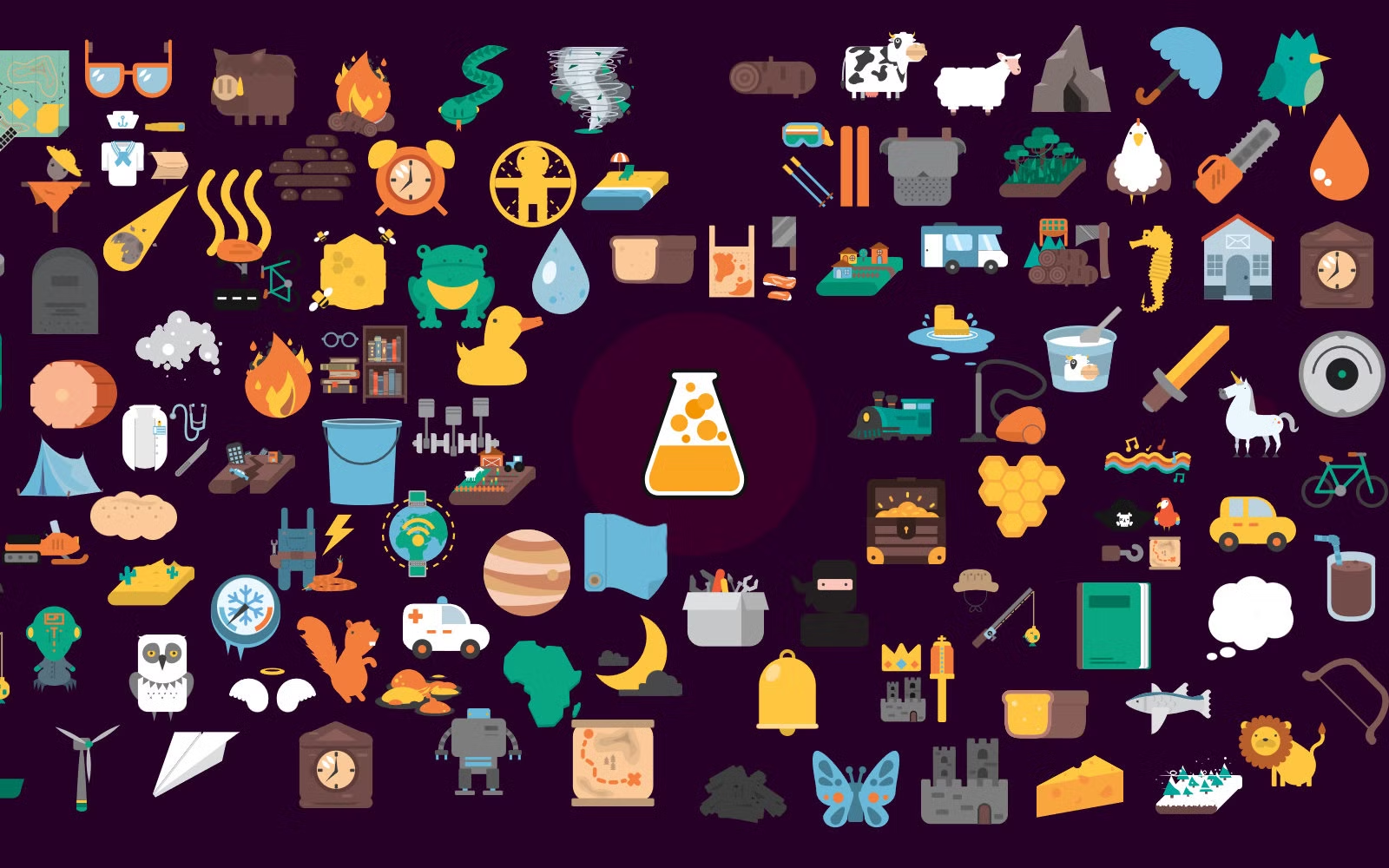
There is something strangely satisfying about putting two simple things together and discovering something you did not expect. That feeling is exactly what makes Little Alchemy 2 so compelling. You begin with only four basic elements—air, earth, fire, and water—and gradually turn them into hundreds of objects, ideas, creatures, technologies, and fantastical discoveries.
At first, the game looks almost too simple. There are no complicated controls, no combat system, no traditional levels and no pressure to beat a clock. You simply combine two items and see what happens. Yet that simplicity hides a surprisingly deep crafting system.
Released in 2017 as the sequel to Little Alchemy, the game was developed by Recloak and expanded the original concept with a new visual style, soundtrack, encyclopedia and a much larger collection of discoveries. The official game currently lists hundreds of items, while its official help material describes 720 free items in the core game.
But Little Alchemy 2 is more than a combination puzzle. Its real appeal comes from curiosity: you are constantly asking yourself what might happen if two completely different ideas are brought together.
What Is Little Alchemy 2?
Little Alchemy 2 is a crafting and discovery puzzle game created by Recloak. It is available to play in a web browser and through mobile platforms, and the basic concept is extremely easy to understand.
You start with:
- Air
- Earth
- Fire
- Water
You combine two items at a time. When a valid recipe exists, a new item appears and is added to your collection.
The official game presents this as creating a world from scratch, and that description captures the central idea well.
The important detail is that not every combination behaves like real chemistry. Some recipes are based on physical processes, some on word associations, some on cultural ideas, and others are deliberately humorous.
That mixture is what keeps the game unpredictable.
How Little Alchemy 2 Works
The basic gameplay loop takes only a few seconds to learn.
- Choose an item from your collection.
- Drag it into the workspace.
- Add a second item.
- See whether the combination produces something new.
- Save the discovery in your encyclopedia.
- Use the new item to experiment with further combinations.
For example, some early combinations include:
- Earth + Air = Dust
- Earth + Fire = Lava
- Earth + Lava = Volcano
- Fire + Stone = Metal
The official hints database confirms several of these recipes and also shows that many items have multiple possible creation paths.
This last point is important for new players. You should not assume that every item has one unique recipe. Some discoveries can be created through several different combinations.
That means getting stuck on one particular recipe does not necessarily mean you have taken the wrong path.
The Four Starting Elements
The four starting elements are the foundation of the entire game.
Air
Air represents atmosphere, movement and many concepts connected with the sky and weather.
It becomes useful surprisingly quickly because it can combine with basic elements to produce things such as dust and other intermediate materials.
Earth
Earth is one of the most productive starting elements. It connects naturally with fire, air and water and eventually leads toward land, stone, soil, minerals and many more advanced discoveries.
Fire
Fire is another extremely versatile element.
It can produce heat-related concepts and combine with materials to create things such as metal. The official recipe database, for example, lists fire + ore and fire + stone among the ways to make metal.
Water
Water opens pathways into weather, life, plants, liquids and many natural processes.
It is especially useful when you start exploring combinations involving earth, air and energy.
The clever part is that these four elements are not merely introductory objects. They remain conceptually important even after you have discovered hundreds of other items.
Why the Game Becomes More Interesting Over Time
The first few discoveries happen quickly.
You combine obvious things and immediately receive new materials. Then those materials become ingredients for something else.
Eventually, the game changes character.
Instead of thinking:
“What does fire make?”
you start thinking:
“What can I make with something that came from fire?”
That second question is where Little Alchemy 2 becomes much more interesting.
A single discovery can create an entirely new branch of possibilities.
For example, creating a material may eventually lead to tools. Tools can lead to human inventions, which can lead to buildings, transportation, science or technology.
The official hints system specifically points out that items such as human, plant and life can lead to many additional discoveries.
This creates a chain-reaction effect: one successful combination can suddenly give you several new directions to investigate.
Little Alchemy 2 Is Not Really About Chemistry
One of the biggest misconceptions about the game is assuming that every recipe follows real scientific rules.
It does not.
The game uses real-world logic as inspiration, but it also relies heavily on language and imagination.
That distinction explains why certain combinations feel scientifically reasonable while others seem completely unexpected.
The official hints guide even encourages players to “try with science in mind,” while acknowledging that the combinations are simplified.
Think of the game as a mixture of:
- Basic science
- Word association
- Cultural references
- Logic puzzles
- Humor
- Creative experimentation
That is why approaching every recipe like a chemistry equation can actually make the game harder.
Sometimes the correct answer is based on what two concepts represent rather than what two substances would physically produce.
The Encyclopedia Makes Discovery More Satisfying
One of the strongest improvements over a basic combination puzzle is the game’s encyclopedia.
Newly discovered items are recorded, allowing players to keep track of their progress instead of trying to remember every combination.
Each discovery also has a short description, which gives the objects personality.
This matters because Little Alchemy 2 is not only about collecting items. The descriptions turn the collection into something closer to a playful dictionary of the world you have created.
The official game specifically highlights its encyclopedia and item descriptions as part of the experience.
For completion-oriented players, this becomes particularly important.
You are no longer simply playing until you get bored. You begin noticing the empty spaces in your collection and wondering what you have not discovered yet.
What Happens When You Get Stuck?
Getting stuck is part of the design.
With hundreds of items available, there will eventually be combinations that seem impossible.
The game provides hints rather than forcing you to stop experimenting.
The official hint system can reveal an item that you can make from things already discovered, but it does not immediately reveal the complete recipe. This preserves some of the challenge while giving you a direction to explore.
There are also personalized hints in the current experience, while the official hints database can be used to look up specific recipes when you need a direct answer.
A better strategy than randomly combining everything
When you are stuck, do not immediately try every possible pair.
Instead:
- Look at your newest discoveries.
- Identify items with many possible meanings.
- Try combining those items with basic elements.
- Think about synonyms and associations.
- Consider whether the intended result is scientific, cultural or humorous.
- Use a hint only when experimentation stops being productive.
This approach makes the game considerably less frustrating.
Why Little Alchemy 2 Feels So Addictive
The game does not need traditional rewards to keep players engaged.
Every successful combination provides a small moment of surprise.
You expected one thing and received another.
That creates a simple psychological loop:
curiosity → experiment → discovery → satisfaction → new curiosity
The important part is that the reward is information.
You are not primarily earning points or defeating an opponent. You are learning something new about the game’s internal world.
That makes each discovery feel meaningful.
A failed combination can also be useful because it tells you that a particular relationship does not work. Since the game does not punish you for experimentation, failure becomes part of the research process.
There Is No Need to Rush
One of Little Alchemy 2’s biggest strengths is its relaxed structure.
The game does not depend on fast reflexes. You can stop and think about a combination for as long as you want.
This makes it very different from action-oriented mobile games.
You can play for:
- Five minutes while taking a break
- Twenty minutes while exploring recipes
- An hour while trying to complete a large section of the encyclopedia
The absence of traditional pressure is part of the appeal.
The official hints guidance emphasizes that there is no penalty for exploring and encourages players to try combinations that come to mind.
Little Alchemy 2 vs. the Original Little Alchemy
The original Little Alchemy established the basic formula: begin with four elements and combine them to create new things.
Little Alchemy 2 keeps that foundation but significantly expands the experience.
| Feature | Little Alchemy | Little Alchemy 2 |
|---|---|---|
| Starting elements | 4 | 4 |
| Core gameplay | Combine elements | Combine elements |
| Visual design | Simpler | More developed art style |
| Music | More limited | Original soundtrack |
| Collection system | Basic | Expanded encyclopedia |
| Discoveries | Hundreds | 720 free core items |
| Content | Original set | Expanded recipes and content |
The official Little Alchemy website describes Little Alchemy 2 as the sequel with new visuals, combinations and an original soundtrack.
The sequel therefore did not need to reinvent the formula. It refined what already worked.
The 720-Item Milestone
A commonly repeated description of Little Alchemy 2 is that it has “over 700 items.”
That is broadly accurate, but there is a more precise figure worth knowing.
The official help-center changelog states that version 1.2.0 added 20 new items, bringing the game to 720 free items.
The official hints system continues to describe the game as featuring hundreds of items and identifies major discoveries such as human, life, plant, tree, clay and time.
There are also additional content packs, including Myths and Monsters, so the overall experience can extend beyond the core free collection.
This is one reason it is better to describe the game as having a large collection of discoveries rather than suggesting that there is only one fixed list of recipes.
Time Is an Important Special Discovery
One particularly interesting design choice is Time.
Unlike ordinary items, Time is not simply another object that you create by combining two ingredients.
The official community documentation identifies Time as a special item that becomes available after reaching a progress requirement: discovering 100 elements, including the starting elements.
This creates a subtle change in the player’s mindset.
Most of the game teaches you:
Combine two things to create something new.
Time teaches you:
Sometimes progress itself unlocks a new possibility.
That is a clever way of rewarding players who explore widely rather than repeatedly chasing one recipe.
Multiple Recipes Make the Game Less Rigid
Another underappreciated feature is that some items can have several recipes.
For example, the official database lists numerous ways to create items such as field, including combinations involving earth, farmer, tool, land, soil and plow.
This has an important gameplay consequence.
You do not always need to follow a single “correct” path.
If one route requires an item you have not discovered, another route may already be available through your existing collection.
This makes experimentation more rewarding and reduces the feeling that the game is simply asking you to memorize a giant answer sheet.
The Educational Side of Little Alchemy 2
Although Little Alchemy 2 is primarily entertainment, it can encourage several useful thinking habits.
Pattern recognition
Players begin noticing relationships between objects and concepts.
Lateral thinking
Not every answer is obvious or literal, so you learn to consider alternative interpretations.
Classification
The encyclopedia naturally encourages players to organize discoveries mentally.
Persistence
You often need several failed attempts before finding a successful combination.
Curiosity
Perhaps most importantly, the game rewards asking questions.
“What happens if I combine these?”
That is the basic question behind both the game and many forms of real-world discovery.
However, it is important not to treat the game as a scientific simulator. Its recipes are intentionally simplified and sometimes fantastical.
A Better Way to Play Little Alchemy 2
If your goal is to discover as many items as possible without constantly checking a recipe guide, use a systematic approach.
Start with broad categories
Think about:
- Natural elements
- Weather
- Materials
- Living things
- Humans
- Tools
- Technology
- Buildings
- Space
- Mythology
Once you create something belonging to one category, try it against items from another category.
Prioritize productive items
Some discoveries open far more possibilities than others.
The official hints guide specifically notes that human and plant are examples of items that can lead to many additional discoveries.
When you discover a major “hub” item like this, experiment with it extensively before moving on.
Keep your workspace manageable
As your collection grows, your workspace can become cluttered.
Clear completed or unnecessary items regularly so that you can focus on the combinations that matter.
The game’s item system also recognizes special categories such as final and depleted items, which can disappear from the active workspace when they no longer have useful combinations.
Common Mistakes New Players Make
Trying only literal combinations
If you assume every recipe must make physical sense, you will miss many discoveries.
Repeating the same failed combination
If fire + water does not give you the result you expected, changing the order usually will not magically solve the problem. Try a different concept.
Ignoring newly created items
A new item is not just a collectible. It is a new ingredient that may unlock an entire branch.
Using cheats too early
Recipe guides are useful, but using them immediately can remove the most enjoyable part of the game: figuring something out yourself.
Assuming every item has one recipe
Many discoveries have multiple routes, so an apparently impossible recipe may simply require a different path.
Why Little Alchemy 2 Still Works
The game’s longevity comes from an unusual combination of simplicity and depth.
The rules are easy enough for almost anyone to understand, but the number of possible discoveries keeps the experience open-ended.
There is also no single way to enjoy it.
A casual player might spend ten minutes making funny objects. A completionist might try to uncover every available item. Someone interested in puzzles may focus on finding efficient paths. Another player may simply enjoy reading the descriptions attached to discoveries.
The underlying system accommodates all of them.
That flexibility is difficult to achieve in a small puzzle game.
The Deeper Idea Behind the Game
There is a reason the concept of alchemy works so well in games.
Alchemy is fundamentally about transformation.
Take something ordinary and turn it into something extraordinary.
Little Alchemy 2 translates that ancient idea into a digital playground.
Instead of trying to transform lead into gold, you transform abstract concepts into new concepts. Instead of secret laboratories and mysterious manuscripts, you have a simple workspace and a collection of icons.
But the underlying human impulse is remarkably similar.
You experiment because you want to know what is possible.
That is the real magic of the game.
FAQ
What is Little Alchemy 2?
Little Alchemy 2 is a crafting and discovery puzzle game developed by Recloak. Players begin with air, earth, fire and water and combine two items at a time to create new discoveries. The game features hundreds of items, an encyclopedia and optional hints.
How many items are in Little Alchemy 2?
The core free game has 720 items, according to the official help-center changelog. Additional content, including the Myths and Monsters pack, can expand the experience beyond the core collection.
Is Little Alchemy 2 free to play?
The browser version is available to play, while mobile versions can include advertising and optional in-app purchases. The Google Play listing identifies the game as containing ads and in-app purchases.
What are the four starting elements in Little Alchemy 2?
You begin with air, earth, fire and water. These four elements form the foundation for the game’s crafting system and lead to progressively more complicated discoveries.
Is Little Alchemy 2 based on real chemistry?
Only partly. Many combinations are inspired by real-world science, but the game also uses wordplay, cultural references, fantasy and humor. The official hints guide specifically describes its scientific logic as simplified, so recipes should not be treated as real chemical reactions.
What should I do if I get stuck in Little Alchemy 2?
Start by experimenting with your newest and most versatile discoveries rather than randomly combining everything. You can also use the game’s official hint system, which can suggest an item you can create without immediately revealing its complete recipe.
Conclusion
Little Alchemy 2 succeeds because it makes discovery the reward.
You begin with four ordinary elements and gradually build an enormous collection of things. Some combinations make perfect real-world sense, while others depend on language, imagination or humor. That unpredictability is not a flaw; it is one of the reasons the game remains enjoyable.
The sequel improved on the original Little Alchemy with a richer visual style, original music, an expanded encyclopedia and a much larger collection of discoveries. Its core free collection reached 720 items, while additional content packs provide further ways to explore.
The most important lesson for players is simple: do not be afraid to experiment.
You do not need to know every recipe before starting. In fact, knowing everything in advance can take away the most satisfying part of the experience.
The real pleasure comes from dragging two familiar things together, watching something unexpected appear, and immediately wondering:
“What can I make with this?”
That question is the entire game—and it is also what makes Little Alchemy 2 so difficult to put down.