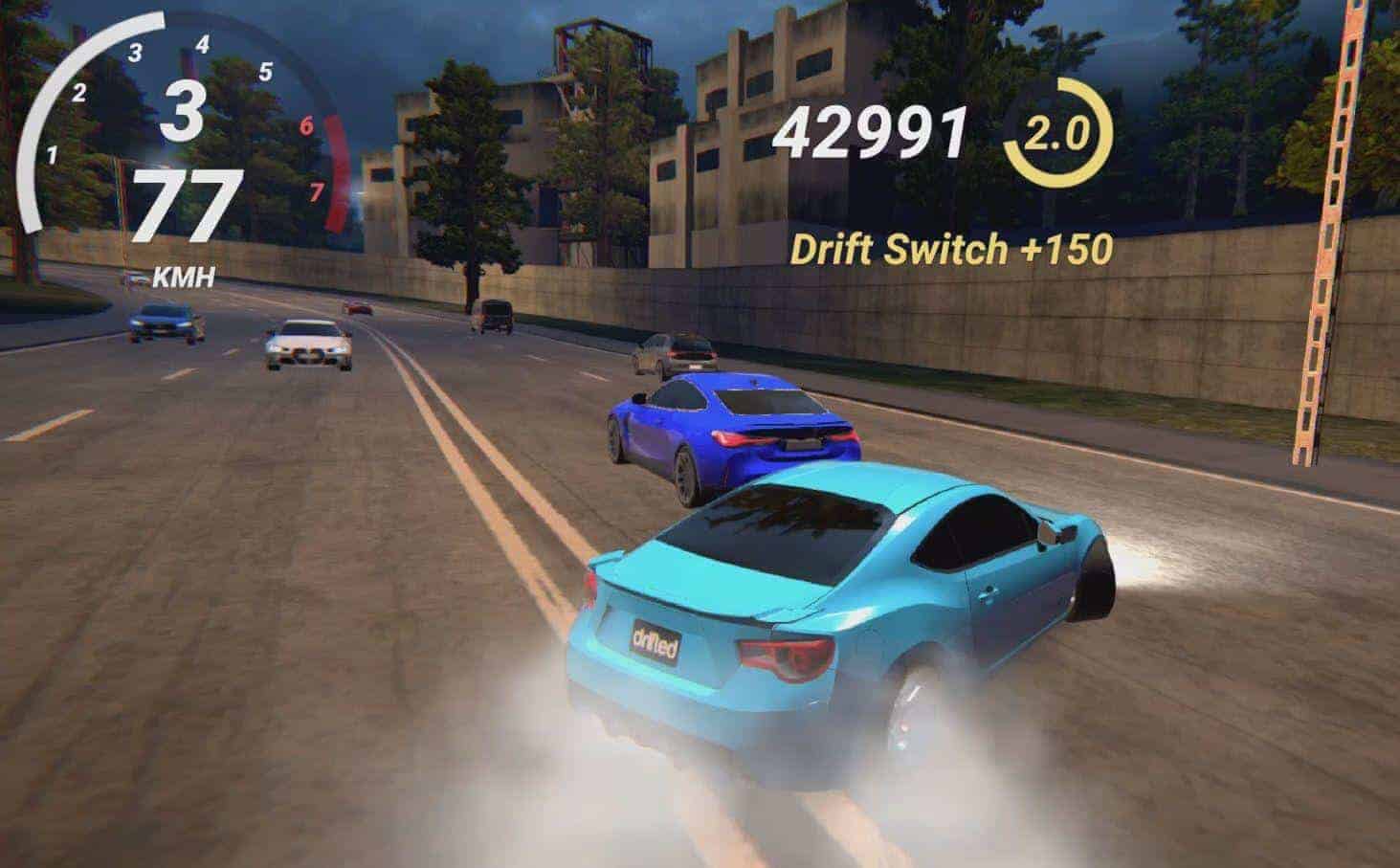
If you enjoy racing games but find ordinary circuit racing a little predictable, Drift Hunters Max offers a very different kind of challenge. The objective is not simply to reach the finish line first. Instead, the game puts the focus on controlling a car while it moves sideways, linking corners together, and building a setup that matches your driving style.
That makes the experience surprisingly technical. A good drift is not created by holding the handbrake and turning as hard as possible. Steering angle, throttle control, speed, weight transfer, tire grip, and the car’s power all work together. Once you understand those relationships, drifting becomes much easier to control.
This guide explains how the game works, how to choose and tune a car, how to earn more from successful drifts, and which mistakes commonly prevent beginners from improving. Whether you are opening the game for the first time or trying to make your existing setup more consistent, the goal is simple: spend less time spinning out and more time connecting clean, controlled drifts.
What Is Drift Hunters Max?
Drift Hunters Max is a browser-based drifting game centered on car control, customization, tuning, and score-based drifting.
Rather than emphasizing conventional racing, the game rewards players for producing controlled slides and maintaining drift chains. Cars can be modified and tuned so players can experiment with different handling characteristics.
The appeal comes from the combination of three systems:
- Driving technique
- Car customization
- Performance tuning
You can therefore approach the game in two different ways.
Some players simply want to drive and enjoy the sliding mechanics. Others enjoy treating the car like a project, adjusting its setup until it behaves exactly as they want.
That second layer gives the game much more replay value than a basic arcade racer.
Why Drifting Is More Difficult Than It Looks
Watching an experienced player drift can make the technique appear effortless.
In practice, several things happen simultaneously.
When a car enters a corner, weight shifts across the chassis. The rear tires lose some of their ability to maintain a straight trajectory, while steering and throttle determine how far the car rotates.
The driver then has to balance the slide.
Too little throttle can cause the car to straighten.
Too much throttle can create excessive wheelspin and rotation.
Too much steering can make the car spin.
This is why successful drifting is less about one button and more about maintaining a moving balance.
Understanding the Basic Drift
A simple drift can be broken into several stages.
1. Approach the corner
Enter with enough speed to generate the necessary weight transfer, but do not approach so quickly that you have no room to correct the car.
2. Initiate the slide
Use steering and, when appropriate, the handbrake to help rotate the car.
3. Countersteer
Once the rear begins to slide, steer against the direction of rotation to control the angle.
4. Manage throttle
Use the accelerator to maintain wheelspin and keep the car sliding.
5. Exit smoothly
Reduce the steering correction and throttle input as you leave the corner.
The exact balance changes from car to car.
That is one reason experimentation is so important.
The Most Important Skill: Throttle Control
Beginners often concentrate almost entirely on steering.
Experienced drifting depends heavily on the accelerator.
Think of throttle as a way to control the car’s rotation.
If the rear is rotating too aggressively, reducing throttle can help stabilize the vehicle.
If the car is beginning to straighten, additional throttle can help restore the slide.
This creates a continuous adjustment rather than a simple “accelerate or brake” decision.
A Useful Practice Exercise
Choose a relatively open area and practice holding a steady drift around a large curve.
Do not worry about your score.
Your only goal should be maintaining approximately the same angle for as long as possible.
Once you can control a steady slide, linking corners becomes much easier.
Choosing a Car
There is no single perfect drift car for every player.
A high-powered vehicle can produce dramatic slides, but excessive power can also make learning harder.
A more manageable car can give beginners better control and make it easier to understand how weight transfer and throttle affect the drift.
When choosing a car, consider:
- Power
- Weight
- Handling
- Acceleration
- Stability
- Your preferred driving style
High-Power Cars
These can be excellent for experienced players who understand throttle control.
Their additional power makes it easier to maintain wheelspin, especially during transitions or longer corners.
Lower-Power Cars
These can be useful for learning.
Because mistakes are sometimes less explosive, beginners can concentrate on line choice, steering, and maintaining momentum.
The fastest car is therefore not automatically the easiest car to master.
Car Customization Adds More Than Appearance
Customization is an important part of the Drift Hunters experience because players can change both the visual appearance and performance characteristics of their cars.
Depending on the available setup options, you may be able to modify areas such as:
- Engine performance
- Turbo or forced induction
- Brakes
- Suspension
- Tires
- Camber
- Ride height
- Steering-related settings
- Wheels and visual details
The important distinction is between cosmetic customization and functional tuning.
A visually impressive car may not be easy to drive.
For consistent drifting, handling changes usually matter more than appearance.
Understanding Suspension Tuning
Suspension settings can significantly affect how a car responds during a slide.
There is no universal setup that works perfectly for every vehicle or track.
Instead, make one adjustment at a time.
If the car feels difficult to control, avoid changing five settings simultaneously.
For example:
- Adjust one suspension characteristic.
- Drive several corners.
- Compare the behavior.
- Keep the change if it helps.
- Revert it if it makes the car worse.
This method may feel slower, but it teaches you what each setting actually does.
Tire Grip and Drift Control
Grip is one of the most interesting balancing factors in a drifting game.
Too much grip can make it difficult to initiate a slide.
Too little grip can make the car unpredictable.
The ideal balance depends on your car, power level, track, and driving style.
A setup that works for a wide, fast corner may feel terrible on a tight technical section.
This is why copying another player’s setup does not guarantee the same results.
Their setup may have been built around a completely different driving approach.
Camber, Ride Height, and Other Adjustments
Advanced tuning settings can look confusing at first.
Do not change them simply because a particular number is considered “optimal.”
The better approach is to understand what problem you are trying to solve.
For example:
Problem: The car feels unstable during transitions.
Approach: Make a small handling adjustment and test it.
Problem: The rear breaks loose too suddenly.
Approach: Experiment with grip, power delivery, or suspension behavior.
The objective of tuning is not to create a theoretically perfect setup.
It is to create a car that you can control consistently.
How Drift Scoring Works
The scoring system is designed to reward sustained and controlled drifting.
Generally, maintaining a drift, linking corners, and avoiding unnecessary interruptions can produce better results than repeatedly initiating short slides.
A useful scoring mindset is:
Flow beats chaos.
A long, controlled drift is usually more valuable than a dramatic spin followed by a restart.
How to Build Better Drift Chains
Try to:
- Maintain momentum
- Connect corners smoothly
- Avoid unnecessary straight sections
- Control your angle
- Stay within the useful part of the track
- Avoid collisions
- Keep throttle inputs smooth
The cleaner your run becomes, the easier it is to build consistency.
Why Long Drifts Are Not Always Better
It is tempting to chase the biggest possible angle.
That can actually reduce your score potential if the car becomes difficult to control.
A huge angle that ends in a spin is less useful than a moderate angle maintained through several corners.
Think about control first, angle second.
Once your car feels stable, you can gradually increase the aggression of your driving.
Track Selection and Practice
Different track layouts encourage different drifting techniques.
Wide areas are useful for learning because they provide room for corrections.
Tighter sections demand greater precision.
Start With Open Corners
Practice:
- Entry speed
- Initiation
- Countersteering
- Throttle control
Then move toward:
- Linked corners
- Narrower sections
- Faster transitions
- More technical layouts
This progression helps prevent the common beginner experience of spinning repeatedly and assuming the car is the problem.
Often, the real problem is simply entering the corner too aggressively.
The Importance of Drift Transitions
A transition occurs when the car moves from one direction of drift to another.
For example, imagine a left-hand corner followed immediately by a right-hand corner.
The car needs to transfer its rotation smoothly.
Poor transitions usually happen when the player:
- Uses too much steering
- Changes direction too suddenly
- Applies too much throttle
- Enters the second corner without enough momentum
Practice transitions separately rather than trying to perfect an entire track immediately.
Common Beginner Mistakes
Using the handbrake constantly
The handbrake can help initiate or adjust a drift, but relying on it for every corner makes it harder to learn proper weight transfer.
Better approach: use it selectively.
Holding full throttle
Maximum throttle is not always faster or better.
Better approach: learn to modulate the accelerator.
Entering corners too fast
Speed creates excitement but reduces your margin for correction.
Better approach: start slower and increase speed gradually.
Overcorrecting with the steering
Large steering movements can cause the car to snap or spin.
Better approach: use smaller, smoother corrections.
Changing too many tuning settings
If you alter everything at once, you will not know what actually improved the car.
Better approach: change one variable at a time.
Copying a setup without understanding it
A setup designed for another vehicle or driving style may feel completely wrong.
Better approach: use other setups as starting points, not universal formulas.
How to Improve Faster
If you want to become more consistent, structure your practice.
Stage 1: Learn one corner
Repeat the same corner until you can initiate and hold the drift reliably.
Stage 2: Add a second corner
Practice connecting the first drift to the next one.
Stage 3: Work on transitions
Concentrate on changing direction without losing control.
Stage 4: Increase speed
Only increase speed after the basic line becomes comfortable.
Stage 5: Tune the car
Once your driving is consistent, adjust the setup to solve specific problems.
This order matters.
A poor driver can easily mistake a driving problem for a tuning problem.
A Practical Tuning Method
Use this simple process whenever the car feels wrong.
Step 1: Describe the problem.
For example: “The rear spins too quickly.”
Step 2: Choose one likely cause.
It could involve power delivery, grip, or suspension behavior.
Step 3: Make a small adjustment.
Avoid extreme changes.
Step 4: Drive the same section again.
Consistency is important when comparing setups.
Step 5: Keep or reverse the change.
Over time, you will build a setup based on your own understanding rather than random numbers.
Graphics and Presentation
One reason browser drifting games remain appealing is accessibility.
Players can quickly enter a driving environment without committing to the complexity of a full racing simulator.
Drift Hunters Max combines that accessibility with customization and tuning, creating a middle ground between simple arcade driving and more demanding simulation-oriented experiences.
The result is particularly attractive to players who want to experiment with cars without learning an enormous collection of simulation systems first.
Drift Hunters Max vs. Traditional Racing Games
| Feature | Drift-focused gameplay | Traditional racing |
|---|---|---|
| Main objective | Controlled sliding and scoring | Completing races efficiently |
| Driving focus | Angle, throttle, transitions | Braking, racing lines, overtaking |
| Customization | Often central to progression | Varies by game |
| Mistakes | Spins and lost drift chains | Lost time or position |
| Best skill | Car control | Race strategy and consistency |
Neither approach is objectively better.
They simply reward different skills.
A player who enjoys perfecting a corner may prefer drifting, while someone who loves overtaking and lap strategy may prefer conventional racing.
Is Drift Hunters Max Good for Beginners?
It can be, provided beginners approach it as a learning experience rather than expecting immediate high scores.
The controls may be easy to understand, but controlled drifting takes practice.
New players should resist the temptation to immediately build the most powerful car possible.
Start with a manageable setup.
Learn how the car behaves.
Then increase power as your control improves.
This makes progression much less frustrating.
Three Insights That Are Easy to Miss
The best setup depends on your hands, not just the numbers
A theoretically strong setup can be terrible if it does not match how you steer and use throttle.
Your ability to control the car matters more than copying someone else’s settings exactly.
A slower entry can create a faster overall run
Entering a corner slightly slower can give you more control, allowing you to maintain the drift through the entire section.
Speed lost at entry can sometimes be recovered through a cleaner exit and better transition.
Tuning cannot compensate for inconsistent inputs
If your throttle and steering are unpredictable, changing suspension or power repeatedly will only hide the real problem.
Improve your inputs first.
Then use tuning to refine the behavior.
Who Should Play Drift Hunters Max?
The game is particularly suited to players who enjoy:
- Drifting
- Car customization
- Tuning
- Experimenting with handling
- Score chasing
- Browser-based racing games
- Learning through repetition
It is less suitable for someone looking exclusively for realistic wheel-and-pedal simulation or traditional competitive circuit racing.
Its strength is the focused drifting experience.
Final Thoughts
Drift Hunters Max works because it turns drifting into more than a visual effect. The player has to manage speed, steering, throttle, momentum, and vehicle setup while constantly adapting to the shape of the track.
The fastest route to improvement is not simply buying more power.
Learn one corner. Control the throttle. Make smaller steering corrections. Practice transitions. Then tune the car around the problems you actually experience.
Once those fundamentals become automatic, the game becomes much more satisfying. Long drift chains stop feeling accidental and start feeling deliberate.
That is ultimately what makes a good drifting game rewarding: the moment when the car, setup, and driver finally work together, and a difficult corner becomes a smooth, controlled slide.
FAQ
What is Drift Hunters Max?
Drift Hunters Max is a browser-based drifting game focused on sliding, car customization, tuning, and drift scoring. Players can experiment with different vehicles and performance setups while practicing controlled drifts across different environments. Its appeal comes from combining accessible controls with deeper vehicle adjustment.
How do you drift better in Drift Hunters Max?
Start by learning throttle control rather than relying heavily on the handbrake. Enter corners at manageable speeds, initiate the slide, countersteer smoothly, and use the accelerator to maintain the desired angle. Once you can consistently hold one corner, practice linking multiple corners together.
What is the best car for drifting?
There is no universally best car for every player. A powerful car may be effective for experienced players but can be difficult for beginners to control. The best choice is usually the vehicle whose power, handling, and balance match your current skill level and preferred driving style.
How should you tune a Drift Hunters Max car?
Tune the car according to a specific handling problem rather than copying a setup blindly. Suspension, grip, power, and other settings can affect how easily the car initiates and maintains a drift. Make one small adjustment at a time and test it repeatedly on the same section so you can understand the result.
How can you get higher drift scores?
Focus on maintaining controlled, connected drifts instead of maximizing angle at every opportunity. Smooth transitions, sustained slides, good momentum, and avoiding spins are generally more useful than aggressive inputs that frequently end the drift. Practice consistency before chasing extreme scores.
Is Drift Hunters Max realistic?
It is better described as a drifting-focused driving game than a full professional racing simulator. It incorporates vehicle handling and tuning concepts that give drifting some depth, while remaining accessible enough for browser-based play. Players looking for detailed real-world simulation may want a dedicated simulator, while casual drift enthusiasts can enjoy its simpler approach.