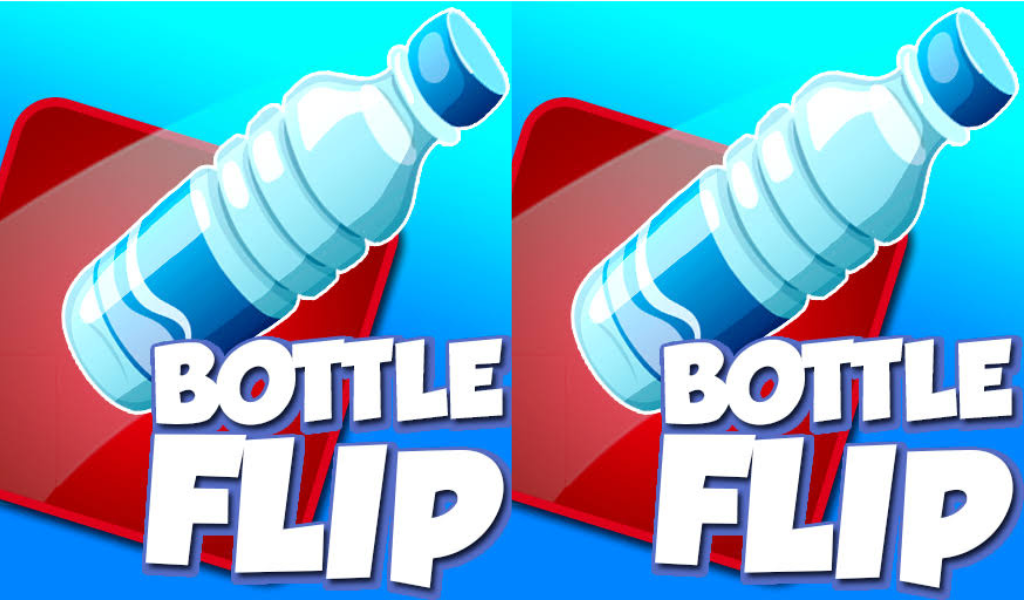
In a digital world bursting with mobile games, few have managed to capture the perfect blend of simplicity, challenge, and satisfaction quite like Bottle Flip 3D. What began as a viral internet challenge turned into a global gaming phenomenon that tests reflexes, timing, and patience in ways both entertaining and unexpectedly skillful.
This game, deceptively straightforward at first glance, taps into something deeply human—the thrill of mastery. Whether you’re a casual player looking for quick fun or a perfectionist chasing the perfect flip, Bottle Flip 3D delivers an experience that’s endlessly engaging.
Bottle Flip 3D – From Viral Craze to Gaming Sensation
To understand Bottle Flip 3D, we must go back to where it all started. The real-life bottle flip challenge exploded in 2016, when people began tossing half-filled plastic bottles into the air, trying to land them perfectly upright. It was part skill, part physics, and entirely addictive. Soon, social media feeds were filled with slow-motion flips, trick shots, and triumphant cheers.
Developers saw an opportunity. What if that same satisfaction could be recreated digitally—accessible anywhere, anytime, without the mess of water bottles falling all over the place? Thus, Bottle Flip 3D was born, bringing the physics-based fun of the real-world challenge into the palm of your hand.
The premise is brilliantly simple: you control a bottle that flips through the air, bouncing across shelves, tables, and furniture. The goal is to land perfectly after each jump without falling. The controls consist of a single tap or swipe—minimalism at its best—but behind this simplicity lies surprising depth.
Each flip requires perfect timing. Each surface behaves differently. And as levels advance, obstacles appear that force players to rethink their rhythm and strategy. The result? A game that’s easy to learn but difficult to master, a hallmark of the most successful mobile titles.
The Gameplay Formula That Keeps Players Hooked
At its core, Bottle Flip 3D thrives on the principle of incremental challenge. The early levels ease you in—short jumps, wide landings, simple arcs. Then, gradually, the game increases difficulty. Tables become farther apart. Moving platforms add motion. Lamps, books, and other household objects become unexpected landing zones.
This progression taps into the brain’s reward system. Every successful flip releases a small burst of dopamine—a reward for precision. Failures sting just enough to make success all the sweeter.
Simple Mechanics, Deep Strategy
Players quickly realize that success in Bottle Flip 3D isn’t just about reflexes. It’s about rhythm and intuition. The game’s physics engine behaves realistically, so you can’t rely on random luck. You have to feel the momentum of each flip. Tap too early, and the bottle barely moves; too late, and it over-rotates into oblivion.
The beauty of this mechanic lies in its immediacy. Each attempt takes seconds, and restarting is instant. This creates a “just one more try” loop that can keep players flipping for hours.
Sound and Visual Design
Part of the game’s charm lies in its clean, bright visuals. The environments—kitchens, offices, living rooms—are rendered with minimal clutter, keeping focus on the bottle itself. The crisp sounds of landing, the subtle “whoosh” mid-air, and the satisfying thud of success are all designed to immerse the player in a tactile experience.
The developers clearly understood that sensory feedback is key. That moment when the bottle lands upright, accompanied by that tiny sound cue, feels just as rewarding as a real-life flip.
The Psychology of Obsession – Why We Can’t Stop Flipping
There’s a fascinating psychology behind the obsession with Bottle Flip 3D. It taps into three powerful motivators that keep players coming back: mastery, unpredictability, and progress.
1. The Pursuit of Mastery
Humans love to master patterns. When you first play, success feels random. But with time, you begin to understand timing, weight, and rotation. The game doesn’t explain these mechanics outright—you learn by doing. That process of discovery, followed by gradual mastery, is deeply satisfying.
2. The Unpredictable Thrill
Each level introduces new elements—rotating fans, shifting tables, or precarious ledges. The unpredictability keeps players alert. You never quite know if your next flip will be triumphant or disastrous. It’s that uncertainty that fuels excitement.
3. The Reward of Progress
Every level cleared is a small victory. Unlockable bottles and themes—ranging from soda cans to exotic shapes—add layers of customization and reward. Progress is visible, tangible, and motivating.
Together, these elements create what psychologists call a “flow state”—that perfect balance between difficulty and skill where time seems to vanish.
The Rise of Mobile Physics Games
Bottle Flip 3D didn’t invent physics-based gaming, but it certainly perfected accessibility. Its success fits within a lineage of minimalist, physics-driven games like Flappy Bird and Stack. These games share a DNA: one-button controls, endless replayability, and a deceptively simple challenge.
Physics games appeal because they rely on natural laws players instinctively understand. Gravity, motion, balance—concepts we interact with daily—become sources of digital play. The pleasure comes from mastering those laws within playful constraints.
For Bottle Flip 3D, this means taking the universal experience of flipping a bottle and amplifying it through level design and progression. Each jump feels like a new puzzle—part physics, part rhythm, and part patience.
The Community and Cultural Impact
Part of Bottle Flip 3D’s enduring success lies in its social aspect. Players love sharing clips of their best flips, impossible landings, or unexpected fails. Social media platforms became extensions of the game itself—a digital playground where creativity and competition coexist.
Challenges such as “no-miss runs” or speed-flipping through levels have spawned an entire subculture of enthusiasts. Some even turn the game into performance art—creating montages, competing for precision records, or designing homemade bottle-flip setups that mirror the game’s virtual landscapes.
In classrooms, cafeterias, and online communities, Bottle Flip 3D evolved from a pastime into a phenomenon—a digital continuation of a real-world craze.
The Developer’s Masterstroke – Simplicity Meets Immersion
What makes Bottle Flip 3D so timeless is its design philosophy: simplicity with purpose. Unlike bloated modern mobile titles cluttered with ads and menus, this game offers instant gratification. Launch it, tap to flip, fail, try again. That’s it.
The developers understood that mobile players crave immediacy. A game should be playable in short bursts—on a commute, in a waiting room, or between classes. Yet those short bursts should feel meaningful.
This design ethos mirrors classic arcade games: limited mechanics, infinite mastery. Every replay is a chance to improve. Every improvement builds confidence. And every confident flip keeps players coming back.
Educational and Skill-Building Aspects
It may sound surprising, but Bottle Flip 3D isn’t just mindless entertainment—it subtly builds cognitive and motor skills.
Spatial Awareness
Understanding trajectories and distances in the game enhances spatial reasoning. You learn to predict movement, calculate angles, and anticipate landings intuitively.
Hand-Eye Coordination
The tap-timing mechanic sharpens coordination. Players unconsciously train their reflexes and timing precision—skills that transfer beyond gaming.
Patience and Persistence
Few games teach perseverance as effectively as Bottle Flip 3D. Each failure feels personal, but every retry reinforces patience and strategic adjustment. Over time, players learn resilience—a quiet lesson in persistence disguised as play.
The Future of Physics-Based Play
With its massive popularity, Bottle Flip 3D paved the way for countless imitators and spin-offs. Yet few have captured its delicate balance of realism and fun. The future of such games likely lies in enhanced realism through augmented reality (AR) and haptic feedback—imagine flipping a digital bottle in your living room via AR glasses, feeling the “impact” through subtle vibrations.
Developers continue to explore how physics-based mechanics can merge with storytelling or multiplayer modes. We might soon see Bottle Flip 3D evolve into collaborative or competitive formats where players race or strategize together in real time.
But no matter the innovations ahead, the heart of the game—its elegant simplicity—will remain timeless.
Why It Still Matters
Years after its release, Bottle Flip 3D remains a fixture on app charts for one reason: accessibility. Anyone can pick it up. Kids, teens, adults—no tutorials needed, no complex mechanics to memorize.
This universality makes it more than a passing trend. It represents a philosophy of design: creating joy from the simplest interactions. It reminds us that gaming doesn’t always need realism or high-end graphics—sometimes, all it takes is a bottle, gravity, and a tap of the finger.
Conclusion
Bottle Flip 3D is more than a mobile game—it’s a testament to how simplicity, when executed with precision, can create lasting impact. It captures the essence of play: the thrill of trying, failing, learning, and finally succeeding.
Every perfect flip carries a tiny spark of triumph, a reminder that mastery—digital or real—comes from persistence and patience.
In a gaming world often overwhelmed by complexity, Bottle Flip 3D stands as proof that less can truly be more. It’s fun distilled to its purest form—a digital echo of that satisfying thud when a bottle lands upright, perfectly balanced, and entirely earned.