
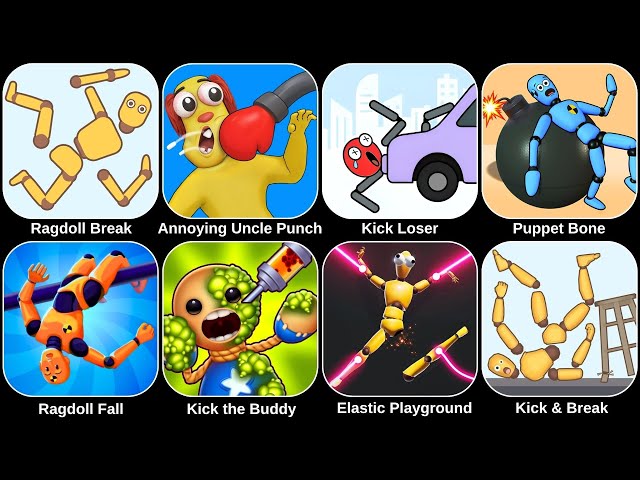
Ragdoll games have earned a unique place in gaming because they turn something that could be a technical feature—realistic character physics—into the main source of entertainment. A character can stumble, fall, bounce, collide with an object, or get launched across a level, often producing an outcome that the player never expected.
The appeal of ragdoll games comes from this unpredictability. Unlike conventional games where animations are carefully scripted, ragdoll systems allow characters to react dynamically to forces and collisions. That can make a simple jump hilarious, transform a failed attempt into the best moment of a level, or create completely unexpected gameplay situations.
Over time, ragdoll mechanics have appeared in puzzle games, sandbox experiences, combat titles, sports games, stunt simulators, and multiplayer projects. Some games use them primarily for comedy, while others use physics to create genuine challenges.
This guide explains what ragdoll games are, how ragdoll physics work, why players enjoy them, the major types of ragdoll experiences, and where the genre could go next.
What Are Ragdoll Games?
Ragdoll games are video games that use physics-based character movement as an important part of gameplay. Instead of relying entirely on predetermined animations, a character can respond dynamically to gravity, collisions, impacts, momentum, and other forces.
The term “ragdoll” comes from the way a character can appear to lose control of their body, similar to a soft mannequin or rag doll being pushed or dropped.
Ragdoll mechanics can be used for several purposes:
- Creating realistic falls and knockdowns
- Adding humor to character movement
- Building physics-based puzzles
- Designing sandbox experiments
- Simulating crashes and stunts
- Making combat reactions more dynamic
Not every game with ragdoll physics is specifically a ragdoll game. In many major action games, ragdoll systems are simply one component of a larger gameplay system.
How Ragdoll Physics Work
The technology behind ragdoll gameplay is more sophisticated than its humorous appearance suggests.
A character model is generally represented by multiple physical components connected through joints. The physics engine calculates how those components react when forces are applied.
Important factors can include:
- Gravity
- Mass
- Velocity
- Friction
- Collision detection
- Joint constraints
- Momentum
- External forces
When a character falls, for example, the engine continuously calculates how different parts of the body should move in response to the environment.
Developers can then adjust the physical properties to create a particular feeling. A highly realistic system may produce subtle movements, while an intentionally exaggerated game may make characters bounce, spin, or collapse dramatically.
The result is what players recognize as ragdoll movement.
From Realistic Animation to Comedy
Ragdoll physics were not originally created purely for comedy. Their development was closely connected with the goal of making character reactions more dynamic and believable.
Older games often relied on fixed animations for actions such as falling or being knocked down. Physics-based systems allowed developers to produce more varied reactions.
But players quickly discovered something important: unpredictability is entertaining.
A physics system does not always produce exactly the same result. A character may land slightly differently, collide with another object, or be pushed at a different angle. These small changes can create completely different outcomes.
Developers eventually began designing games around this unpredictability rather than simply using it as a background effect.
That helped turn ragdoll physics into a gameplay identity of its own.
Why Ragdoll Games Are So Entertaining
The popularity of the genre is not simply about watching characters fall over. Several design principles make ragdoll experiences especially engaging.
1. Unexpected Results
Players cannot always predict what will happen after an interaction. A simple action can produce a surprisingly complicated result.
That uncertainty encourages experimentation.
2. Failure Becomes Entertainment
In many competitive games, failure is frustrating. Ragdoll games often reverse that relationship.
Missing a jump, crashing into a wall, or falling from a platform can become the funniest moment of the session.
3. Easy to Understand
The basic idea is immediately recognizable. Players do not necessarily need extensive tutorials to understand that pushing, jumping, falling, or colliding with objects will produce physical reactions.
4. Player Creativity
Physics-based environments often provide multiple ways to solve a problem or create an outcome. Players can experiment instead of following one predetermined path.
5. Strong Replay Value
Because physics interactions can produce different results, the same situation may remain entertaining after several attempts.
Major Types of Ragdoll Games
Ragdoll mechanics appear in several different forms. Understanding these categories makes it easier to see how broad the genre has become.
Physics Sandbox Games
Sandbox titles give players tools and environments where they can experiment with characters, objects, machines, and physical interactions.
The objective may not always be traditional progression. Instead, the entertainment comes from discovering what the physics system can do.
Puzzle and Platform Games
Some games use ragdoll movement as part of the challenge.
Players may need to:
- Climb awkward surfaces
- Balance objects
- Move through obstacles
- Cooperate with other players
- Use momentum creatively
Here, physics is not simply visual comedy—it becomes the central gameplay mechanic.
Stunt and Crash Games
Another popular category focuses on launching characters, performing stunts, navigating obstacles, or creating spectacular crashes.
These games often exaggerate physics for entertainment rather than attempting to simulate real-world accidents accurately.
Combat Games
Ragdoll mechanics can also make combat more dynamic. Characters may react physically when hit, knocked down, thrown, or pushed.
This creates more varied interactions than completely scripted animations.
Multiplayer Physics Games
Multiplayer games add another layer of unpredictability. When several players interact with the same physics environment, their actions can combine in unexpected ways.
That makes cooperation, competition, and even accidental interference part of the experience.
Ragdoll Games and Streaming Culture
The rise of video platforms and game streaming has helped physics-based games reach much larger audiences.
Ragdoll moments are particularly suitable for short clips because they often produce an immediate visual payoff. A character suddenly flying across a level or failing spectacularly can be understood without extensive context.
Creators can turn these moments into:
- Funny clips
- Challenge videos
- Multiplayer highlights
- Physics experiments
- Speedrun attempts
- Compilation content
This shareability has helped physics-driven games remain visible even when individual titles are relatively simple.
Ragdoll Games on PC, Console, and Mobile
The genre is not limited to one gaming platform.
PC
PC remains an important environment for physics-heavy games because computers can support sophisticated simulations and community-created content.
PC players also benefit from modding communities in some titles, allowing them to expand maps, characters, objects, and gameplay systems.
Consoles
Console games often combine ragdoll mechanics with polished environments, multiplayer modes, and controller-friendly gameplay.
The emphasis tends to be on accessibility and immediate entertainment.
Mobile Devices
Mobile games have helped introduce physics-based gameplay to casual audiences. Simple touch controls can make launching, balancing, jumping, and interacting with objects easy to understand.
However, mobile hardware and control limitations can influence the complexity of physics systems.
Ragdoll Physics vs. Traditional Animation
The difference between traditional animation and ragdoll physics is important.
| Feature | Traditional Animation | Ragdoll Physics |
|---|---|---|
| Movement | Predetermined | Dynamically calculated |
| Consistency | Highly predictable | Often unpredictable |
| Control | Animation-driven | Physics-driven |
| Reactions | Scripted | Context-dependent |
| Comedy potential | Designed manually | Often emerges naturally |
| Replay variation | Limited | Potentially high |
Modern games frequently combine both approaches.
A character might use traditional animation while walking normally, then transition to ragdoll physics after a powerful impact. This combination provides developers with both visual control and physical unpredictability.
The Importance of Controlled Chaos
A good ragdoll game cannot simply make everything random.
If physics are too unpredictable, players may feel that their actions do not matter. If everything is too rigid, the experience loses its humor and spontaneity.
Successful games therefore rely on controlled chaos.
Developers tune:
- Character weight
- Joint strength
- Movement speed
- Collision behavior
- Environmental physics
- Recovery mechanics
- Player control
The goal is to create a system where unexpected events happen, but the player still understands why they happened.
That balance is one of the most difficult aspects of physics-based game design.
Famous Games That Helped Popularize Physics-Based Fun
Several games have demonstrated how powerful physics-driven gameplay can be.
Human: Fall Flat is known for combining physics-based character movement with environmental puzzles and cooperative play.
Totally Accurate Battle Simulator uses deliberately exaggerated physics to create humorous battles in which unit interactions can produce surprising results.
People Playground focuses heavily on sandbox experimentation and physics interactions.
Turbo Dismount built its experience around vehicle stunts and exaggerated crash physics.
These games are different from one another, but they share a common principle: the physics system is not merely decorative. It actively creates gameplay.
The Psychology Behind the Fun
There is a simple psychological reason these games can be so satisfying: they combine prediction with surprise.
Players understand basic physical expectations. They know that gravity pulls objects downward and that hitting a wall should change movement.
But game physics can exaggerate these familiar rules.
The result is a mixture of:
- Recognition
- Surprise
- Humor
- Experimentation
- Curiosity
Players naturally want to test the boundaries of the system.
“What happens if I jump from here?”
“What if I push this object?”
“What happens when two characters collide?”
Every question becomes a small experiment.
Ragdoll Games as Digital Playgrounds
Traditional games often provide clearly defined objectives: defeat an enemy, complete a level, collect an item, or reach the finish.
Physics sandboxes can work differently.
They function more like digital playgrounds.
Instead of asking only, “How do I win?”, players may ask:
“What can I make happen?”
That distinction is important. It shifts the experience from achievement-focused gameplay toward experimentation.
This is why some players can spend hours testing strange combinations even when there is no conventional reward.
The Role of Mods and User-Generated Content
Community content can significantly extend the lifespan of physics-based games.
Depending on the title, players may create:
- Custom maps
- New objects
- Character modifications
- Challenges
- Game modes
- Experimental physics scenarios
User-generated content can turn a relatively small game into a constantly evolving community experience.
It also gives creative players an opportunity to become designers themselves.
Are Ragdoll Games Only for Casual Players?
Not necessarily.
While many ragdoll games are designed primarily for entertainment, physics-based mechanics can require considerable skill.
Players may need to understand:
- Momentum
- Timing
- Positioning
- Balance
- Object interactions
- Movement efficiency
Some puzzle-based physics games can become surprisingly difficult because players must learn how the system behaves and then apply that knowledge precisely.
The visual comedy may be casual, but the underlying mechanics can still demand mastery.
Benefits of Physics-Based Gameplay
Ragdoll games can provide several positive aspects of interactive entertainment.
Creativity
Players are encouraged to experiment and discover their own solutions.
Problem-Solving
Physics puzzles require players to understand relationships between objects and movement.
Social Interaction
Multiplayer physics games can encourage cooperation and produce memorable shared moments.
Stress Relief
The humorous nature of exaggerated physical movement can make these games relaxing compared with highly competitive experiences.
Replayability
Emergent interactions can create different outcomes even when players repeat similar actions.
Challenges in Designing Ragdoll Games
Physics-based games also present technical and design challenges.
Performance
Real-time physics calculations can require significant processing power, especially when many objects interact simultaneously.
Unpredictable Bugs
Physics systems sometimes create unexpected behavior that developers must identify and correct.
Player Control
Too much randomness can make gameplay frustrating.
Animation Transitions
Moving smoothly between conventional animation and ragdoll states can be technically difficult.
Multiplayer Synchronization
When physics interactions happen online, keeping multiple players’ versions of the simulation consistent can be challenging.
These problems demonstrate that the apparent simplicity of ragdoll gameplay can hide substantial development complexity.
The Future of Ragdoll Games
The future of physics-driven games is closely connected with improvements in hardware, game engines, animation technology, and artificial intelligence.
Several developments could make these experiences even more sophisticated.
More Advanced Physics
Better physics systems can produce increasingly convincing interactions between characters and environments.
Improved Animation Blending
Future games can combine keyframe animation, procedural animation, and ragdoll simulation more seamlessly.
Virtual Reality
VR could make physics interactions more immersive by allowing players to physically manipulate objects and characters.
AI-Driven Characters
AI-controlled characters could respond dynamically to physics events instead of following predictable behavior patterns.
More Interactive Worlds
As game environments become more physically reactive, players may be able to manipulate almost every object around them.
These developments could transform ragdoll mechanics from simple comedy systems into important components of immersive game worlds.
How to Choose a Ragdoll Game
If you’re looking for a ragdoll experience, consider what type of gameplay you enjoy.
Choose a sandbox game if you want freedom and experimentation.
Choose a puzzle game if you enjoy solving problems using physics.
Choose a stunt game if crashes, challenges, and high scores are your priority.
Choose a multiplayer physics game if you want unpredictable moments with friends.
And if you enjoy watching chaotic gameplay more than playing it yourself, streaming platforms offer countless examples of physics-based game moments.
Final Thoughts
Ragdoll games demonstrate that sophisticated technology does not always need to produce serious or realistic experiences. Sometimes the most memorable result of advanced physics is simply a character falling in an unexpectedly ridiculous way.
The genre has grown from a technical animation technique into a broad category of interactive entertainment. Physics now drives puzzles, sandbox experiments, combat, stunts, multiplayer experiences, and countless viral gaming moments.
What makes ragdoll games special is the relationship between player input and unexpected results. Players make a decision, the physics engine responds, and something happens that may be completely different from what they imagined.
That combination of control and unpredictability is the genre’s greatest strength.
As physics engines, animation systems, AI, and immersive technologies continue to improve, ragdoll mechanics are likely to become even more sophisticated. Yet their fundamental appeal will remain unchanged: experimentation, surprise, laughter, and the simple pleasure of seeing what happens when you let physics take over.