Some games fade as technology moves forward. Others remain quietly present, passed from one generation to the next without losing their charm. The minesweeper game belongs firmly in the second group. Simple in appearance yet demanding in thought, it has challenged minds for decades with nothing more than a grid, a few numbers, and hidden danger beneath the surface.
At first glance, it seems modest. There are no characters, no soundtrack pushing emotions, no story to follow. And yet, players return again and again. The reason is not nostalgia alone. It is the way the game sharpens logic, rewards patience, and punishes careless assumptions. Every move matters, and every choice teaches something about risk, deduction, and restraint.
Origins and Early Popularity
Minesweeper did not rise through flashy marketing or competitive scenes. Its growth was quiet and organic. Early versions appeared on mainframe systems, where programmers experimented with grid-based logic puzzles. Over time, the concept evolved into a recognizable form.
Its biggest breakthrough came when it was bundled with personal computers. For many users, it became a default way to explore mouse control, right-clicking, and basic interface interaction. What started as a teaching tool quickly became a favorite distraction.
The lack of instructions forced players to learn by doing. That process of discovery played a key role in its appeal. You did not read how to play. You figured it out, square by square.
How the Game Works at Its Core
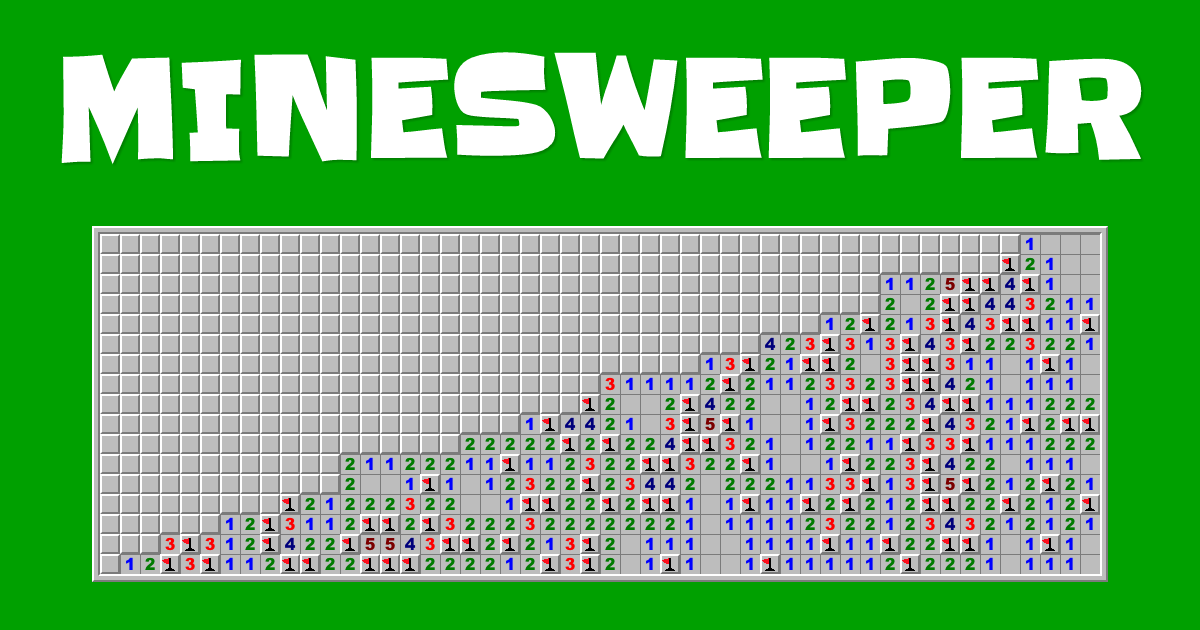
At its heart, the minesweeper game is built on one idea: information is revealed gradually, and you must act on incomplete knowledge. The grid hides mines, and the goal is to uncover all safe squares without triggering a single one.
Each revealed square may show a number. That number tells you how many mines are touching that square, including diagonally. With this information, you infer where mines must be and where it is safe to proceed.
There is no timer forcing speed in casual play. The pressure comes from uncertainty. One wrong assumption ends the session immediately.
Why the Rules Feel Simple but Never Easy
The rules can be explained in minutes. That is part of the design’s brilliance. However, understanding the rules does not guarantee success.
As the grid expands, patterns overlap. A single number can connect to multiple possibilities. This is where logic becomes layered. Players must weigh probabilities, not just certainties.
This balance between clarity and complexity is why the minesweeper game remains satisfying even after hundreds of sessions. Mastery is always partial. There is always a configuration that makes you pause and rethink.
Logical Thinking and Pattern Recognition
One of the strongest benefits of playing is how it trains the brain. The game rewards structured thinking. Players learn to recognize common number patterns and understand how information interacts across the grid.
For example, certain number arrangements almost always imply a specific mine placement. Over time, these patterns become instinctive. You stop calculating every move and begin reading the board as a whole.
This mental process is why many people describe the game as calming despite its tension. The focus required pushes distractions aside.
The Role of Probability and Risk
Not every situation can be solved with pure logic. Eventually, the player reaches a point where all safe deductions are exhausted. At that moment, probability enters the picture.
You must choose the least risky option. This element of chance adds emotional weight to decisions. A guess that works feels earned. A guess that fails feels cruel but fair.
In this way, the minesweeper game mirrors real-life decision-making. You gather facts, analyze patterns, and sometimes still have to take a leap.
Difficulty Levels and Their Impact
Most versions offer multiple difficulty settings. Smaller grids with fewer mines are forgiving and ideal for learning. Larger grids introduce density, where numbers cluster and space becomes tight.
Higher difficulty does not just mean more mines. It means fewer obvious moves. The player must manage attention carefully, scanning the entire grid instead of focusing on one area.
Advanced players often develop personal strategies, such as clearing edges first or opening the center early to gain more information.
Speed Versus Precision
Some players enjoy taking their time, treating each game as a quiet puzzle. Others chase speed, trying to finish grids as fast as possible.
This flexibility contributes to the game’s longevity. It adapts to different moods and personalities. Precision-focused players enjoy clean, mistake-free clears. Speed-focused players thrive on muscle memory and rapid pattern recognition.
Both approaches are valid, and both highlight different strengths of the minesweeper game.
The Psychological Pull of Hidden Information
Human curiosity plays a major role in the experience. Every unopened square represents unknown information. Revealing it brings either relief or sudden failure.
This push and pull keeps players engaged. The grid feels alive, even though it is static. Each click carries consequence.
That tension is subtle. There are no loud effects or dramatic visuals. The suspense exists entirely in the mind of the player.
Modern Variations and Digital Revival
While the classic version remains popular, modern interpretations have introduced new ideas. Some add color, animations, or alternate shapes. Others adjust rules to reduce forced guessing.
Despite these changes, the core appeal remains intact. Players still seek that moment when a complex section suddenly becomes clear.
Even in a world of high-definition graphics and online competition, the minesweeper game continues to find new audiences who appreciate its purity.
Educational Value Beyond Entertainment
Teachers and puzzle designers have long recognized the educational value of this style of play. It strengthens reasoning, encourages patience, and teaches the importance of checking assumptions.
Unlike many games, failure does not feel like wasted time. Each loss offers information. You learn where your reasoning broke down or where you took an unnecessary risk.
This feedback loop makes improvement feel natural rather than forced.
Why It Endures Across Generations
Trends change. Interfaces evolve. Yet this game remains relevant because it does not rely on novelty. It relies on the human brain’s love for solving problems.
Parents introduce it to children as a thinking exercise. Older players return to it as a familiar challenge. New players discover it through curiosity rather than hype.
The minesweeper game survives because it respects the player. It does not guide excessively or reward blindly. It simply presents a problem and waits.
A Game of Silence and Focus
In a noisy digital world, silence has become rare. This game offers silence by design. No dialogue, no soundtrack, no notifications.
That quiet space allows concentration. Many players find it meditative. The grid becomes a temporary world where only logic matters.
This sense of focus is part of why people return to it during breaks, travel, or moments when they want mental clarity.
Conclusion
The lasting power of the minesweeper game lies in its restraint. It proves that depth does not require complexity and that engagement does not require spectacle.
With nothing more than numbers and hidden danger, it invites players into a dialogue with their own reasoning. Every success feels earned. Every mistake teaches humility.
In the end, it is not just a game about avoiding mines. It is a quiet lesson in thinking carefully, acting deliberately, and respecting the unknown. That is why, decades later, it still matters.