For generations of children, mathematics was associated with worksheets, textbooks, and classroom drills. Then came Math Blaster, an educational game series that approached the subject from a completely different direction. Instead of asking children to sit quietly and solve page after page of problems, it placed mathematics inside a science-fiction adventure filled with missions, characters, targets, and challenges.
First introduced in the 1980s, Math Blaster became one of the best-known educational game brands of its era. Its basic idea was straightforward: give children opportunities to practice arithmetic while making the activity feel like a game rather than conventional schoolwork.
That distinction mattered. Math Blaster did not replace mathematics education, but it demonstrated how repetition could become more engaging when combined with goals, feedback, competition, and an imaginative setting.
Today, the series is remembered both as a piece of educational-game history and as an early example of gamification in learning. Looking at how it worked helps explain why some educational games become memorable while others are quickly forgotten.
What Is Math Blaster?
Math Blaster is a series of educational computer games designed primarily to help children practice mathematics through interactive gameplay.
The franchise was created by Knowledge Adventure, a company that became well known for educational software during the home-computer era. One of its most recognizable early releases was Math Blaster!, followed by several sequels, expansions, and later adaptations.
The games generally combined mathematical exercises with action-oriented or adventure-style activities.
Depending on the particular version, players might need to solve arithmetic problems to:
- Progress through a mission
- Hit a target
- Defeat an opponent
- Navigate an obstacle
- Complete a challenge
- Earn points or rewards
The exact mechanics changed across different releases, but the fundamental principle remained consistent:
Solve mathematics → receive immediate gameplay feedback → continue progressing.
The Origins of Math Blaster
Math Blaster emerged during an important period in educational technology.
Home computers were becoming increasingly common, and developers were experimenting with ways to make computers useful for children’s education. Early educational software often resembled digital versions of worksheets or electronic quizzes.
Math Blaster took a more entertainment-focused approach.
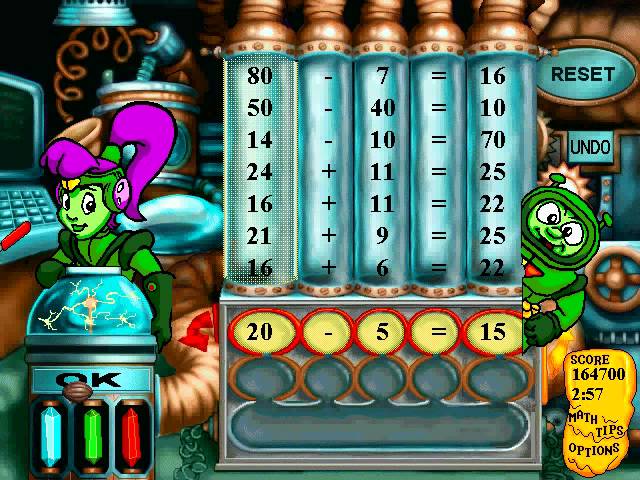
Rather than presenting arithmetic as a standalone exercise, it placed questions inside an imaginative game environment.
This was especially significant because computer games were already proving that children could spend long periods practicing the same basic actions when those actions were connected to a meaningful goal.
Math Blaster applied that principle to mathematics.
How Math Blaster Turned Arithmetic Into Gameplay
The most important design decision was not the science-fiction setting.
It was the connection between correct answers and consequences inside the game.
A child did not simply answer:
7 + 5 = ?
and immediately receive a grade.
Instead, the answer could influence what happened next.
Correct responses might allow the player to continue, score points, or complete an action. Incorrect answers could interrupt progress or require another attempt.
This gave basic arithmetic a purpose.
Why Immediate Feedback Matters
Immediate feedback is one of the strongest features of interactive educational software.
When a learner answers a question and instantly sees the result, the relationship between action and outcome is clear.
In a well-designed learning game, that can create a simple cycle:
Attempt → Feedback → Adjustment → Retry → Improvement
Math Blaster used this structure extensively.
However, it is important not to assume that simply playing an educational game automatically produces better academic results. The value depends on the skills being practiced, the quality of the activity, the learner’s age, and how the game is used alongside other forms of instruction.
The Science-Fiction Setting Was More Than Decoration
One reason Math Blaster stood out was its imaginative presentation.
Instead of placing children in an ordinary classroom, the series used a futuristic world with space-oriented themes, characters, missions, and colorful environments.
That setting helped answer an important psychological question:
Why should I solve this problem?
The answer was no longer simply:
“Because your teacher assigned it.”
The game provided another motivation:
“Because solving it lets me complete the mission.”
That difference can make repetitive practice feel more purposeful.
Math Skills Practiced in Math Blaster
Different Math Blaster releases targeted different age groups and mathematical abilities, so the exact content varied.
Common areas included foundational arithmetic such as:
- Addition
- Subtraction
- Multiplication
- Division
- Number recognition
- Basic mathematical reasoning
- Arithmetic speed and accuracy
Some versions also introduced more advanced concepts depending on the intended age and difficulty level.
This variety allowed the franchise to grow beyond a single game and become an educational software brand.
Practice Through Repetition
Arithmetic fluency often requires repetition.
The challenge for educators is that repetition can quickly become boring.
Math Blaster’s approach was to disguise or contextualize repetition through gameplay.
Instead of repeatedly solving problems from a worksheet, the player could solve similar problems while trying to accomplish an in-game objective.
That did not fundamentally change the mathematics.
It changed the experience surrounding the mathematics.
Why the Game Became So Memorable
Educational software has historically faced a difficult problem: children can recognize when something is pretending to be a game.
If an activity feels like a worksheet with a few animated decorations, engagement can disappear quickly.
Math Blaster was memorable because it treated gameplay as an important part of the experience rather than merely adding entertainment around a quiz.
The player had something to do.
There was movement.
There were goals.
There were consequences.
There was a sense of progression.
Those elements helped distinguish the series from simpler educational programs.
The Role of Challenge
A useful educational game needs an appropriate level of difficulty.
If every question is too easy, the player becomes bored.
If every question is too difficult, the player becomes discouraged.
Math Blaster’s challenge structure attempted to create a middle ground by allowing players to practice skills while pursuing game objectives.
This is particularly useful for basic arithmetic because players can gradually become faster and more confident through repeated exposure.
The important distinction is between productive repetition and meaningless repetition.
A learner benefits most when the activity remains understandable, challenging enough to require thought, and rewarding enough to encourage continued effort.
Math Blaster and Motivation
Traditional schoolwork often relies on external motivation:
- Grades
- Homework
- Tests
- Teacher expectations
- Deadlines
Games can introduce different motivational structures.
Math Blaster used elements such as:
- Scores
- Goals
- Missions
- Immediate feedback
- Progression
- Competition
- Rewards
These mechanisms can encourage learners to continue practicing.
But there is an important caveat: game rewards should support learning rather than completely replace it.
If a child becomes focused only on achieving a high score, the mathematical objective can become secondary.
The strongest educational games make the learning task itself part of the challenge.
Math Blaster Compared With Traditional Worksheets
The difference can be summarized simply.
| Traditional Worksheet | Math Blaster |
|---|---|
| Problems presented directly | Problems embedded in gameplay |
| Written responses | Interactive responses |
| Feedback may come later | Feedback is often immediate |
| Progress measured by completed work | Progress connected to game objectives |
| Primarily academic presentation | Academic content inside an imaginative setting |
Neither approach is inherently superior in every situation.
Worksheets can be useful for focused practice and assessment. Games can provide variety and motivation.
The most effective learning environment can combine multiple approaches rather than relying on one format exclusively.
The Importance of the Player’s Age
One aspect that is sometimes overlooked when discussing Math Blaster is that the franchise was not designed around one universal learner.
Children at different ages have very different needs.
A young learner practicing addition needs a different experience from an older student working on more advanced arithmetic.
That means parents and educators should consider:
- Age suitability
- Mathematical level
- Reading ability
- Difficulty
- Session length
- Whether the game reinforces the skills currently being taught
An educational game is most useful when its difficulty matches the learner rather than simply being labeled “educational.”
A Practical Way to Use Math Blaster for Learning
If you are introducing an educational game to a child, avoid treating it as a complete replacement for mathematics instruction.
A better approach is to use it as supplementary practice.
For example:
Before playing
Identify one skill the child is currently learning.
It might be multiplication facts or basic subtraction.
During play
Pay attention to whether the child is actually solving the problems or simply guessing.
After playing
Ask the child to explain one or two problems without the game.
This small step can reveal whether the activity produced genuine understanding or simply fast guessing.
That is a useful lesson for educational games generally.
Math Blaster’s Influence on Educational Gaming
Math Blaster belongs to an important generation of software that helped establish the idea that education and entertainment did not have to exist separately.
Later educational games and learning platforms adopted many similar principles:
- Reward systems
- Progress bars
- Interactive challenges
- Instant feedback
- Character-based learning
- Missions and goals
- Difficulty progression
Modern educational technology often calls this gamification.
The concept itself is much broader than simply turning a lesson into a game. Effective gamification uses game-inspired structures to encourage participation and sustained practice.
Math Blaster was an early, recognizable example of this philosophy in children’s computer software.
What Math Blaster Got Right
Looking back, several design decisions remain relevant.
It gave practice a purpose
Solving arithmetic questions contributed directly to gameplay.
It made feedback immediate
Players generally did not have to wait until the end of a lesson to discover whether they were succeeding.
It created a recognizable identity
The futuristic setting separated the experience from conventional school materials.
It encouraged repeated attempts
Players could continue practicing rather than treating one wrong answer as the end of the activity.
It connected progress with effort
Correct responses were tied to visible advancement within the game.
These principles remain useful when designing educational software today.
What Modern Educational Games Can Learn From It
Technology has changed dramatically since the original Math Blaster releases.
Modern devices can provide adaptive difficulty, detailed progress tracking, personalized content, and sophisticated interfaces.
But technology alone does not guarantee better learning.
One of the enduring lessons from Math Blaster is that the underlying interaction matters more than technological complexity.
A simple game that gives a child meaningful practice can be more useful than an impressive application that provides little educational value.
That is why the basic Math Blaster formula remains relevant:
clear objective + appropriate challenge + immediate feedback + motivation.
A Less-Obvious Insight: The Game Changed the Context, Not the Mathematics
One of Math Blaster’s cleverest ideas was that it did not need to reinvent arithmetic.
Addition was still addition.
Multiplication was still multiplication.
What changed was the context in which children encountered those problems.
That distinction is important for educational design.
Sometimes the best way to make a difficult subject more approachable is not to simplify the subject itself, but to create a more engaging reason to interact with it.
Another Insight: Speed Can Be Both Helpful and Misleading
Math Blaster’s action-oriented structure naturally encouraged quick responses.
That can be useful when practicing arithmetic fluency, where faster recall can become valuable.
But speed is not the same thing as understanding.
A student who can quickly answer 6 × 7 may have strong recall. A student who can explain why 6 × 7 equals 42 demonstrates a deeper level of understanding.
This distinction is still important in modern educational games.
A good learning experience should avoid rewarding speed so heavily that children begin guessing instead of thinking.
The Nostalgia Factor
For adults who encountered Math Blaster during childhood, the series represents more than educational software.
It can be a reminder of an era when computer games were often distributed through physical media and installed on home computers.
The graphics may look simple by modern standards, but that simplicity is part of the nostalgia.
The bright colors, futuristic themes, characters, sound effects, and arcade-inspired activities can instantly bring back memories of childhood computer use.
Nostalgia also explains why educational games can have a cultural life beyond their original educational purpose.
A child may remember a game years later not because they remember every arithmetic problem, but because they remember how the experience made learning feel.
Is Math Blaster Still Relevant Today?
The answer depends on what you expect from it.
If you are looking for a modern adaptive mathematics platform with sophisticated analytics, Math Blaster’s older releases obviously cannot compete with today’s technology.
But as an example of educational game design, it remains highly relevant.
Its core concept—turning repeated academic practice into an interactive challenge—is still widely used.
Parents and educators can also learn something from its history: children do not necessarily need mathematics to be made easier. They often benefit from having a more engaging reason to practice it.
FAQ
What is Math Blaster?
Math Blaster is a series of educational computer games that teaches and reinforces mathematics through interactive gameplay. The franchise became particularly well known for combining arithmetic practice with science-fiction themes, missions, characters, and arcade-style challenges.
Who created Math Blaster?
Math Blaster was developed and published by Knowledge Adventure, an educational software company associated with a large number of children’s learning titles. The original Math Blaster series began during the 1980s and expanded through numerous releases over subsequent decades.
What math skills does Math Blaster teach?
Different versions target different age groups and skills, but the franchise is strongly associated with foundational arithmetic, including addition, subtraction, multiplication, and division. Some releases expanded into other mathematical concepts and difficulty levels.
Is Math Blaster good for learning math?
It can be useful as supplementary practice, particularly for foundational arithmetic. However, an educational game should not automatically be considered a replacement for structured teaching, explanation, and assessment. Its effectiveness depends on whether the game’s content matches the learner’s level and whether the child is actually engaging with the mathematics.
Why was Math Blaster popular?
Its popularity came partly from combining familiar arithmetic exercises with an imaginative science-fiction setting and game-like objectives. Children could practice mathematics while completing missions and responding to interactive challenges, making repetitive practice feel more like entertainment.
Is Math Blaster still available today?
The Math Blaster brand has appeared in different forms over the years, and availability can vary depending on the specific version. Older releases are best understood as part of the history of educational computer games, while newer adaptations may differ considerably from the original experience.
Conclusion
Math Blaster occupies an important place in the history of educational gaming because it demonstrated that mathematics practice did not have to feel like traditional schoolwork.
Its biggest achievement was not creating a revolutionary way to calculate numbers. It was creating a more engaging context in which children could practice skills they already needed to learn.
The combination of science-fiction adventure, immediate feedback, missions, scoring, and arithmetic gave players a reason to keep trying. Mistakes became opportunities to attempt the challenge again, while successful answers produced visible progress.
Its legacy is particularly relevant today. Modern educational technology has far more powerful tools than the developers of the original Math Blaster could have imagined, but the fundamental question remains unchanged:
How do you make a learner want to keep practicing?
Math Blaster’s answer was simple—make practice interactive, give it a purpose, and turn learning into an experience.
That idea may be decades old, but it remains one of the most valuable principles in educational game design.