Few indie games have built a world as mysterious, atmospheric, and rewarding as Hollow Knight. Developed by Team Cherry and released in 2017, this 2D action-adventure takes players beneath the quiet town of Dirtmouth and into Hallownest, a ruined kingdom filled with strange creatures, forgotten civilizations, dangerous bosses, and secrets that are rarely explained directly.
What makes Hollow Knight special is not simply its difficulty. Its greatest strength is the relationship between exploration, combat, movement, and discovery. You are rarely told exactly where to go or what a mysterious character means. Instead, the game gives you fragments and lets you build the larger picture yourself.
The result is a Metroidvania that rewards curiosity as much as reflexes. New abilities open previously inaccessible paths, charms allow different combat approaches, and even areas that initially seem empty can contain important discoveries.
This guide explains what makes Hollow Knight work, how its progression system functions, what beginners should know before exploring Hallownest, and why the game remains a standout in the genre.
What Is Hollow Knight?
Hollow Knight is a single-player 2D action-adventure game with strong Metroidvania elements. Team Cherry describes it as a challenging adventure through a forgotten insect kingdom, combining exploration, combat, platforming, characters, and an ancient mystery.
The game was released on February 24, 2017, and has developed an exceptionally strong reputation among players. On Steam, it is currently rated Overwhelmingly Positive, with more than 180,000 English-language reviews listed on the store.
Its core ingredients include:
- Interconnected exploration
- Precise melee combat
- Platforming challenges
- Abilities that unlock new routes
- Collectible and customizable Charms
- Optional bosses and areas
- Environmental storytelling
- Multiple endings and completion goals
- A distinctive hand-drawn visual style
Rather than separating these systems into isolated stages, Hollow Knight connects them into one enormous world.
Entering the Fallen Kingdom of Hallownest
The game begins in Dirtmouth, a small settlement above the remains of Hallownest.
From there, the Knight descends into the kingdom and gradually discovers what happened to this once-great civilization.
Hallownest is not presented through long opening cutscenes or constant exposition. Instead, the player learns about it through:
- NPC conversations
- Environmental details
- Item descriptions
- Architecture
- Ancient monuments
- Boss encounters
- Dream-related discoveries
- Small pieces of dialogue
This approach can initially feel confusing, but that confusion is intentional.
The game wants you to become an investigator.
The Knight and the Mystery at the Center
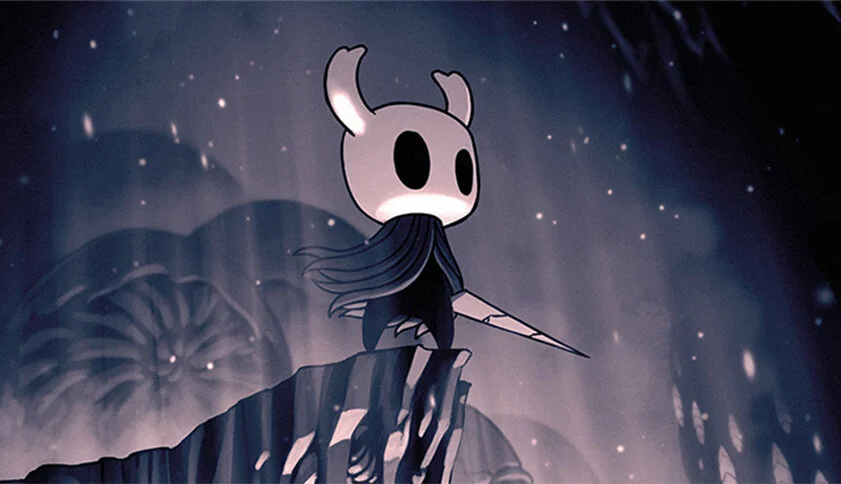
The player controls the Knight, a small, silent figure armed with a Nail.
The Knight’s identity and purpose are deliberately mysterious. Rather than immediately explaining everything, the game gradually reveals information about Hallownest and the Knight’s connection to its history.
This makes exploration feel meaningful.
A seemingly ordinary room may contain a detail that becomes important much later. A character who initially appears insignificant can provide another piece of a much larger story.
That fragmented storytelling is one of Hollow Knight’s defining characteristics.
The World Design Is the Real Star
One of Hollow Knight’s greatest achievements is its interconnected map.
The kingdom contains distinct regions with their own visual identities, enemies, environmental hazards, music, and atmosphere.
Some memorable areas include:
- Forgotten Crossroads
- Greenpath
- Fungal Wastes
- City of Tears
- Crystal Peak
- Deepnest
- Ancient Basin
- Kingdom’s Edge
- Queen’s Gardens
- The Abyss
These areas do not simply feel like separate levels. Paths, elevators, hidden rooms, shortcuts, gates, and abilities gradually connect them.
The official game description emphasizes this interconnected-world structure as a central part of the experience.
Why Getting Lost Can Be Part of the Fun
Hollow Knight does something unusual with navigation: getting lost is sometimes part of the experience.
You may enter an unfamiliar region, discover a blocked passage, find an unexpected shortcut, and later return with a new ability.
That creates a satisfying realization:
“I remember that place I couldn’t reach earlier.”
The map gradually transforms from a confusing collection of rooms into a mental model of Hallownest.
Exploration and Progression
Hollow Knight does not use a conventional level system where defeating enemies simply makes your character stronger.
Instead, progression comes from discovering new tools, upgrades, routes, and knowledge.
Important abilities include:
Mothwing Cloak
This gives the Knight a dash, dramatically increasing mobility and opening new possibilities during exploration and combat.
Mantis Claw
The wall-jump ability allows the Knight to cling to and leap from walls, making vertical exploration possible.
Crystal Heart
This ability allows the Knight to launch forward at high speed across long distances, creating new traversal opportunities.
Monarch Wings
The double jump expands vertical movement and allows access to areas that were previously unreachable.
Isma’s Tear
This upgrade allows the Knight to move through pools of acid, opening additional paths and shortcuts.
Dream Nail
The Dream Nail adds another layer to exploration and storytelling, allowing the Knight to interact with dreams and uncover information that ordinary exploration cannot reveal.
The important lesson is that new abilities are not merely combat upgrades. They change how you understand the entire map.
Combat: Simple Controls, High Skill Ceiling
At first, Hollow Knight’s combat appears straightforward.
You attack with the Nail, move around enemies, jump, dash, and use Soul-based abilities.
The difficulty comes from timing.
Enemies have different attack patterns, movement styles, ranges, and vulnerabilities. As the game progresses, encounters increasingly require you to recognize patterns instead of simply attacking as quickly as possible.
Learn Before You Attack
A common beginner mistake is treating every enemy as something to eliminate immediately.
Sometimes the better strategy is to watch.
Ask:
- How does the enemy approach?
- When does it attack?
- Does it have a predictable recovery animation?
- Is there a safe position?
- Can I attack after its movement rather than during it?
This mindset becomes especially valuable against bosses.
Soul: The Resource That Connects Combat and Healing
Hollow Knight uses Soul as an important resource.
Attacking enemies allows the Knight to build Soul, which can then be used for spells or healing.
This creates an interesting decision.
Should you spend Soul on damage immediately?
Or should you save it for healing after taking a hit?
That choice becomes increasingly important during difficult encounters.
A player who treats every bit of Soul as automatic spell ammunition may find themselves without healing when they need it most.
Charms and Build Customization
Charms are one of Hollow Knight’s most flexible systems.
They provide different effects and allow players to adjust their approach to exploration or combat.
Examples include:
- Quick Slash, which improves attack speed
- Grubsong, which provides Soul when the Knight takes damage
- Longnail, which increases Nail range
- Shaman Stone, which strengthens spells
- Fragile/Unbreakable Strength, which increases Nail damage
The best Charm setup depends heavily on the situation.
A combination that works well against one boss may be less useful for platforming or exploration.
Why Charm Experimentation Matters
There is no single universally perfect build.
Some players prefer aggressive melee combat. Others rely heavily on spells. Some prioritize mobility or survivability.
Experimenting with Charms is therefore part of learning the game rather than something to ignore until the end.
Boss Battles: Learning Instead of Button-Mashing
Hollow Knight is famous for its bosses, but the most important thing about them is not simply their difficulty.
Each boss teaches something.
One may teach you to react to horizontal movement. Another may test vertical positioning. Another may force you to manage multiple threats simultaneously.
Bosses encourage a useful cycle:
Observe → fail → understand → adapt → succeed.
This is why victories can feel so rewarding.
Hornet
Hornet is one of the game’s most memorable recurring characters and provides an important early lesson in movement, timing, and reaction.
The Hollow Knight
The Hollow Knight encounter has particular narrative significance because it connects the player’s immediate objective with the deeper history of Hallownest.
The Radiance
The Radiance represents one of the game’s ultimate challenges and is closely connected to the larger mystery surrounding the Infection.
Importantly, Hollow Knight contains more optional challenges than a straightforward first playthrough requires. Players who want to explore everything will encounter significantly more demanding content.
Death and the Shade System
Death in Hollow Knight has consequences, but it is not simply a traditional “restart from the beginning” system.
When the Knight dies, a Shade remains at the location of death. Returning to that location allows the player to recover what was lost, provided they can reach it.
This creates tension.
You are not merely trying to survive the next room. You may also be carrying the consequences of your previous mistake.
That makes careful exploration particularly valuable when carrying a significant amount of Geo.
Why Hollow Knight Feels Difficult but Fair
Hollow Knight can absolutely be difficult, especially for players unfamiliar with precision platformers or action-focused Metroidvanias.
However, much of its difficulty comes from learning.
Enemies usually have recognizable behaviors. Bosses have patterns. Dangerous platforming sections can be practiced.
When you finally overcome a difficult encounter, it often feels less like your character suddenly became powerful and more like you became better at the game.
That distinction is central to Hollow Knight’s appeal.
The Art and Atmosphere
Hollow Knight’s visual identity is immediately recognizable.
Team Cherry uses hand-crafted 2D artwork to create an underground world that can feel beautiful, lonely, threatening, and mysterious within the same hour. The official site specifically highlights its hand-drawn animation and distinct environments.
The soundtrack is equally important.
Christopher Larkin’s score supports the emotional tone of the world, shifting between melancholy exploration, tension, mystery, and dramatic confrontation.
The combination of art, music, sound effects, and environmental design gives Hallownest a personality of its own.
The Lore Rewards Curiosity
Hollow Knight’s story is deliberately incomplete.
You are not given a simple explanation of every event.
Instead, the game presents clues about:
- The ancient kingdom
- The Infection
- The Pale King
- The vessels
- The Dreamers
- The Radiance
- The Void
- The kingdom’s collapse
Some details are explicit, while others require interpretation.
This has helped create a large community dedicated to analyzing theories and connections within the game’s world.
The important point for new players is simple:
You do not need to understand everything immediately.
Let the mystery develop naturally.
A Better Way to Approach Your First Playthrough
New players sometimes make the mistake of trying to follow a perfect walkthrough from beginning to end.
That can make Hollow Knight less enjoyable.
A better approach is:
Explore First
When you enter a new region, investigate naturally.
Mark Places You Cannot Reach
If you encounter a suspicious gap, locked door, high ledge, or strange obstacle, remember it.
Return Later
New abilities frequently change the meaning of previously explored areas.
Upgrade When Possible
Nail upgrades, masks, Soul capacity, and other improvements can make future exploration easier.
Accept Some Confusion
You are not expected to understand Hallownest immediately.
The uncertainty is part of the game’s design.
Beginner Tips That Actually Matter
Buy Maps
Mapping is one of the most important parts of exploring efficiently.
If you enter a new region, finding its map can dramatically reduce frustration.
Don’t Hoard Geo Forever
Saving money is useful, but carrying a large amount into a dangerous unexplored area increases the consequences of death.
Practice Movement
Movement abilities become just as important as combat later in the game.
Experiment With Charms
Do not assume the first Charm combination you discover will remain your best setup.
Heal Strategically
Healing is powerful, but finding safe opportunities to use it is a skill.
Explore Side Paths
Some of the game’s most memorable discoveries are optional.
How Long Is Hollow Knight?
There is no single playtime because Hollow Knight offers very different experiences depending on how thoroughly you explore.
A player primarily interested in reaching an ending will spend substantially less time than someone attempting high completion percentages, optional bosses, challenge content, and achievements.
The game also includes Steel Soul Mode, which provides a more punishing experience for players seeking an additional challenge. Steam lists Hollow Knight as a single-player game with 63 achievements.
So instead of thinking of Hollow Knight as a game with one fixed length, it is better viewed as a game with several layers of completion.
What Makes Hollow Knight Different From Other Metroidvanias?
Many Metroidvanias rely heavily on the same basic formula: explore, find ability, return to earlier location, unlock new route.
Hollow Knight does this exceptionally well, but its identity comes from how seamlessly the systems interact.
Exploration leads to combat.
Combat provides Soul.
Soul supports survival and spells.
Abilities change movement.
Movement changes exploration.
Exploration reveals lore.
Lore gives meaning to bosses and locations.
That interconnected design is why Hallownest can feel like a coherent world rather than a collection of levels.
Hollow Knight’s Free Content Expansions
Another major strength of the original game is that Team Cherry expanded it through four major free content packs: Hidden Dreams, The Grimm Troupe, Lifeblood, and Godmaster. These added bosses, quests, charms, enemies, music, upgrades, and other content.
This significantly expanded the experience beyond the original release.
For players returning to Hollow Knight after several years, that matters: the game they remember may contain considerably more content than they experienced during their first playthrough.
Hollow Knight and Its Sequel
The original article’s description of Hollow Knight: Silksong as a future project is now outdated.
As of 2026, Hollow Knight: Silksong has been released. Team Cherry announced its availability in September 2025, and the game is available across its supported platforms.
Silksong shifts the focus to Hornet, introducing a new kingdom, new enemies, tools, movement mechanics, and challenges.
Team Cherry has also continued supporting its Hollow Knight games, including work on an updated Nintendo Switch 2 edition of the original Hollow Knight.
This makes the original game particularly interesting for newcomers: Hollow Knight is no longer simply an isolated indie classic but the foundation of a larger franchise.
FAQ
Is Hollow Knight difficult for beginners?
Yes, Hollow Knight can be challenging, especially during boss battles and advanced platforming sections. However, its difficulty is largely based on recognizable patterns and learnable mechanics. With practice, most early challenges become much more manageable.
How long does Hollow Knight take to complete?
Playtime varies significantly depending on how much of Hallownest you explore and how much optional content you pursue. A focused playthrough is much shorter than a high-completion run involving optional bosses, secrets, and achievements. The game’s structure encourages exploration rather than following one fixed route.
Is Hollow Knight multiplayer?
No. Hollow Knight is primarily a single-player experience. Its design is built around personal exploration, combat mastery, discovery, and progression. Steam lists the game as single-player.
What genre is Hollow Knight?
Hollow Knight is a 2D action-adventure game strongly associated with the Metroidvania genre. It combines interconnected exploration, ability-based progression, platforming, combat, and backtracking.
Is Hollow Knight: Silksong a sequel?
Yes. Silksong is the follow-up to Hollow Knight and places Hornet in the starring role. Unlike the original game’s Hallownest setting, Silksong introduces a different kingdom and its own collection of enemies, characters, tools, and challenges. It was released in September 2025.
What makes Hollow Knight so highly regarded?
Its strongest qualities work together: precise combat, interconnected exploration, atmospheric art, excellent music, environmental storytelling, and a large amount of optional content. The game also trusts players to discover its world rather than explaining everything immediately. That combination has helped it maintain an exceptionally strong player reception years after release.
Final Verdict
Hollow Knight succeeds because it understands the value of discovery.
It does not constantly tell you where to go, what to think, or why every mysterious event matters. Instead, it gives you a beautifully constructed world and lets you explore it at your own pace.
Its combat rewards patience. Its bosses reward observation. Its map rewards memory. Its Charms reward experimentation. And its lore rewards curiosity.
For a first-time player, the best advice is simple: do not rush Hallownest. Explore unfamiliar paths, remember places you cannot yet reach, learn enemy patterns, experiment with your Charms, and allow the story to reveal itself gradually.
More than nine years after its original release, Hollow Knight remains a remarkable example of how a relatively small game can create an enormous sense of place. Its hand-drawn world, demanding combat, mysterious storytelling, and layered exploration continue to make it one of the defining modern Metroidvanias—and now, with Silksong available, the beginning of an even larger adventure.