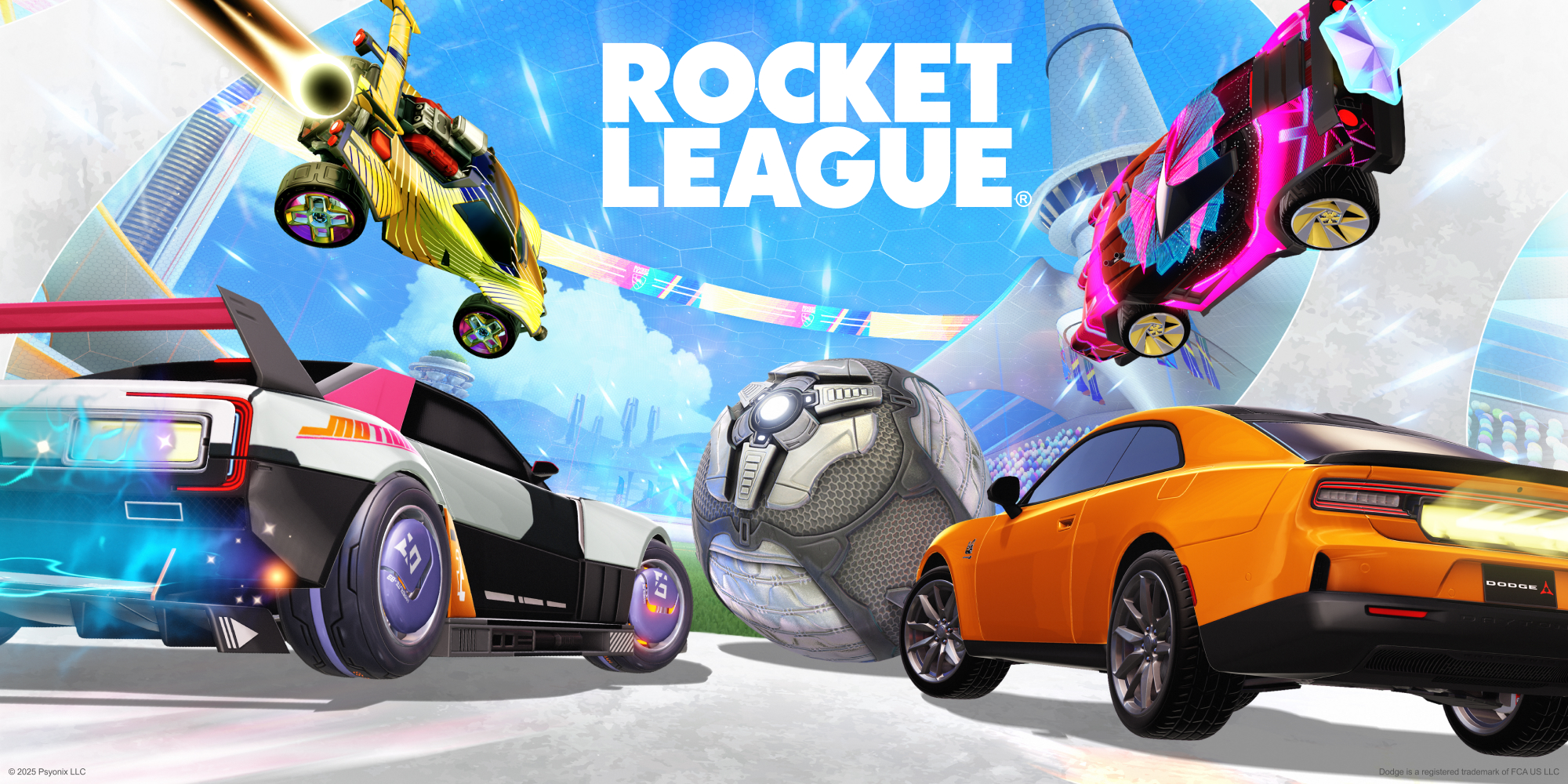
Few multiplayer games have created such a simple yet remarkably deep formula as Rocket League. The idea is easy to understand: players control rocket-powered cars and use them to hit a giant ball into the opposing team’s goal.
Yet that simplicity is deceptive.
Underneath the bright arenas and spectacular goals is a demanding competitive game built around physics, positioning, timing, boost management, teamwork and mechanical precision. A new player can understand the objective within minutes, while mastering advanced movement and aerial control can take hundreds or even thousands of hours.
That combination has helped Rocket League remain one of the most recognizable competitive sports games of the modern era.
What Is Rocket League?
Rocket League is a physics-based sports game developed and published by Psyonix. It combines football-style objectives with vehicles capable of jumping, boosting and flying through the arena.
The basic objective is straightforward:
- Hit the ball.
- Score in the opponent’s goal.
- Prevent the other team from scoring.
- Finish the match with more goals than your opponent.
Matches can be played casually or competitively, with different team sizes and game modes providing different challenges.
The official game is available through Epic Games Store, while its cross-platform ecosystem has helped it build a large and diverse player community.
How Rocket League Started
Rocket League wasn’t created from an entirely new idea.
Its predecessor was Supersonic Acrobatic Rocket-Powered Battle-Cars, released by Psyonix for PlayStation 3 in 2008. The concept combined cars and soccer, but the earlier title remained relatively niche.
Psyonix revisited the idea and developed Rocket League with a stronger focus on accessibility, improved physics and online multiplayer.
Rocket League launched in July 2015 and quickly attracted attention, helped in part by its availability through PlayStation Plus at launch.
The game’s basic concept proved far more powerful than its unusual premise suggested.
Players didn’t need to understand complicated rules. They could immediately see what they needed to do: get the ball into the goal.
Why Rocket League Is Easy to Learn but Hard to Master
This is perhaps the game’s defining characteristic.
A beginner can learn the basic controls relatively quickly:
- Drive
- Jump
- Boost
- Hit the ball
- Defend the goal
But those controls create an enormous number of possibilities.
A player can jump while turning, use boost to change direction, strike the ball at different angles and combine aerial movement with momentum.
As skill increases, players begin learning techniques such as:
- Aerial shots
- Fast aerials
- Air dribbles
- Flicks
- Wall plays
- Half-flips
- Wave dashes
- Ceiling shots
- Advanced recoveries
The difference between knowing that these techniques exist and performing them consistently is enormous.
The Importance of Physics
Rocket League’s physics system is central to its identity.
The ball doesn’t simply travel in a predetermined direction when a car touches it. Its movement depends on the interaction between the car, ball, speed, angle and surrounding environment.
That creates an unusual learning experience.
Players gradually develop an instinct for where the ball will go after a particular collision. They learn how to approach it, when to jump and how much momentum to use.
Reading the Ball
Experienced players don’t simply react to the ball’s current location.
They anticipate its next position.
For example, when the ball approaches a wall, a skilled player can predict the likely rebound and position their car before the ball arrives.
That ability to anticipate rather than react is one of the biggest differences between beginner and advanced play.
Boost Management
Boost is another fundamental part of Rocket League.
Players can use boost to accelerate rapidly, reach airborne balls and recover after making mistakes. But boost isn’t unlimited.
Large boost pads are distributed around the arena, while smaller pads provide smaller amounts.
This creates a strategic decision:
Should you chase the ball, or preserve enough boost to recover afterward?
Using all your boost for an unsuccessful attack can leave you vulnerable. On the other hand, refusing to spend boost can cause you to miss an important opportunity.
Good players therefore treat boost as both a movement tool and a strategic resource.
Positioning Matters as Much as Mechanics
Mechanical skill is highly visible in Rocket League, but positioning is just as important.
A player doesn’t need to perform spectacular aerial tricks to contribute to a team.
Sometimes the correct decision is simply to:
- Rotate back to defense
- Cover the passing lane
- Wait for a rebound
- Challenge an opponent
- Give a teammate space
- Avoid committing too many players to the same ball
This is particularly important in team modes.
If three teammates all chase the ball simultaneously, the goal can be left completely exposed.
Teamwork and Rotation
Rocket League becomes much more strategic when played with teammates.
In a typical team match, players constantly move between offensive and defensive positions.
A simplified rotation might look like this:
Player 1: challenges the ball
Player 2: supports the play
Player 3: remains farther back to protect against a counterattack
After the play develops, players rotate positions.
This system isn’t rigid, but the underlying principle is important: don’t leave the team vulnerable simply because you want to touch the ball.
Good rotations create space, maintain defensive coverage and give teammates opportunities to attack.
From Casual Game to Major Esport
Rocket League’s competitive potential became apparent relatively early.
Its matches are easy for spectators to understand. Even someone unfamiliar with advanced mechanics can recognize a goal, save or last-second comeback.
That makes it particularly suitable for competitive broadcasting.
The professional scene eventually developed into the Rocket League Championship Series (RLCS), creating a structured pathway for high-level competition.
Professional players demonstrate an extraordinary level of mechanical control, game awareness and teamwork.
At the highest level, tiny differences can decide a match.
A missed touch, poor rotation or delayed challenge can turn an apparently safe position into a goal.
Rocket League’s Free-to-Play Transition
One of the biggest changes in the game’s history came in 2020, when Rocket League transitioned to a free-to-play model.
The move significantly lowered the barrier to entry.
Instead of requiring players to purchase the base game, new players could download and play without paying an upfront price.
The change also introduced a broader progression and seasonal ecosystem, including items and other forms of customization.
The free-to-play model helped Rocket League reach an even wider audience while maintaining its core gameplay.
Cross-Platform Play
Another important part of Rocket League’s accessibility is cross-platform multiplayer.
Players across supported platforms can compete with one another, reducing the traditional separation between console and PC communities.
Cross-platform support also helps matchmaking by creating a larger pool of potential opponents.
For friends, it has an additional advantage: players don’t necessarily need to own the same type of gaming hardware to play together.
Customization and Player Identity
Rocket League isn’t only about competition.
Players can customize their vehicles with cosmetic items that allow them to create distinctive designs.
Customization can include things such as:
- Car bodies
- Decals
- Wheels
- Boost effects
- Goal explosions
- Trails
- Antennas
- Player banners
These items generally function as cosmetic expression rather than fundamental gameplay advantages.
That distinction is important for competitive integrity.
A player can make a vehicle look spectacular without automatically making it faster or more powerful.
Why Rocket League Remains Engaging
There are several reasons players continue returning to the game.
1. Every Match Is Different
Even with the same arena and rules, player behavior changes every match.
One game might become a defensive battle, while another turns into a high-scoring exchange.
2. Improvement Is Easy to Notice
Rocket League provides a very visible progression curve.
You may initially struggle to hit the ball.
After practice, you can make consistent touches.
Later, you might begin controlling aerial plays or executing advanced recoveries.
That feeling of improvement is highly motivating.
3. Short Matches Create Accessibility
Matches are relatively short compared with many other competitive games.
This makes it easier to play a few games during a break without committing to a lengthy session.
4. Skill Matters
Rocket League doesn’t rely on traditional character levels or complex ability systems to determine who wins.
Mechanical execution, positioning, teamwork and decision-making play major roles.
The Mental Challenge
Rocket League can be mechanically demanding, but the psychological side shouldn’t be ignored.
Competitive matches can change extremely quickly.
A team may lead for several minutes and suddenly concede two goals.
Players therefore need to manage frustration and remain focused.
Common mental mistakes include:
- Chasing the ball after making an error
- Blaming teammates
- Playing too aggressively after conceding
- Giving up when behind
- Making rushed decisions
Learning to reset mentally after mistakes is an important part of competitive improvement.
How New Players Can Improve
If you’re starting Rocket League today, trying to learn everything at once can be overwhelming.
A better approach is to build skills progressively.
Start With Car Control
Become comfortable with:
- Steering
- Jumping
- Boosting
- Reversing
- Recovering after landing
Learn Basic Positioning
Understand where you should be when your teammate has possession.
Don’t automatically follow the ball.
Practice Ball Contact
Learn how different parts of your car affect the ball.
Consistent contact is more valuable than spectacular but unreliable shots.
Use Training Modes
Training provides a controlled environment where you can repeat the same mechanic without worrying about the outcome of a competitive match.
Watch Better Players
Professional matches and high-level gameplay can teach positioning, rotations and decision-making that aren’t obvious when you’re first learning.
Rocket League and the Importance of Practice
One of the most satisfying aspects of Rocket League is that practice generally has a direct relationship with performance.
If you practice aerial control, your aerial consistency can improve.
If you practice shooting, your finishing can improve.
If you study rotations, your positioning can improve.
However, practice needs to be deliberate.
Simply playing hundreds of matches isn’t always the fastest route to improvement.
A player who spends focused time correcting a specific weakness may improve more efficiently than someone who plays without analyzing mistakes.
Community and Social Experience
Rocket League has developed into more than a competitive game.
Players share:
- Highlights
- Tutorials
- Memes
- Training techniques
- Tournament content
- Strategy discussions
- Custom designs
This community culture helps new players find information and experienced players discover increasingly advanced techniques.
At the same time, online competitive environments can sometimes become frustrating. Maintaining healthy communication and using available moderation and privacy tools can make multiplayer sessions more enjoyable.
What Makes Rocket League Different From Traditional Sports Games?
Rocket League doesn’t attempt to reproduce real football.
There are no human players running around a conventional pitch.
Instead, it transforms familiar football concepts into a physics-based vehicle game.
| Feature | Rocket League | Traditional Football Game |
|---|---|---|
| Players | Cars | Human athletes |
| Movement | Physics-based vehicles | Character movement |
| Main skill | Driving + ball control | Passing + player control |
| Boost | Yes | No |
| Aerial movement | Major mechanic | Limited |
| Match style | Highly physics-driven | Sports simulation |
| Learning curve | Mechanical | Tactical + mechanical |
This difference is exactly what gives Rocket League its identity.
The Future of Rocket League
The game’s future depends on maintaining the qualities that made it successful while continuing to support its evolving community.
Competitive integrity, matchmaking, seasonal content, new players and professional competition all contribute to the health of the ecosystem.
The biggest challenge is balancing innovation with familiarity.
Players want new experiences, but they also want the core mechanics they’ve spent years mastering to remain meaningful.
That makes long-term development particularly important for a game whose identity is so strongly connected to its physics and competitive balance.
FAQ
What is Rocket League?
Rocket League is a physics-based sports game where players control rocket-powered cars and compete to score a giant ball into the opposing goal.
Is Rocket League free to play?
Yes. Rocket League transitioned to a free-to-play model in 2020.
Can you play Rocket League with friends on different platforms?
Rocket League supports cross-platform multiplayer on supported platforms, allowing players from different systems to compete together.
Is Rocket League difficult for beginners?
The basic controls are relatively easy to understand, but mastering advanced mechanics can take considerable practice.
What is the most important skill in Rocket League?
There isn’t one single skill that guarantees success. Car control, positioning, boost management, ball awareness, decision-making and teamwork all matter.
Is Rocket League an esport?
Yes. Rocket League has an established professional competitive scene, including the Rocket League Championship Series.
Conclusion
Rocket League succeeds because it takes an incredibly simple idea and gives it remarkable depth.
The objective can be explained in a sentence: use your car to score goals.
Mastering that objective is another story.
Players must learn physics, positioning, boost management, aerial control, rotations, teamwork and mental discipline. Every improvement opens another layer of the game, which helps explain why beginners and highly experienced competitors can both find something worthwhile in the same arena.
Its evolution from an unconventional car-soccer experiment into a major competitive title demonstrates the power of focused game design. Rather than relying on complicated systems, Rocket League built its identity around movement, physics and player skill.
That formula remains its greatest strength—and the reason the game continues to attract players who want something that’s easy to start, difficult to master and endlessly satisfying to improve at.