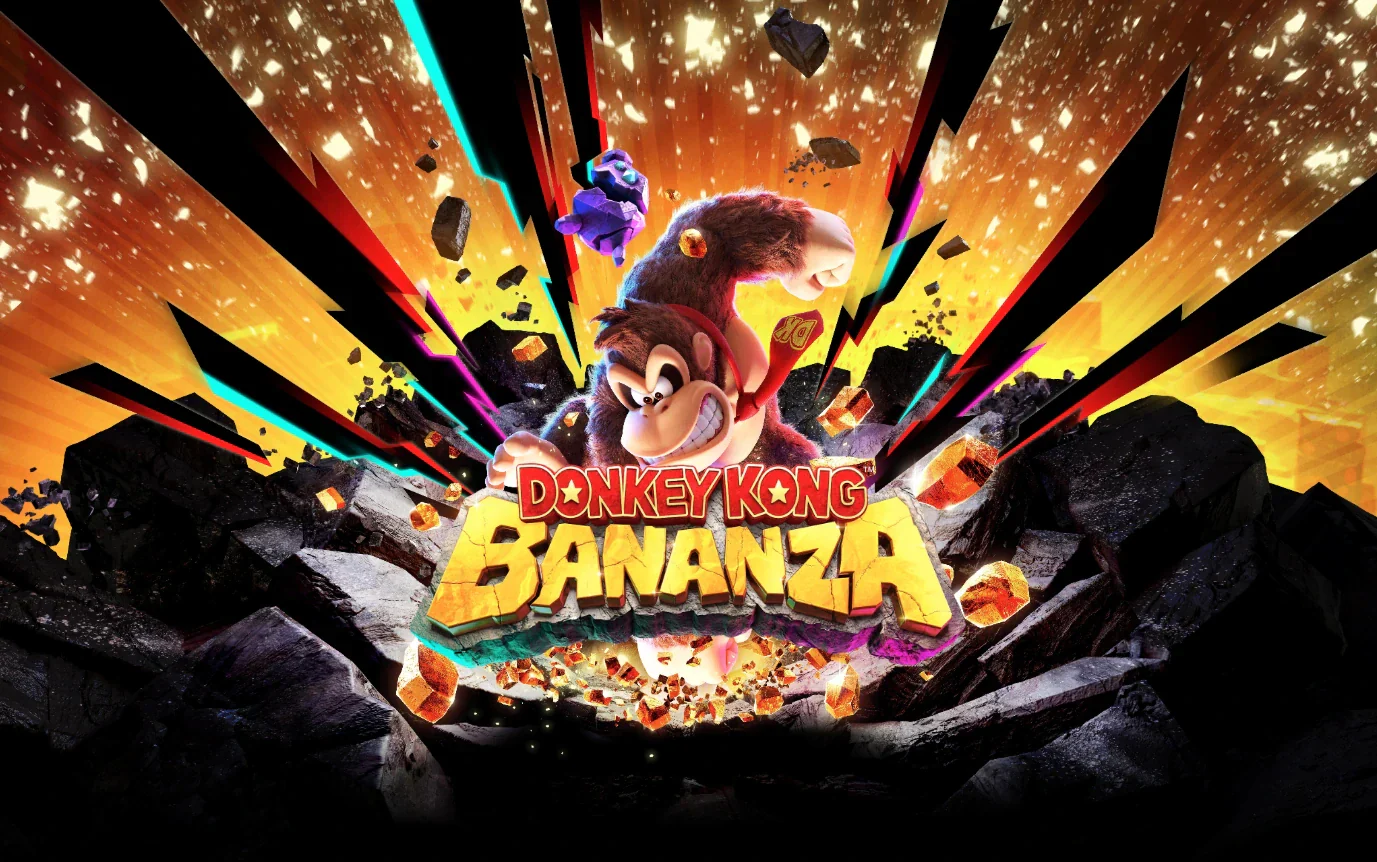
For decades, Donkey Kong has been one of Nintendo’s most recognizable characters, evolving from an arcade villain into a platforming hero with a personality all his own. Donkey Kong Bananza takes that long history in a surprisingly modern direction. Rather than simply recreating the formula of older Donkey Kong games, it builds an entire 3D adventure around one central idea: what if Donkey Kong could smash his way through almost everything?
Released for Nintendo Switch 2 on July 17, 2025, Donkey Kong Bananza combines 3D platforming, exploration, collectibles, environmental destruction, transformations, puzzles, and a story featuring Pauline. Nintendo describes its Underground World as a place where players can carve tunnels, break walls, tear pieces from the terrain, and use those pieces to interact with the environment.
The result is not simply a rhythm-based Donkey Kong game, as some early speculation might have suggested. Music is important, particularly through Pauline’s singing and the game’s memorable soundtrack, but destruction and exploration are the real foundations of Bananza.
What Is Donkey Kong Bananza?
Donkey Kong Bananza is a 3D action-adventure platformer developed for Nintendo Switch 2. The game sends Donkey Kong and Pauline deep beneath the surface into a vast Underground World filled with different environments, enemies, challenges, collectibles, and secrets.
The basic premise is deliberately simple. Donkey Kong wants bananas, while Pauline wants to return to the surface. Together, they travel toward the Planet Core while dealing with the mysterious VoidCo and the dangers hidden underground.
But the interesting part is how players move through this world.
Instead of treating the environment as a fixed obstacle course, Bananza lets DK reshape much of it. A wall can become a tunnel. A piece of ground can become a weapon. A chunk of terrain can help create a route to an otherwise inaccessible location.
That changes the basic question of platforming from:
“How do I get around this obstacle?”
to:
“How can I change the obstacle?”
That distinction is what gives Bananza its identity.
The Destruction Mechanic Changes Everything
The game’s most important feature is its destructible terrain.
Nintendo gives DK several ways to interact with the environment, including punching, diving into the ground, rolling, tearing off pieces of terrain, swinging those pieces, throwing them, and even using chunks for movement.
This sounds like a simple gimmick until you actually consider what it means for level design.
In a conventional platformer, designers decide where the player can walk. In Bananza, designers can create spaces where the player has several possible routes.
You might:
- Punch directly through a wall.
- Dig underneath a platform.
- Tear a piece of terrain loose and throw it.
- Use a chunk as a temporary platform.
- Swing a heavy piece of scenery at an enemy.
- Ride terrain across certain areas.
- Search underground for hidden collectibles.
This makes exploration feel much more physical.
Why Smashing Is More Than Just Destruction
One of the most interesting things about Bananza is that destroying terrain is not always the smartest solution.
Reviews found that later areas encourage players to think about what they destroy and how they use the resulting pieces, rather than simply flattening everything. Chunks can interact with hazards, provide platforms, block dangers, or solve environmental puzzles.
That is an important distinction.
The game isn’t really asking you to destroy the world randomly. It gradually teaches you to treat the environment as a toolbox.
The Underground World Is the Real Playground
The setting is one of the game’s strongest features.
Rather than presenting one continuous jungle, Bananza divides its adventure into underground layers containing different environments. Players encounter areas inspired by forests, canyons, lagoons, icy regions, and other subterranean landscapes.
This structure gives the game a useful rhythm.
One layer may encourage exploration and digging. Another may introduce environmental hazards. A later area can change the rules by introducing new materials, enemies, or transformation abilities.
The vertical structure also fits the game’s central concept perfectly. You’re not simply moving across a giant map; you’re gradually going deeper.
A World Designed for Curiosity
One of the easiest mistakes to make is to follow the obvious objective marker and ignore everything else.
That can work, but it misses much of what makes the game interesting.
Banandium Gems, challenge areas, hidden paths, NPC interactions, and environmental secrets reward players who stop and investigate. Reviews have highlighted how densely packed the layers are with optional activities and discoveries.
A practical approach is to treat unexplained terrain as suspicious.
If you see:
- an unusually thin wall,
- a strange indentation,
- an isolated platform,
- a suspicious pile of material,
- or an area that seems inaccessible,
try interacting with the environment before assuming you need a special key or ability.
That habit often turns ordinary exploration into discovery.
Donkey Kong’s Moves Have More Depth Than They First Appear
At first, DK’s move set seems straightforward because punching is so dominant. But the game gradually gives players a surprisingly broad collection of movement and environmental tools.
Nintendo’s official gameplay guide includes:
- Punch for enemies and terrain
- Dive Punch for attacking directly downward
- Roll for fast movement and knocking objects away
- Hand Slap for collecting items and detecting hidden objects
- Tear Off for removing terrain
- Swing for using terrain as a weapon
- Chunk Jump for gaining extra height
- Throw for launching terrain
- Turf Surf for riding pieces of the environment
The important thing is how these abilities interact.
A piece of terrain isn’t merely something you destroy. It can become part of your movement system.
That makes DK feel less like a traditional platforming character and more like a character who can physically manipulate his surroundings.
Pauline Is More Than a Side Character
Pauline’s role is another major change from the traditional Donkey Kong formula.
Nintendo presents Pauline as DK’s companion, and her singing abilities directly affect gameplay. Her voice can help guide DK, remove strange seals, and activate Bananza transformations.
This makes her mechanically important rather than simply being someone who follows the hero through the story.
The relationship between the two characters also gives the adventure more personality. DK supplies the physical power, while Pauline provides abilities that DK cannot access alone.
Pauline and Two-Player Gameplay
The partnership becomes even more interesting in co-op.
A second player can control Pauline, allowing them to assist DK while exploring and fighting. Nintendo supports several GameShare configurations, including local play between compatible systems and GameShare through GameChat.
This is a useful example of Nintendo building multiplayer around an existing story relationship rather than creating a completely separate competitive mode.
Bananza Transformations Add Another Layer
Pauline’s singing also enables DK to use Bananza Transformations.
These transformations change the way DK interacts with the world and provide abilities that complement his normal movement. Nintendo highlights forms including Kong and Zebra transformations, with different forms designed around different types of movement and interaction.
This matters because it prevents the destruction mechanic from becoming repetitive.
Instead of giving DK one universal solution to every problem, transformations introduce new possibilities.
A situation that seems difficult in normal form may become much easier when the appropriate transformation is available.
Banandium Gems Replace the Traditional Collectible Chase
Collectibles are a major part of the game’s progression.
Banandium Gems serve as important rewards throughout the adventure. Some are obtained through story progression, while others are hidden inside optional challenges and exploration areas.
This creates a familiar Nintendo-style loop:
- Explore an area.
- Notice something unusual.
- Experiment with DK’s abilities.
- Find a hidden route or challenge.
- Complete it.
- Receive a reward.
- Use the reward to improve progression.
The system works because the collectibles aren’t simply scattered randomly. They give players reasons to investigate the world more carefully.
Is Donkey Kong Bananza a Rhythm Game?
This is where the original concept needs an important correction.
No, Donkey Kong Bananza is not primarily a rhythm-platforming game.
Music is certainly part of the experience. Pauline’s singing is directly connected to gameplay, and the soundtrack contributes significantly to the atmosphere. Reviews have also praised Pauline’s Bananza songs and the game’s environmental music.
But rhythm isn’t the central gameplay system.
The game’s core is built around:
- 3D platforming
- environmental destruction
- exploration
- puzzle solving
- combat
- transformations
- collectibles
So it is more accurate to describe Bananza as a destruction-focused 3D platforming adventure with an important musical identity.
That distinction matters for anyone deciding whether the game matches their preferred style.
What Makes the Destructible World So Impressive?
The technology behind the environments is one of the game’s defining achievements.
The terrain uses voxel-based construction, essentially treating three-dimensional spaces as collections of tiny volumetric pieces. This allows large sections of the environment to be altered without making the world feel like a collection of pre-scripted breakable objects.
The practical effect is more important than the technical terminology.
When DK punches into a wall, the world visibly changes.
You can create:
- tunnels,
- holes,
- shortcuts,
- improvised platforms,
- new lines of attack,
- and alternative routes.
That sense of physical manipulation gives exploration a different texture from traditional platformers.
The Game Is Not Simply About Destroying Everything
This is one of the less obvious lessons players discover.
If you destroy everything immediately, you can sometimes make an area harder to understand.
Later challenges increasingly ask you to use terrain intelligently. Certain materials can interact with environmental hazards, while chunks can become tools for traversal or puzzle solving.
So a better strategy is:
Destroy with a purpose.
Before punching through a large section of terrain, look around.
Ask yourself:
- Is this material useful somewhere else?
- Could I use this chunk as a platform?
- Am I removing something that protects me?
- Is there a hidden path nearby?
- Would digging create a shortcut or make navigation harder?
This mindset turns the destruction mechanic from a novelty into a genuine gameplay skill.
Accessibility and Player-Friendly Features
Despite its mechanical depth, Bananza includes options intended to make the experience more approachable.
Nintendo Switch 2 players can access an Assist Mode, and reviews have noted options such as additional health support, guidance, button remapping, language settings, and subtitle controls.
That is useful for a game with so many movement possibilities.
New players don’t need to master everything immediately. The game can be approached gradually, with more advanced techniques becoming useful as the environments become more demanding.
Performance on Nintendo Switch 2
Donkey Kong Bananza is a Nintendo Switch 2 exclusive, and its destructible environments make it an obvious showcase for the hardware.
Reviews generally praised its presentation and reported that it runs at around 60 frames per second for most gameplay, although some reviewers observed occasional performance drops in demanding areas.
This is particularly noticeable when large amounts of terrain and environmental objects are being manipulated simultaneously.
Even with those limitations, the scale of the destruction remains one of the game’s most impressive technical accomplishments.
What Has Changed Since Launch?
The game has also continued beyond its original release.
Nintendo’s version 2.0.0 update, released on September 12, 2025, added support for the paid DK Island & Emerald Rush DLC. The update also increased the Banandium Chip storage limit from 9,999 to 99,999 and included other gameplay improvements.
That is significant because it shows Nintendo treating Bananza as more than a one-and-done launch title.
The post-launch content gives players another reason to return after finishing the main adventure.
How Donkey Kong Bananza Fits Into the Franchise
The Donkey Kong series has traditionally been associated with side-scrolling platforming, particularly through the Donkey Kong Country games.
Bananza takes a dramatically different route.
It is a fully 3D adventure that emphasizes freedom, exploration, and environmental manipulation. Reviewers have naturally compared its structure to Super Mario Odyssey, particularly because both games reward exploration with large numbers of collectibles and optional challenges.
But Bananza develops its own identity through destruction.
Mario usually asks you to master the environment.
DK can change it.
That single design difference is enough to make the experience feel distinct.
Common Mistakes New Players Should Avoid
1. Following the Main Objective Too Closely
The obvious path is rarely the only interesting path.
Explore side areas before moving on.
2. Punching Without Thinking
Smashing everything feels satisfying, but some terrain is more useful intact.
3. Ignoring Collectibles
Banandium Gems are important for progression and upgrades, so exploration has a practical purpose.
4. Forgetting Transformations
If a particular challenge feels unnecessarily difficult, consider whether another transformation or ability is intended for it.
5. Treating Pauline as Passive
Her abilities are an important part of the game’s mechanics. Learn how her singing interacts with DK’s transformations and the environment.
Why Donkey Kong Bananza Works
The game’s biggest success is that destruction isn’t just an impressive visual feature.
It is connected to movement.
It is connected to exploration.
It is connected to puzzles.
It is connected to combat.
And it is connected to progression.
That integration is what makes the concept work.
A weaker game could have used destructible environments as a flashy gimmick. Bananza instead makes destruction the language through which players understand its world.
The Lasting Appeal of Donkey Kong Bananza
Donkey Kong Bananza represents an important new direction for the character. It doesn’t simply recreate the side-scrolling adventures that made Donkey Kong famous. Instead, it asks what a modern 3D Donkey Kong game could look like when the character’s greatest strength—his physical power—is placed at the center of exploration.
The answer is a game where walls are potential shortcuts, terrain can become equipment, collectibles encourage curiosity, and Pauline’s abilities expand what DK can accomplish.
The most memorable moments often come from experimentation rather than following instructions. You see a wall, punch it, discover something behind it, and suddenly realize the developers expected you to think that way.
Conclusion
Donkey Kong Bananza is much more than a new Donkey Kong adventure. It is an experiment in giving players physical freedom inside a platforming world.
Its destructible environments, Banandium Gems, Pauline partnership, Bananza Transformations, challenging side activities, and underground layers create a 3D adventure that feels distinctly different from traditional Donkey Kong games.
The most important lesson for players is simple: don’t treat the world as scenery. Treat it as a tool.
Punching through a wall might reveal a collectible. Tearing off a chunk might create a weapon. Digging downward might expose an entirely different route. And sometimes the best solution isn’t finding the correct path—it is creating your own.
That philosophy gives Donkey Kong Bananza its personality. It takes one of gaming’s oldest characters and gives him a surprisingly modern playground: a world that doesn’t merely ask where you want to go, but gives you the power to decide how you get there.