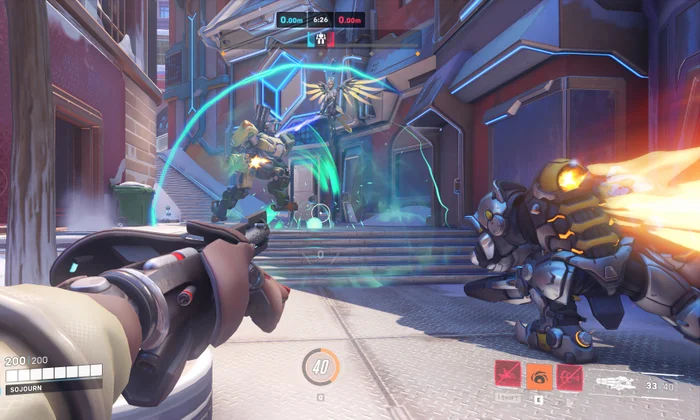
Few multiplayer shooters have made teamwork and character identity such a central part of the experience as Overwatch. Instead of giving every player essentially the same tools, the game built its identity around distinct heroes with different abilities, personalities, movement styles, and responsibilities.
That design creates an interesting challenge. Winning is not simply about having the fastest aim. Players also need to understand positioning, timing, objectives, team composition, ability interactions, and when to help teammates rather than chasing individual eliminations.
The world of Overwatch adds another layer. Its colorful future is filled with heroes, rivalries, organizations, conflicts, and locations that give the matches a recognizable identity. Even players who never follow every piece of the lore can understand that the characters are more than interchangeable avatars.
This guide looks at what makes Overwatch distinctive, how its hero-based gameplay works, why teamwork matters, how maps shape strategy, and why the game has remained an important part of the multiplayer-shooter conversation.
What Is Overwatch?
Overwatch is a team-based hero shooter developed by Blizzard Entertainment.
The original game launched in 2016 and introduced a roster of heroes with highly different abilities. Its successor, Overwatch 2, continued the franchise with major changes to gameplay structure, progression, hero design, and live-service systems.
The central idea remains straightforward:
Two teams compete around objectives while using heroes with different abilities and roles.
A typical match can involve:
- Attacking or defending an objective
- Escorting a payload
- Controlling an area
- Fighting for map space
- Managing ultimate abilities
- Coordinating hero abilities
- Adapting to the opposing team
The objective gives every fight context. Eliminating an opponent can be useful, but an elimination that does not help the team gain space or progress toward the objective may have limited value.
The World Behind the Heroes
Overwatch takes place in a futuristic version of Earth shaped by technological development, conflict, and the rise of artificial intelligence.
One of the central events in its history is the Omnic Crisis, a major conflict involving humanity and omnics, artificial beings created for industrial purposes.
In response to the crisis, the Overwatch organization was established as an international group of heroes and specialists.
The organization eventually became controversial and was disbanded, but its legacy continued to influence the characters and events of the series.
This history gives the game a foundation for stories involving:
- Friendship
- Betrayal
- Redemption
- Responsibility
- Technology
- Human-machine relations
- Political conflict
- Personal identity
Storytelling Through Characters
Overwatch does not tell its story exclusively through traditional campaign missions.
Instead, much of the narrative has been delivered through cinematics, short stories, character interactions, voice lines, seasonal content, maps, and other pieces of lore.
This approach allows individual heroes to carry parts of the larger story.
For example, a character’s dialogue can reveal relationships with another hero, while a map can provide clues about an organization’s history.
Why This Approach Works
The fragmented structure gives players different ways to engage.
Someone can simply enjoy competitive matches without following the lore.
Another player can spend time learning the history of every hero.
Both experiences are possible because the narrative does not need to interrupt every match.
Heroes Are the Heart of the Game
The hero roster is one of Overwatch’s defining features.
Instead of selecting a generic soldier and gradually changing equipment, players choose a specific hero with a predefined kit.
That hero determines things such as:
- Movement options
- Weapon type
- Abilities
- Defensive tools
- Utility
- Ultimate ability
- Effective range
- Preferred positioning
This creates dramatically different playstyles.
A mobile hero may rely on speed and flanking.
A support hero may focus on healing, utility, and keeping teammates alive.
A tank may create space and absorb pressure.
A damage hero may specialize in controlling angles or finishing vulnerable targets.
Understanding the Main Roles
The modern Overwatch structure revolves around three broad roles:
Tank
Tanks are generally responsible for creating space, absorbing pressure, disrupting opponents, and helping the team control important areas.
Playing tank does not simply mean standing in front of everyone.
Good tank play involves understanding when to advance, when to retreat, and how to force opponents away from valuable positions.
Damage
Damage heroes are generally focused on applying offensive pressure and securing eliminations.
However, simply chasing kills is not enough.
A strong damage player understands sightlines, target selection, positioning, and when to pressure the enemy backline versus when to help control the objective.
Support
Support heroes provide healing, utility, protection, buffs, debuffs, or other forms of assistance.
The term “support” does not mean that these heroes are passive.
Good support players actively contribute to fights through positioning, ability usage, damage, and decision-making.
Why Team Composition Matters
Because heroes have different strengths and weaknesses, team composition affects how a match develops.
For example, a team may struggle if everyone chooses heroes that are strong individually but fail to cover important weaknesses.
A balanced composition can provide:
- Frontline pressure
- Sustained healing
- Damage at different ranges
- Mobility
- Defensive utility
- Crowd-control or disruption options
- Ways to contest objectives
However, there is no single composition that automatically guarantees victory.
Map layout, player skill, enemy choices, and coordination can all change what works.
The Importance of Positioning
One of the biggest differences between new and experienced players is positioning.
A beginner may focus almost entirely on aiming and abilities.
An experienced player is constantly asking:
Where should I stand?
Positioning affects survival, damage output, visibility, escape options, and the ability to help teammates.
A strong position can provide:
- Cover
- Multiple escape routes
- A useful angle
- Access to teammates
- Control over an objective
A poor position can leave you isolated and vulnerable even if your mechanical skills are strong.
Maps Are Part of the Strategy
Overwatch maps are designed around objectives, routes, sightlines, elevation, cover, and chokepoints.
That means the same hero can feel completely different depending on the environment.
Chokepoints
Narrow areas can create intense fights because teams have limited routes through them.
High Ground
Elevated positions can provide better visibility and safer angles for certain heroes.
Open Areas
Open sections can expose players to long-range attacks while also providing more movement options.
Flanking Routes
Alternative paths allow mobile heroes to approach from unexpected directions.
Learning a map therefore means learning more than its visual appearance.
You need to understand where fights are likely to happen and why.
Objectives Change the Meaning of a Fight
One of Overwatch’s most important design decisions is that matches revolve around objectives.
A team can win a fight but still lose the overall battle if it cannot convert that advantage into objective progress.
For example, eliminating three opponents may create an opportunity to advance.
But if the surviving players retreat too far or fail to move the objective, the advantage can disappear.
This is why objective awareness is so important.
Ask These Questions During a Match
- Where is the objective?
- How many teammates are alive?
- How many opponents are alive?
- Do we have important abilities available?
- Should we push forward or regroup?
- How much time remains?
These questions can improve decision-making more than simply focusing on the scoreboard.
Ultimate Abilities and Resource Management
Ultimate abilities are another major strategic layer.
Because they charge over time through gameplay, players must decide when to use them.
Using an ultimate too early may waste its potential.
Waiting too long can be equally harmful if the team loses an opportunity.
Strong players learn to recognize moments when an ultimate can:
- Secure important eliminations
- Protect teammates
- Win an objective fight
- Counter an enemy ultimate
- Create space
- Turn around a losing engagement
The best ultimate is not necessarily the most dramatic one.
It is the one that creates meaningful value at the right moment.
Communication Is a Competitive Advantage
Overwatch is fundamentally social.
Even mechanically strong players can struggle if the team cannot coordinate.
Communication can involve:
- Warning teammates about enemy positions
- Calling targets
- Requesting assistance
- Announcing important abilities
- Coordinating an attack
- Calling for a retreat
- Sharing information about enemy ultimates
Voice chat can help, but communication does not have to mean constant talking.
Simple signals, pings, positioning, and awareness can also communicate useful information.
The Psychology of Team-Based Matches
Team games create a unique emotional experience.
When everything works, a coordinated team can feel incredibly powerful.
A well-timed combination of abilities, a successful defensive hold, or a last-second objective contest can create memorable moments.
The opposite is also true.
A frustrating loss can make players blame teammates, matchmaking, or hero balance.
One of the most useful competitive habits is learning to separate what you can control from what you cannot.
You cannot control every teammate.
You can control your positioning, decision-making, communication, and willingness to adapt.
Adapting During a Match
A major strength of hero-based gameplay is the ability to change your approach.
If a strategy is failing, repeating it indefinitely is unlikely to produce a different result.
Instead, consider:
- Changing heroes
- Adjusting positioning
- Taking a different route
- Playing more defensively
- Focusing a different target
- Waiting for teammates before engaging
- Saving abilities for specific threats
Switching heroes should have a purpose.
Changing simply because you are frustrated can make the situation worse.
Art Direction and Visual Clarity
Overwatch has a distinctive visual identity built around colorful environments, strong character silhouettes, expressive animations, and readable abilities.
This is not merely an artistic choice.
In a fast multiplayer shooter, players need to understand what is happening quickly.
Distinct silhouettes help identify heroes.
Clear visual effects help communicate abilities.
Strong environmental contrast helps players navigate maps.
The goal is to make a visually busy match understandable without making it visually dull.
Sound Design Matters Too
Audio provides another layer of information.
Players can hear:
- Enemy footsteps
- Ability effects
- Ultimate announcements
- Weapon sounds
- Damage indicators
- Environmental cues
Experienced players often use sound as an additional source of information rather than relying entirely on what appears on screen.
A familiar sound can sometimes tell you that an enemy ability is being used before you have visually identified the threat.
Accessibility and Different Playstyles
One reason Overwatch has attracted a broad audience is the variety of heroes.
Not everyone enjoys the same kind of gameplay.
Some players prefer precise aim.
Others enjoy movement and mobility.
Some prefer protecting teammates.
Others enjoy creating space or disrupting opponents.
This variety allows players to experiment until they find a role that fits their strengths.
At the same time, every hero has weaknesses, which prevents the game from becoming purely about choosing the most comfortable character.
Representation and Character Identity
Character identity has always been an important part of Overwatch’s appeal.
Heroes come from different countries, cultures, backgrounds, and personal experiences.
Their personalities are communicated through dialogue, animation, visual design, relationships, and story material.
This gives players reasons to become attached to particular characters beyond their gameplay abilities.
For some players, a favorite hero begins with a strong playstyle.
For others, it starts with the character’s personality or story.
How Overwatch Has Changed
Overwatch has gone through significant changes since the original game launched.
The transition to Overwatch 2 brought major structural changes, including a shift in team format and changes to hero balance, progression, competitive systems, and live-service content.
The game has also continued to receive hero adjustments, balance changes, new content, and system updates.
This constant evolution has two effects.
It keeps the game from becoming completely static.
But it also means that strategies and opinions can become outdated quickly.
A hero that was considered essential several months ago may play a very different role after balance changes.
Why Players Keep Coming Back
Long-term engagement does not come from a single feature.
For many players, it comes from a combination of:
- Hero mastery
- Competitive progression
- Social interaction
- New content
- Character attachment
- Map knowledge
- Personal improvement
- Memorable matches
The game gives players several different reasons to return.
Someone can return because they want to improve their aim.
Another player may return to learn a new hero.
Someone else may simply want to play with friends.
That variety is valuable for a multiplayer game with a long lifespan.
Practical Tips for New Players
If you’re starting Overwatch, don’t try to master everything at once.
Start With a Small Hero Pool
Choose a few heroes rather than attempting to learn the entire roster immediately.
Understanding two or three heroes deeply is more useful than having shallow knowledge of twenty.
Learn the Objective
Always know what your team is trying to accomplish.
Kills are useful, but objectives win matches.
Watch Your Position
Before every engagement, ask where you can retreat if things go wrong.
Don’t Use Every Ability Immediately
Abilities often have more value when used in response to a specific threat.
Review Your Deaths
Instead of asking only, “Who killed me?”
Ask:
“What decision put me in that situation?”
That question produces much more useful information.
FAQ
What makes Overwatch different from other shooters?
Overwatch combines first-person-shooter mechanics with a large roster of heroes who have dramatically different abilities and responsibilities. Winning therefore depends on more than aim; positioning, teamwork, hero interactions, objective control, and ability timing are all important.
Is Overwatch difficult for beginners?
The basic controls are relatively approachable, but mastering the game can take considerable time. New players need to learn hero abilities, map layouts, positioning, objectives, and team coordination. Starting with a small selection of heroes can make the learning process easier.
What are the main roles in Overwatch?
The game’s primary roles are Tank, Damage, and Support. Tanks generally focus on creating space and absorbing pressure, Damage heroes apply offensive pressure, and Supports provide healing and other forms of utility. The exact responsibilities vary between individual heroes.
Why is positioning so important in Overwatch?
Positioning affects how much damage you can deal, how easily opponents can reach you, and whether you can help your teammates. Good positioning provides useful angles and escape options, while poor positioning can leave even a skilled player vulnerable.
How can I improve at Overwatch?
Start by learning a small group of heroes, understand their strengths and weaknesses, and study the maps you play most often. Focus on positioning, objective awareness, ability timing, and communication rather than concentrating only on eliminations. Reviewing your own mistakes is one of the most effective ways to improve.
Conclusion
Overwatch remains distinctive because it combines competitive shooting with character-driven design and team-based decision-making.
Its heroes give players dramatically different ways to contribute, while maps and objectives ensure that individual skill is constantly shaped by the needs of the team. Good aim helps, but so do positioning, communication, timing, resource management, and the ability to adapt when a strategy stops working.
The game’s evolution has also become part of its identity. Balance changes, new heroes, system updates, and shifting strategies mean that players are rarely solving exactly the same competitive puzzle forever.
Perhaps the most lasting idea behind Overwatch is simple: individual ability matters most when it helps the team accomplish something together.
That philosophy is what turns a collection of characters and abilities into a multiplayer experience capable of creating the moments players remember long after a match has ended.