Few video games manage to remain relevant decades after their release, yet some titles feel almost immune to time. They continue to be discussed, replayed, and admired long after technology has moved on. One such example is Theme Hospital, a game that transformed management simulation into something playful, witty, and deeply human. Its legacy is not built on realism alone, but on imagination, humor, and clever design choices that still resonate with players today.
This article explores why this classic continues to matter, how it shaped an entire genre, and what it teaches us about creativity, systems thinking, and player engagement.
Theme Hospital and the Art of Playful Simulation
At its core, Theme Hospital is a management simulation that refuses to take itself too seriously. Instead of aiming for strict realism, it leans into exaggeration and satire. Patients arrive with bizarre illnesses, doctors make questionable decisions, and the hospital itself feels like a living, breathing organism shaped by the player’s choices.
This balance between structure and absurdity is the foundation of its enduring appeal. It invites players to think strategically while laughing at the unexpected outcomes of their own decisions.
Humor as a design philosophy
Humor in games is difficult to execute well. It can easily become repetitive or distracting. In this case, humor is woven directly into the mechanics. Diseases are visual jokes, treatments are animated punchlines, and announcements over the intercom add personality without interrupting gameplay.
Rather than existing as decoration, comedy reinforces the systems. It makes failure less frustrating and success more satisfying. When things go wrong, players are more likely to experiment instead of quitting.
Accessibility without simplification
Although the tone is light, the systems are not shallow. Players must manage finances, staff morale, patient flow, and room placement. The interface presents this complexity in a way that feels intuitive, allowing newcomers to learn through play.
This accessibility is one reason the game reached audiences beyond traditional simulation fans. It welcomed curiosity instead of demanding expertise.
A World Built on Systems, Not Scripts
What truly sets this experience apart is how its world reacts dynamically. There is no fixed story forcing the player down a narrow path. Instead, emergent narratives arise from interactions between systems.
The joy of emergent chaos
A poorly designed corridor can cause overcrowding. A mismanaged staff schedule can lead to exhausted doctors and unhappy patients. These situations are not scripted events but natural consequences of player choices.
This sense of cause and effect creates stories unique to each playthrough. Players remember the hospital that collapsed under debt or the one that thrived despite constant emergencies. These memories feel personal because they are earned.
Learning through consequence
Failure is an essential teacher here. Instead of punishing mistakes harshly, the game allows players to observe outcomes and adjust strategies. This approach encourages experimentation and long-term thinking.
Over time, players develop an intuitive understanding of flow, efficiency, and balance. These lessons feel organic because they emerge from play rather than instruction.
The Visual Language of Simplicity
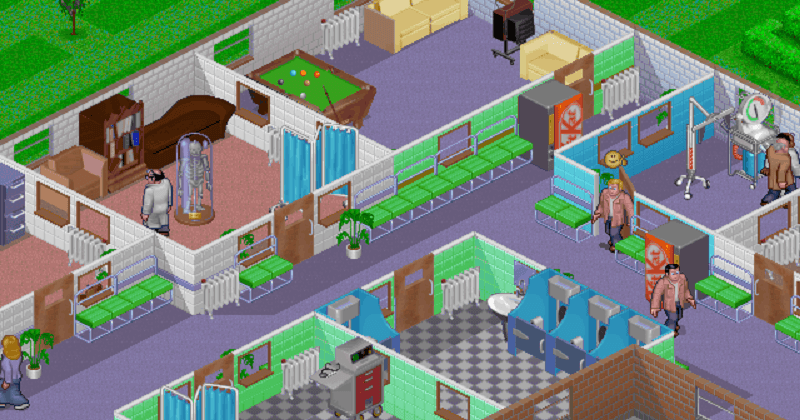
The visual style plays a crucial role in making complex systems readable. Characters are expressive, environments are colorful, and animations clearly communicate what is happening at any moment.
Clarity over realism
Rooms are designed to be instantly recognizable. A treatment area looks different from a diagnosis room, not because it mirrors reality, but because it communicates function at a glance. This clarity reduces cognitive load and keeps players focused on decision-making.
The art style also supports humor. Exaggerated proportions and playful animations reinforce the game’s tone without undermining clarity.
Sound design as feedback
Audio cues provide constant feedback. Announcements alert players to issues, while sound effects emphasize actions and outcomes. This auditory layer keeps the player informed even when attention is elsewhere.
Sound becomes another system, guiding behavior subtly rather than through intrusive prompts.
Cultural Impact and Lasting Influence
Years after its release, the influence of Theme Hospital can still be felt. Many modern management and simulation games borrow its philosophy, if not its specific mechanics.
Redefining expectations of simulation games
Before this title, simulations were often perceived as dry or overly technical. This game challenged that perception by proving that depth and humor could coexist. It expanded the audience for the genre and inspired developers to experiment with tone.
By blending satire with strategy, it demonstrated that games could be intellectually engaging without being intimidating.
Inspiring creative risk-taking
Its success encouraged studios to take creative risks. Quirky themes, exaggerated settings, and playful mechanics became more acceptable within simulation design. The idea that fun could come from personality as much as precision gained traction.
This shift helped diversify the kinds of experiences available to players.
Player Agency as the Core Experience
One of the most compelling aspects of the game is the sense of ownership it gives players. Every decision, from room layout to hiring choices, shapes the hospital’s identity.
Freedom within structure
While goals and challenges exist, players have freedom in how they approach them. There is no single correct solution. Different strategies can lead to success, depending on priorities and play style.
This openness respects player intelligence and creativity. It allows experimentation without fear of breaking the game.
Emotional investment through control
Because outcomes are directly tied to decisions, players feel responsible for both successes and failures. This responsibility creates emotional investment. The hospital becomes more than a set of systems; it becomes a project.
That emotional connection is a key reason the experience remains memorable.
Why Theme Hospital Still Matters Today
In an era of hyper-realistic graphics and massive open worlds, the appeal of this classic might seem surprising. Yet its design principles feel more relevant than ever.
Timeless mechanics over technological spectacle
Technology evolves quickly, but strong mechanics endure. The game’s systems are elegant, readable, and deeply interconnected. They reward thinking, adaptation, and creativity rather than reflexes or hardware power.
This timelessness allows new players to enjoy it without feeling dated.
A reminder of playfulness in design
Modern games often strive for seriousness and scale. This title reminds designers that playfulness can be a strength, not a weakness. Humor can coexist with challenge, and charm can enhance engagement.
Its legacy encourages a more human approach to design.
Lessons for Modern Game Designers
Beyond nostalgia, the game offers concrete lessons for creators.
Respect the player’s intelligence
By trusting players to learn through interaction, the game avoids excessive tutorials and hand-holding. This respect fosters curiosity and deeper engagement.
Let systems tell stories
Emergent storytelling creates experiences that feel personal and unpredictable. Designers who focus on systems rather than scripts can achieve similar depth.
Balance clarity and personality
Clear communication does not require bland presentation. Visual and audio personality can enhance understanding when thoughtfully applied.
The Enduring Charm of Theme Hospital
Even today, discussions around Theme Hospital reveal a shared affection rooted in experience rather than memory alone. Players recall specific moments, humorous failures, and triumphant recoveries.
That emotional resonance is the mark of a truly impactful game. It does not simply entertain; it teaches, challenges, and delights in equal measure.
Conclusion
Theme Hospital remains a benchmark for creative simulation design. Its blend of humor, depth, and player agency created an experience that feels as engaging now as it did at release.
By prioritizing systems, personality, and respect for the player, it achieved something rare: longevity without reliance on nostalgia alone. Its lessons continue to influence design, and its charm continues to invite new players into its wonderfully chaotic world.