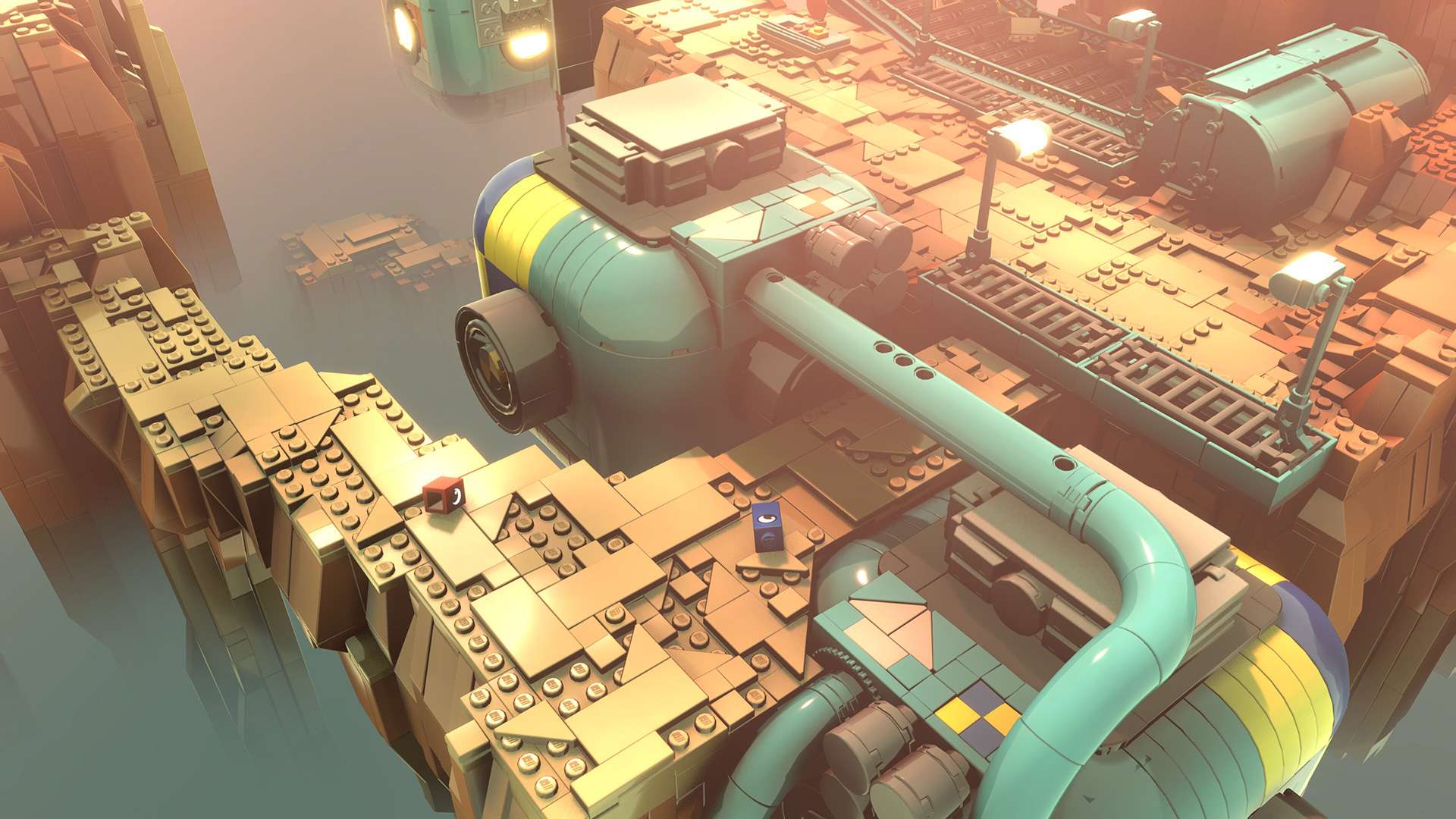
LEGO Voyagers is not a traditional LEGO building set or a broad theme about explorers. It is a 2025 cooperative adventure game from Light Brick Studio, the team behind LEGO Builder’s Journey, and published by Annapurna Interactive. Released on September 15, 2025, it takes the familiar LEGO brick and turns it into something unexpectedly expressive: a tiny playable character.
The game’s biggest idea is simple: two players are better than one. Instead of controlling a conventional minifigure, each player controls a small LEGO brick—one red and one blue—and together they travel through carefully constructed brick worlds, solve environmental puzzles and help recover an abandoned spaceship. The story is largely nonverbal, allowing the relationship between the two characters to emerge through movement and cooperation rather than long dialogue scenes.
That makes LEGO Voyagers quite different from the larger, character-heavy LEGO games many players know. There is no huge roster of playable heroes, no combat-focused progression and no sprawling open world. Instead, the game concentrates on friendship, teamwork, physics-based movement and the simple pleasure of figuring something out with another person.
What Is LEGO Voyagers?
LEGO Voyagers is a two-player co-op puzzle-platformer about friendship, exploration and play.
It was developed by Light Brick Studio, whose previous game was LEGO Builder’s Journey. The project was announced in June 2025 by LEGO, Light Brick Studio and Annapurna Interactive. LEGO described it as a cooperative experience in which players control LEGO bricks while tackling platforming challenges and puzzles together.
The basic premise follows two little LEGO bricks that become involved in a mission to rescue an abandoned spaceship. Their journey takes them through a series of brick-built environments where they must work together to move forward.
That premise sounds straightforward, but the presentation is unusually gentle.
Rather than relying heavily on dialogue, LEGO Voyagers tells its story through:
- Character movement
- Environmental changes
- Animation
- Sound
- The actions of the two players
- Small visual details
The result is a game where cooperation itself becomes part of the storytelling.
LEGO Voyagers Release Date and Platforms
LEGO Voyagers was released on September 15, 2025. It launched for:
- PlayStation 4
- PlayStation 5
- Xbox Series X|S
- Nintendo Switch
- PC through Steam
- PC through the Epic Games Store
The official publisher also lists the game across these platforms.
An important later addition was online cross-platform support. According to Annapurna Interactive, an update released on December 9, 2025 enabled players on PlayStation, PC, Nintendo and Xbox to connect with one another. Players need Epic accounts for cross-platform play, while console players also need the relevant online subscription.
That makes the game considerably easier to recommend to friends who own different systems.
Is LEGO Voyagers a Single-Player Game?
No.
This is one of the most important things to know before buying LEGO Voyagers.
LEGO Voyagers is strictly a two-player experience. There is no traditional single-player campaign and no AI partner to replace a second human player.
You can play in two main ways:
- Local co-op with two players sharing a screen.
- Online co-op with another player.
This design decision has a major effect on the entire game. The puzzles are not simply designed for two people because multiplayer happens to be available. They are built around cooperation.
One player may need to help the other cross an obstacle. You may need to move objects together, operate machinery or construct a solution that neither character could manage alone.
How the Co-Op Gameplay Works
The controls are intentionally uncomplicated.
You control a small LEGO brick that can:
- Roll
- Jump
- Attach to LEGO studs
- Move around environments
- Interact with objects
- Work together with the other brick
The physical design of the characters is part of the gameplay. You are not controlling a humanoid character with conventional running and jumping mechanics. You are literally moving a LEGO brick around a LEGO environment.
That creates some amusing moments because the brick’s shape affects how movement feels.
Reviews have noted that rolling can sometimes feel slightly awkward, particularly during precise platforming sections. But that clumsiness also reinforces the physical personality of the characters.
Building Is Part of the Puzzle
The most natural question is: How does a LEGO game use building without becoming a traditional LEGO construction simulator?
The answer is through environmental problem-solving.
Instead of spending most of your time constructing elaborate models, you manipulate loose LEGO pieces and objects to overcome obstacles.
For example, you might need to:
- Build a bridge
- Create steps
- Move a battery
- Activate a machine
- Operate a vehicle
- Launch one player toward another area
- Use an object to create a path
GameSpot described early challenges such as building LEGO bridges and later puzzles involving machinery and cooperative movement.
This is an important distinction.
LEGO Voyagers is not primarily about building beautiful LEGO models. It is about using LEGO construction as a gameplay mechanic.
The Story: Two Bricks and an Abandoned Spaceship
The narrative begins with two friends and an abandoned spaceship.
Their mission gives the adventure a clear purpose, but the game does not overwhelm players with exposition.
Instead, the story is deliberately poetic and largely nonverbal. Annapurna describes it as a “poetic, nonverbal narrative” built around friendship, dreams and connection.
This approach works particularly well because the two players are already participating in the relationship.
You do not simply watch two characters become friends.
You and another person are cooperating to make them succeed.
That creates an interesting connection between the game’s mechanics and its message.
If the characters need each other to progress, and the players need each other to solve puzzles, the game’s central theme is being communicated through gameplay rather than explained through dialogue.
The LEGO Worlds Are the Real Star
One of the strongest aspects of LEGO Voyagers is its visual presentation.
Everything is constructed from LEGO elements, but the game uses lighting, depth of field and environmental detail to make these miniature worlds feel surprisingly substantial.
You encounter environments containing:
- Natural landscapes
- Water
- Vegetation
- Roads
- Industrial areas
- Mechanical structures
- Small LEGO creatures
- Detailed brick-built scenery
Push Square praised the game’s colorful plastic environments, lighting and miniature-world presentation, while Nintendo Life similarly highlighted its attractive brick-built environments and realistic-looking lighting.
This gives the game a distinctive visual identity.
It looks like LEGO, but it does not look like someone simply placed a few bricks on a table.
The lighting and camera work make the environments resemble carefully photographed LEGO dioramas brought to life.
Why the Two-Player Requirement Actually Makes Sense
At first, requiring two players may seem restrictive.
After all, most games allow you to play alone.
But in LEGO Voyagers, the limitation is also the point.
Imagine a puzzle where:
- Player One holds a mechanism.
- Player Two crosses the opening.
- Player Two activates something on the other side.
- Player One can then continue.
Neither player is merely following the other.
Both contribute to the solution.
This is why the game works particularly well for people who enjoy relaxed co-op experiences rather than competitive multiplayer.
You are not trying to beat your partner.
You are trying to figure something out together.
Friend’s Pass Makes Co-Op Easier
One of the smartest features is the Friend’s Pass.
If one player owns LEGO Voyagers, a second player can join the full cooperative experience through the free Friend’s Pass. The publisher specifically confirms that only one person needs to own the game for both players to experience the full co-op adventure.
This removes a common barrier to co-op games.
Normally, convincing someone to play means convincing them to buy the same game.
Here, the owner can invite a friend without requiring a second purchase.
For families, couples or friends who are unsure whether the game is for them, this is a particularly useful feature.
How Long Is LEGO Voyagers?
One of the main criticisms of LEGO Voyagers is its relatively short campaign.
GameSpot completed the experience in around four hours, describing it as a short but worthwhile co-op adventure.
Other reviews have similarly characterized it as a brief experience.
This is worth considering before purchasing.
If you are expecting a massive LEGO game with dozens of hours of content, LEGO Voyagers may feel too short.
If you are looking for a focused weekend or evening co-op experience, its length can actually be an advantage.
There is little filler.
You start the adventure, learn the mechanics, solve increasingly elaborate challenges and reach the conclusion without the game stretching the concept unnecessarily.
Are the Puzzles Difficult?
Generally, no.
The puzzles are designed to encourage cooperation rather than punish players for not being expert gamers.
GameSpot praised the forgiving world design, while Brick Fanatics found the challenges engaging without becoming overwhelmingly difficult.
That makes LEGO Voyagers particularly approachable for:
- Parents and children
- Couples
- Siblings
- Friends
- Players new to gaming
- People who prefer relaxed puzzle games
There are still moments where communication matters.
The challenge is often less about solving an extremely complicated logic puzzle and more about coordinating two people who are physically moving around the same environment.
Sometimes the funniest part of the puzzle is simply getting both players into the correct position.
Where LEGO Voyagers Falls Short
The game is charming, but it is not perfect.
The campaign is short
The approximately four-hour length may leave some players wanting more.
Limited replay value
Once you understand the puzzles and complete the story, there is not the same huge amount of optional content found in larger LEGO titles.
Movement can feel awkward
Rolling a rectangular LEGO brick around platforms is charming, but it can also make precise movement more difficult than expected. Nintendo Life specifically noted some frustration with the control feel during platforming.
Puzzle variety can be uneven
Some reviewers felt that several challenges rely on familiar ideas such as bridge building, with fewer radically different puzzle mechanics than the concept might suggest.
These limitations do not destroy the experience, but they are important if you are deciding whether it fits your expectations.
LEGO Voyagers vs. Traditional LEGO Games
The biggest difference is structure.
Traditional LEGO games are often built around:
- Large character rosters
- Licensed franchises
- Combat
- Collectibles
- Open or semi-open levels
- Humor
- Character abilities
LEGO Voyagers is much more focused.
| Feature | Traditional LEGO Games | LEGO Voyagers |
|---|---|---|
| Main focus | Adventure and collectibles | Co-op puzzle adventure |
| Characters | Many playable characters | Two LEGO bricks |
| Combat | Often present | No combat focus |
| Multiplayer | Often available | Required |
| Building | Construction and abilities | Environmental problem-solving |
| Storytelling | Dialogue-heavy | Mostly nonverbal |
| Campaign | Often longer | Around four hours |
| Solo play | Usually available | Not available |
This difference is important because LEGO Voyagers should not be approached as a smaller version of a Traveller’s Tales LEGO game.
It is trying to do something else.
LEGO Voyagers vs. LEGO Builder’s Journey
The connection to LEGO Builder’s Journey is significant because both games come from Light Brick Studio.
Builder’s Journey established the studio’s interest in LEGO as a quiet, visually polished puzzle experience.
Voyagers takes that philosophy and adds a human partner.
Instead of one person solving puzzles alone, two people must coordinate their actions.
That makes the sequel-like spiritual connection obvious even though the games are not simply the same experience with multiplayer added.
Why LEGO Voyagers Works So Well for Families
A major strength is its accessibility.
The controls are simple enough for inexperienced players to understand, while the cooperative structure gives more experienced players an opportunity to help without completely taking over.
It also avoids the pressure associated with competitive multiplayer.
A parent and child can play together without worrying about scores or rankings.
A couple can play while chatting.
Two friends can experiment and laugh when they accidentally send a brick in the wrong direction.
That social element is arguably more important than the puzzles themselves.
The Emotional Side of LEGO Voyagers
The game’s most interesting idea is that LEGO bricks are usually objects we manipulate.
Here, the bricks become characters.
That small change creates an unusual emotional effect.
A tiny red or blue brick has almost no conventional facial expression or dialogue, yet players can still begin to care about what happens to it.
The relationship develops through action.
You help another brick cross a gap.
You wait for your partner.
You build something together.
You make mistakes together.
Eventually, those repeated interactions become the story.
GameSpot specifically highlighted the emotional impact of the game’s ending and its ability to make players care about the two simple LEGO characters.
That is perhaps the game’s cleverest trick.
It proves that a character does not necessarily need a complicated backstory to become memorable.
Sometimes interaction is enough.
Is LEGO Voyagers Worth Playing?
For the right audience, yes.
It is especially easy to recommend if you already have someone you want to play with.
Choose LEGO Voyagers if you want:
- A relaxed two-player adventure
- Simple cooperative puzzles
- A short campaign
- A visually attractive LEGO world
- A game suitable for mixed gaming experience
- Local couch co-op
- Online multiplayer
- A gentle, emotional story
You may want to look elsewhere if you specifically want:
- A solo LEGO game
- Dozens of hours of content
- Extensive character collections
- Difficult puzzle solving
- Combat
- A huge open world
The game’s design is intentionally narrow.
That focus is both its biggest strength and its biggest limitation.
A Practical Tip Before You Start
If you are playing with someone who is new to games, resist the temptation to solve everything for them.
Because LEGO Voyagers is designed around cooperation, the experience becomes much better when both players participate.
Instead of saying:
“I know what we need to do.”
Try asking:
“What do you think we should build?”
That small difference can turn the game from one person solving puzzles while the other follows into a genuine shared experience.
FAQ
Is LEGO Voyagers a two-player game?
Yes. LEGO Voyagers is designed specifically for two players and does not include a conventional single-player mode or AI companion. You can play locally or online with another person.
Can you play LEGO Voyagers online with a friend?
Yes. The game supports online co-op, and a Friend’s Pass allows a second player to join the complete experience when one player owns the game. Cross-platform online support was added in December 2025.
What platforms is LEGO Voyagers on?
The game is available on PlayStation 4, PlayStation 5, Xbox Series X|S, Nintendo Switch and PC through Steam and the Epic Games Store.
How long does LEGO Voyagers take to finish?
The main adventure takes roughly four hours for many players. Its short length is one of the most frequently mentioned limitations in reviews, although the focused campaign can also make it appealing for a relaxed co-op session.
Is LEGO Voyagers suitable for children?
Its simple controls, forgiving design and cooperative structure make it approachable for younger players, although the ideal experience depends on the child’s ability to coordinate with another player. Reviews have specifically noted that it works well across different experience levels.
Who developed LEGO Voyagers?
LEGO Voyagers was developed by Light Brick Studio, the studio behind LEGO Builder’s Journey, and published by Annapurna Interactive.
Conclusion
LEGO Voyagers is a LEGO game built around a surprisingly simple idea: sometimes the best adventure is one you experience with another person.
Rather than creating another large-scale LEGO action game, Light Brick Studio built a focused two-player puzzle-platformer in which the players themselves become part of the game’s central relationship.
You roll, jump, snap onto studs, manipulate LEGO pieces and build solutions together. The story remains largely wordless, allowing the game’s environments, animations and cooperative mechanics to communicate its themes of friendship and connection.
Its short campaign, limited replay value and occasional movement frustrations mean it will not satisfy everyone. But those looking for a relaxed, accessible and visually charming co-op adventure may find exactly what they are looking for.
Most importantly, LEGO Voyagers understands something fundamental about LEGO.
LEGO has never been only about the finished model.
It is about what happens when people build something together.
And in LEGO Voyagers, that idea becomes the game itself.